Chapter 17: Is This Blog About: (a) Peri-urban Slums, (b) Malaria, (c) Multiple-Choice Questions, or (d) All of the Above?

bazin smoke

Don’t worry about those toxic fumes kids, just smile for the camera please.

No doubt about it, field trips make teachers as gleeful as the students. I mean c’mon, what educator doesn’t enjoy a break from the routine, a glimpse of the world outside of those classroom walls, an occasion for the “real world” to be the teacher, an opportunity to get to know a different side of your students, and a perfect chance to “lose” a student you don’t particularly care for (“Seriously Principal Jones, I really have no idea how Timmy got locked inside that ancient Egyptian sarcophagus in the museum.”)

peek

Field trips give us a peek inside the real world.

So it’s just utterly depressing that field trips in the U.S. are becoming as rare as a third grader without a cell phone. There was a time when field trips were a normal part of the curriculum, as routine as those bad baby showers in the school library where I always chipped in to buy “ones-ies” for some teacher I hadn’t said two words to in three years (and I still don’t know what “ones-ies” are).
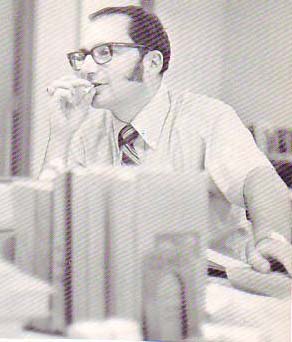
Smoking in school and triangular sideburns have fallen out of fashion.

Smoking in school and triangular sideburns have fallen out of fashion.

But now field trips have mostly gone the way of the dodo bird and recess and smoking in the teacher’s lounge…even though field trips can be an important part of the curriculum.

Now granted field trips didn’t always appear on the surface to be related to the curriculum, but scout’s honor they were. Growing up in rural Illinois, I recall yearly trips in junior high to the Six Flags amusement park in St. Louis, Missouri where we would ingest as much fat and sugar as possible before riding an upside-down roller coaster and discovering just how the body’s digestive system does/doesn’t work.

Junior High trip to Six Flags

Junior High trip to Six Flags, where the back of the bus was the place to be.

Or how one could use an umbrella and a wad of gum to rescue coins from the fountain and finance another trip to the sno-cone cart. Or how certain chemicals in Mountain Dew can remove the vomit smell from your clothes. Or how certain forces, maybe evil ones, can allow your spit to travel in many directions on spinning rides. These valuable life lessons have stayed with me for years.bus

I can remember going on plenty of non-vomiting field trips too. We once visited New Salem State Historic Site near Springfield, IL, a reconstruction of the village where Abe Lincoln spent his early adulthood.

Boiling a classmate on our New Salem field trip

Me (right) and several others boil a classmate on our New Salem field trip.

I can still remember asking the guide what they sold at the general store back in Abe’s day. She said, simply, “A lot of liquor.” And our two teachers tried to secretly give each other the thumbs-up sign except we all saw them. So history for me has always had positive, liquor-related connotations. Now excuse me while I go study Samuel Adams six to twelve more times.
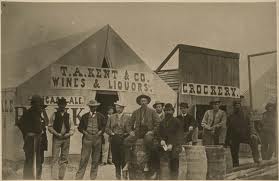
Photo: ©2012 Linda Hall Library

Photo: ©2012 Linda Hall Library

There were plenty of other field trips too. In high school we went to the movie theatre to see the rerelease of Zeffirelli’s Romeo and Juliet—you know the one where we see Romeo’s butt and Juliet’s boobies for a millisecond each? Of course back at school those were the only milliseconds of this 138-minute film we could recall in vivid detail.romeo

In elementary school we visited the potato chip factory where we all decided we would work one day since we figured the workers ate as many free chips as they wanted. We also went to art museums where I remember our 4th grade selves sprawling on the ground to look up the dress of a realistic sculpture of a woman and getting a quick anatomy lesson.

Oregon Industries slides.Photo: Original Collection: Visual Instruction Department Lantern Slides

Oregon Industries slides.
Photo: Original Collection: Visual Instruction Department Lantern Slides

I also remember a fantastic college field trip to Toronto where we came up with redesign plans for the urban waterfront to make it more pedestrian friendly, toured the city to see cutting-edge urban design work, and watched Canadian Border guards use a drug-sniffing dog to find pot in one of my classmate’s guitar case. Good times.

Drug sniffing dog finds what it's looking for in our classmate's luggage. And it's not dog biscuits.

Drug sniffing dog finds what it’s looking for in our classmate’s guitar case. And it’s not sheet music.

But these days, school is all about that damn high-stakes test in the spring. If a school activity doesn’t involve a multiple-choice question or a fact that can be memorized and regurgitated, it’s not seen as valuable. Never mind that not a shred of evidence supports this drill-and-kill nightmare approach to “instruction.” And never mind that it numbs kids’ brains and makes them hate school. It’s enough to drive a teacher to drink. Or at least take a field trip that supports that habit.winesMy old school district back in Florida actually had an official “blackout period” in the months preceding the state test–no field trips, no guest speakers, no sending teachers out of the school for professional development. What WAS allowed was having kids sit bored in their classrooms answering multiple-choice questions to prepare for the state test that’s comprised of multiple-choice questions. On that note, I’ve got a question for people who believe that approach makes sense:

1. Why are multiple choice tests stupid?

a. They lead kids to believe that there is just one “right” answer to every question.

b. Kids can answer correctly without actually thinking or problem solving or even reading the question.

c. They give kids no way to apply the knowledge they have learned.

d. They purposely include “distracter” answers that are wrong or confusing, like “none of the above” or “all of the above.”

e. All of the above.

absolut

Point me in the direction of the free samples!

But seriously, what moron doesn’t understand the benefits of a field trip? Would you rather read a worksheet about chocolate production, or pay a visit to the Snickers factory? Analyze a report on the effects of alcohol on your short-term memory, or participate in some experiments at the Absolut headquarters? Memorize the process of human reproduction or….oh well, I think you get the picture.

Now that I’ve escaped that madness by leaving the country, I have a new appreciation for the power of field trips, especially as they relate to service learning. This is one educational trend that doesn’t suck at all. Basically service learning means that you involve students in a community service project that also incorporates one or more academic areas. They learn academic skills, help their community, and hopefully understand that they can make a difference in this world by stepping away from the PlayStation.

So with the wind back in my sails in a brand new non-test-obsessed school, I’ve partnered my class with a U.S.-based, non-profit organization here in Bamako called Mali Health whose mission is to “empower impoverished urban communities in Mali to transform maternal and child health sustainably.” As far as mission statements go, that’s a biggie because the situation here in Mali is just darn scary. For starters:

  • life expectancy in Mali averages 49 years
  • 93% of Malians live in poor, urban communities (AKA slums)
  • Mali is one of the 15 poorest countries in the world
  • 1 in 5 children dies before age 5
  • 1 in 3 children are underweight
  • 1 out of 22 women die from maternal complications

A month or so ago Mali Health did a short presentation at our school that really piqued my students’ interest. They were especially interested in the fact that the communities Mali Health serve have no sewage systems, plumbing, or electricity. And as usual they dwelled on bathroom-related questions, such as:

  • So the people poop in holes? (affirmative)
  • Does it smell? (affirmative)
  • Does it ever leak out? (yes, and contaminating nearby wells)
  • Who cleans out the holes when they get full? (someone is lowered in, and he shovels it out)
  • Do they use toilet paper? (varies)
  • Do they have flat screen TVs in their latrines? (OK, I just made that one up, but I’m sure they were thinking this)
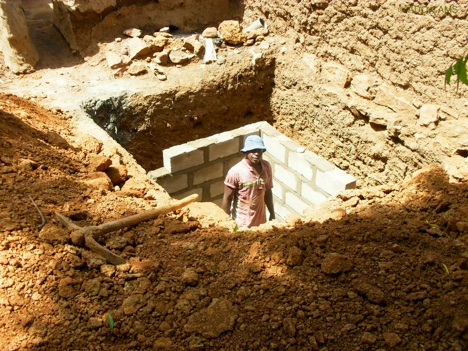
    A latrine under construction in Sikoro. Photo: ©Sikoro Teriw - www.sikoro-mali.org

    A latrine under construction in Sikoro. Photo: ©Sikoro Teriw – http://www.sikoro-mali.org

Working with their energetic young director we decided that my students would create graphic novels (the fancy name for comic books) that teach about malaria prevention—but in an entertaining way that would engage kids.mosquito

Malaria is a big problem in sub Saharan Africa, especially this year. Most of the teachers and students at my school have fancy mosquito nets over their beds, have plenty of mosquito spray in a variety of scents and consistencies (I prefer Off Smooth & Dry Powder Formula), Offand take weekly preventative malaria medication. If we do get malaria it is easily treatable with a 3-day course of pills that cost $7 at the pharmacy (no prescriptions required for meds here). For most of us malaria is nothing more than flu-like symptoms that go away quickly with the meds.

But the folks in these impoverished communities don’t have these luxuries, though I doubt many Americans consider a can of Off Bug Spray a luxury. A doctor visit and malaria meds would cost a Malian about $10 total—or about 10% of a skilled worker’s average salary here. Quite a few organizations do donate mosquito nets.

Our mosquito net in its upright position; at night it encloses us in a netty cube

Our mosquito net in its upright position; at night it encloses us in a netty cube.

But tightly woven nets keep out mosquitoes AND breezes—not exactly a plus in an oven-like climate—so they are used as fishing nets or room dividers or bridal veils (which totally sounds like an episode of Project Runway or Design Star).

On top of everything else, because malaria is common and can go away on its own, folks here don’t consider it a big deal, even though it can actually kill them if left untreated.

So the plan is for my kids to create these books to help create awareness about this illness, and Mali Health will distribute them to local school children. Since these local kids either speak Bambara (their first language) or French (taught in schools here) my students will first write their text in English, then translate it into French. Thankfully our AISB French teachers will assist. My French language skills, while improving, are still in the Tonto-sounding phase (“Me happy big feast tonight Ke-mo Sah-bee.”)

The great part is that while my students are creating something that can potentially save lives, they are practicing their reading, writing, science, and French skills in a real world way that doesn’t require a single photocopied worksheet or multiple-choice question. I tried this approach once back in the States, where four years ago I had my students create PSAs to encourage people to spay and neuter their pets. Long story short, the Humane Society of the United States put them on DVDs and sent them to shelters nationwide, and the Humane Society still has a link to them on their website (see link at bottom of that page). Here are two of the PSAs:

To get the ball rolling we decided a field trip to the Mali Health office would be in order so that my students could receive background information on malaria transmission and prevention from the experts. So the director put together a full morning of activities and a week ago we headed to Sikoro, a peri-urban slum on the outskirts of Bamako with 80,000 residents (peri-urban, a word I just learned too, means this was once a rural area that has become urbanized). Over 90% of Mali’s population lives in poor urban communities like Sikoro.
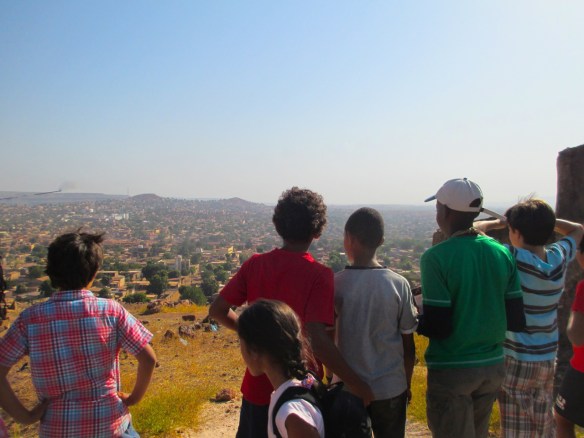
IMG_2521

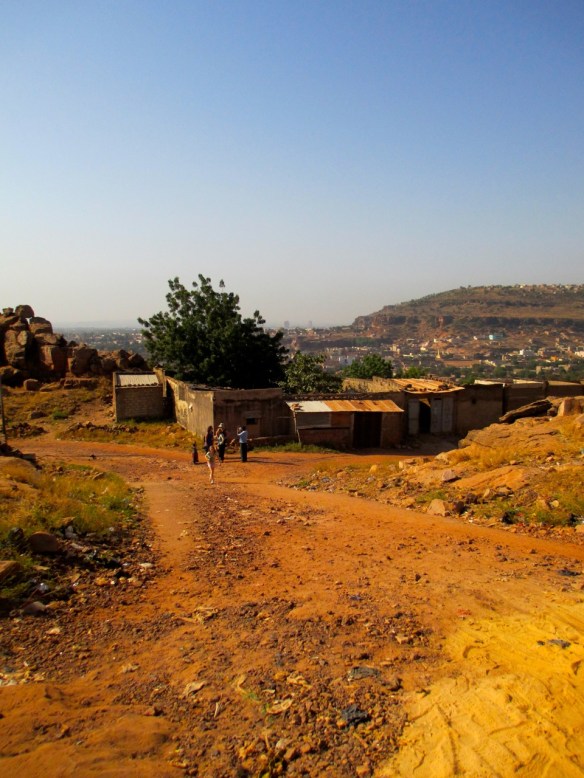
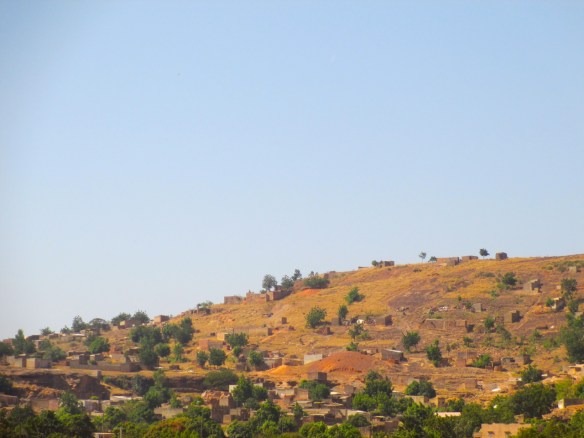
Looking down on Bamako (literally, not figuratively).

Aside from the obvious fact that this is a slum, I have to say that the locale is fabulous! The community begins at the bottom of a very large hill and climbs right up the side, all the way to the top. So like the hillside shanty towns in Rio de Janiero, Brazil with gorgeous viewsover the city, Sikoro gives you amazing views over Bamako.

But the roads in there, wow. Our two school vans struggled to navigate the steep dirt paths, full of giant craters and gullies, strewn with trash, and filled with people going every which way.

IMG_2509

Zak and Jade present our class donation to Devon, director of Mali Health.

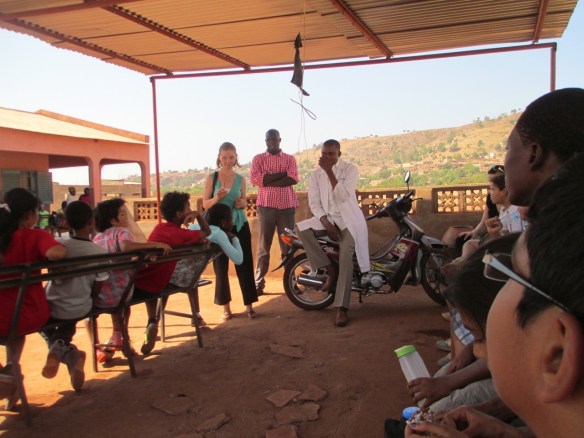
The Mali Health office, a simple structure with rooms open to the outside, was our first stop. There we presented Devon, the director, with a donation of funds our class raised running two booths at our school Halloween carnival. Devon and Matt gave a short but kind of scary presentation on malaria that will forever make me keep the mosquito net canopy tight over the bed while I live in West Africa, or maybe anywhere in the world except for Antarctica.

IMG_2512

Matt at Mali Health gives us the scoop on mosquitoes.

Next we walked/hiked up and up and up rambling roads to Bandiagara Coura Elementary School, one of the local schools in Sikoro and one of the potential audiences for our malaria prevention graphic novel. Again, a fantastic locale on a hilltop that, in an alternative universe, would be the perfect setting for a luxury hotel or my sprawling mansion (hey, a teacher can dream, can’t he?).

Daredevil sheep.

Daredevil goat.

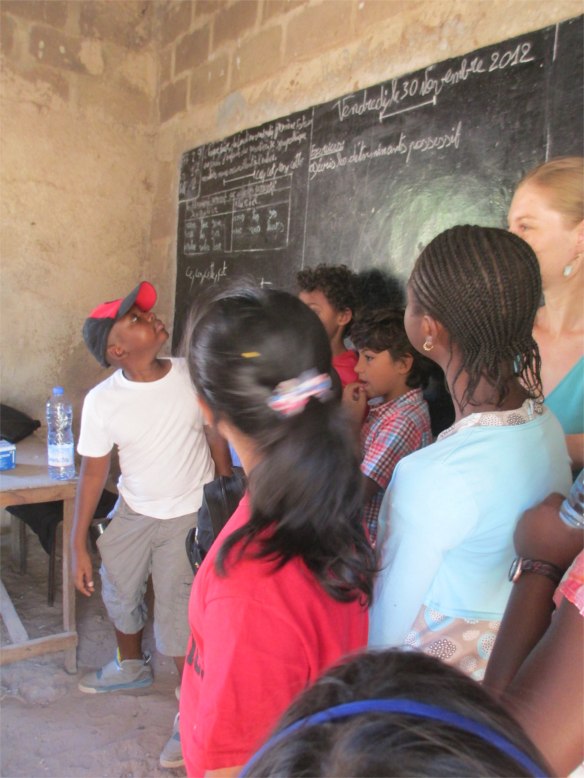
But instead here sat the school, several unpainted, concrete block rectangles comprised of three or so side-by-side classrooms. There were no doors. Above each doorway someone had quickly hand-painted the grade level. The classrooms were no more than 12 by 12 feet with dirt floors and a single window opening without glass or a screen. There was no electricity, hence no lights. Thirty kids sat scrunched together at little wooden desk/bench combos meant for about half that many. A piece of plywood painted black was nailed to the front wall and covered with chalked on French sentences.

When U.S. teachers complain about crowded classrooms, I'll whip out this photo.

When U.S. teachers complain about crowded classrooms, I’ll whip out this photo.

IMG_2529

No books, pencils, or floor.

IMG_2527

My tongue-tied students.

IMG_2524

Q&A with the school’s director.

The crazy thing is that this is a PRIVATE school that has better conditions than the public schools (which kids have to pay to attend too, just not as much). To attend this private school these kids pay anywhere from $5.00 to $18.00/month. It doesn’t sound like much, but remember a skilled worker here makes a whopping average of $100/month. So having a few kids in school could wipe out a big chunk of your salary.

DSC_0040

I prop myself up against a tree after hiking the steep roads.

DSC_0045

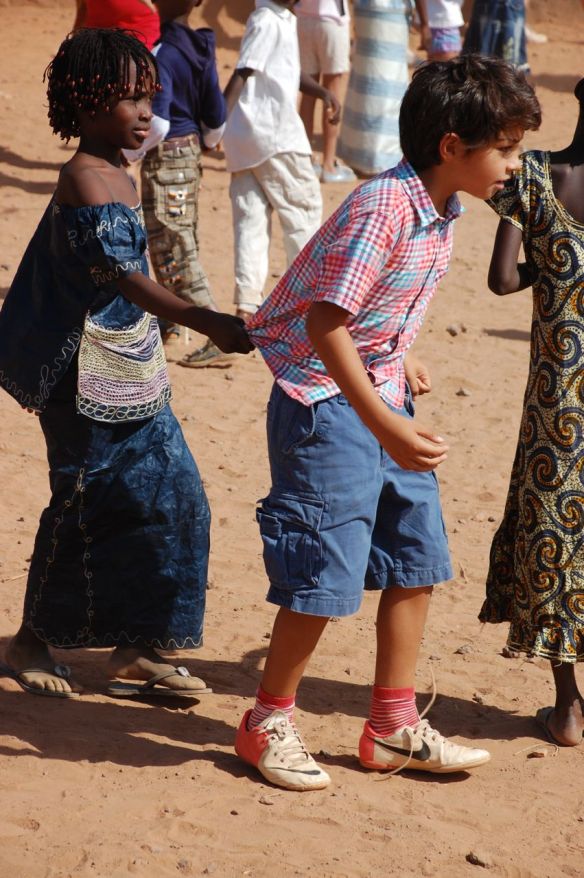
My students mix in. Well, kind of.

It was the first time I saw my students speechless. Really, they couldn’t even think of one question to ask the kids in the classroom. My vision was that this part of the visit was going to be a dynamic, back-and-forth conversation between my kids and the Bandiagara Coura kids, discovering that even though they were from vastly different worlds they were all just kids when it came down to it. Nuh-uh. Now it looked like the rich kids ogling the poor kids, and vice versa.
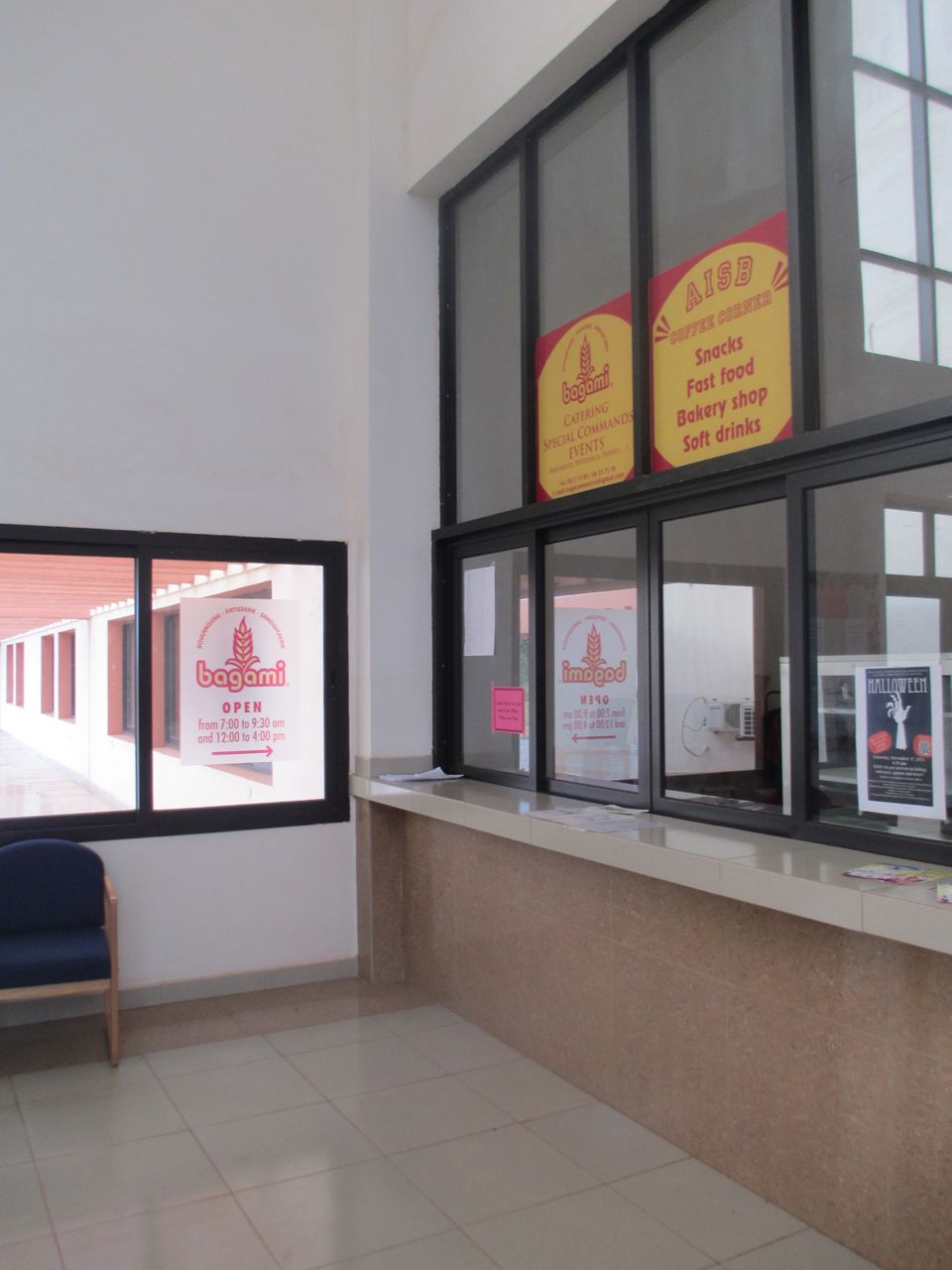
bagami

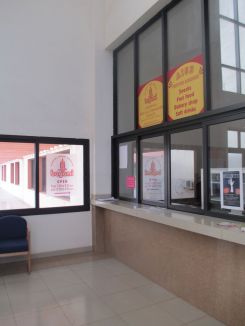
The bakery in our school lobby.

I suppose I understand their reticence though. After all, we had just left our expansive 18-month-old school overlooking the Niger River, with LCD projectors and classroom sets of MacBook computers and a bakery shop in our lobby and our classroom with 6 ceiling fans and sliding windows on three sides and a floor plan that is so huge for the 18 of us that I have room for an acting area, a library area, round tables for student seating, a teacher zone, a walk in closet, a computer area. And where I recently put in a work order because I didn’t think the AC was quite cool enough. Now, in 15 minutes, we were in the real world–at least as far as Mali is concerned—and the contrast was massive.

For the most part my students come from privileged backgrounds. They travel internationally at least a few times a year. They have maids, gardeners, and drivers. Their parents have great jobs in embassies, big mining companies, or international aid organizations. They mostly are kept far away from places like Sikoro, so I can understand why they were a little tongue-tied as they stared at 30 kids crammed into a room that would fit twice into our own school’s hedge maze garden (yep, we have a hedge maze at school).
IMG_2547

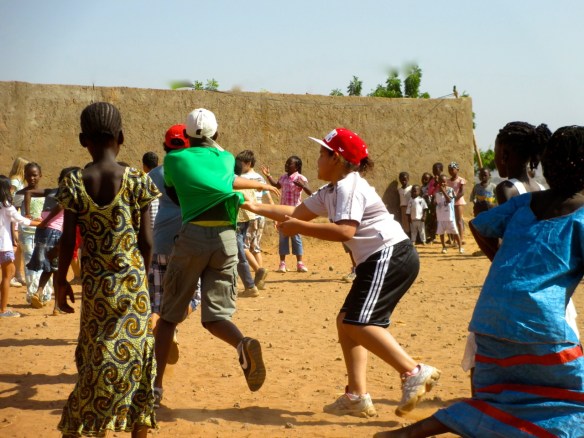
The Malaria Games; like the Hunger Games without the killing.

After some awkward silence my students and the Bandiagara Coura students headed to a nearby dirt play field where the Mali Health staff taught a capture the flag style game. Except this one involved students playing either humans, mosquitoes, or the malaria virus, and the goal was to capture the mosquito eggs (small plastic balls, thank goodness). Together the students kicked up quite the dust storm, but from what I could see (and taste) through the brown fog they seemed to be enjoying themselves.
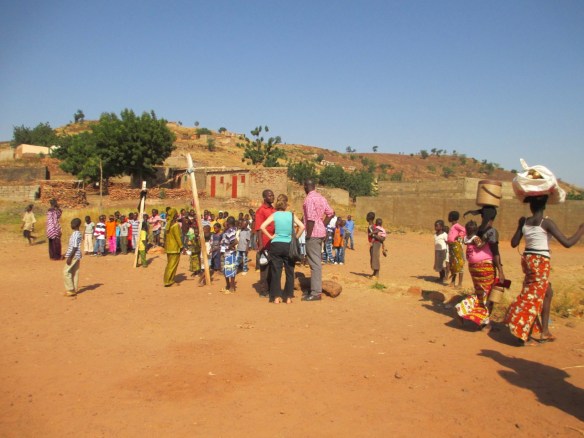
IMG_2532IMG_2543

Photo: Matt Schinske

Photo: Matt Schinske

Then it was time for another hike, this time back down the hill along more rambling dirt roads. I have to say that up there at the top it didn’t seem so slummy. The small plaster houses with tin roofs were mostly spaced apart on the hillside, kind of reminding me of some rural areas in Greece. You could see for miles over the chaos of Bamako while standing in peace and quiet.
IMG_2557IMG_2553IMG_2550IMG_2554IMG_2518But, as we made our way down and the community grew denser, it felt more like a slum. Since there are no sewage systems, dirty water of some sort trickled down the wrinkles in the dirt road. It did not have a pleasant odor. IMG_2514It pooled here and there into puddles where I am sure Ms. Mosquito and her ten trillion closest friends have a hopping shindig every night, from dusk to dawn. The smell was somewhat intense too, gag-inducing actually, and we all pulled our shirts up over our noses for the better part of tour hike.

Before long we arrived at Sourakabougou Clinic, a tiny public health center for the residents. After a quick talk with the very young head doctor ($250/month salary BTW), we broke up in groups of three to tour the facility, which like the school is a concrete block structure with tiny, un-airconditioned rooms.clinicIMG_2558 One fit only four, old metal twin beds placed side by side which held malaria patients, each with an IV drip in their arm. Another, about half the size of that one, held two metal tables with stirrups—the birthing room. It was a sobering experience for my students who, if they need medical care, usually travel to Paris or the States to very fancy schmancy clinics.

Back in our own classroom the kids were so beat they collapsed into our comfy beanbag chairs (not sure I saw many of those at the Bandiagara Coura school) and I postponed the math test we were going to take. We had walked a lot that day in some pretty intense sun on some pretty crazy paths, and gave our senses quite a workout too (especially our sense of smell).

The kids were exhausted, but they were buzzing (haha) with ideas for our graphic novel about malaria and how they wanted to help the school and the kids in that community. There was talk of a school supply drive and hosting their students at our school for a day. One boy even remarked that today he realized “how lucky he really was.” Another said, “Even though they don’t have very much, they didn’t seem sad at all.”

So to summarize, my students were enlightened about malaria, poverty, community service, and life because

a. they were forced to memorize this information from a textbook at school.

b. they read a passage about this information on a worksheet, then answered five multiple-choice questions.

c. they read this information on Wikipedia.

d. they went on a four-hour field trip.

IMG_2561

Our last stop before returning to school…lunch at the Parc National du Bamako.

Chapter 16: These Are a Few of My Favorite Things

I don’t particularly fawn over raindrops on roses and whiskers on kittens. And if I’m ever finding myself in a situation where I notice “snowflakes that stay on my nose and eyelashes” I’m probably getting frostbite and my toes will eventually blacken and fall off.

But like Maria/Julie Andrews I actually do have a few favorite things, none of

The African hills are alive with the sound of music.

which are Austrian-based at this time (though I’m not adverse to “crisp apple strudels”).

Nope, my favorite things all come courtesy of Mali. Which is good, I suppose, because I do live in Mali now. It would really blow to have lots of favorite things that were Malian and live in, say, a small town in Arkansas—though that would probably blow no matter what. I am extremely thankful that my Malian list of favorite things continues to grow and is much, much longer than my list of “Things That Drive Me Insane,” a list that was always growing when I lived in the States, particularly after a drive on I-95.

Speaking of thankful, I’ve noticed a lot of folks doing a daily “What I’m Thankful For” post on Facebook during the month of November. I thought about jumping on that bandwagon, expressing my gratitude for all my favorite things in Mali. But while I personally enjoy reading these “thankful” posts, there are others who, hmmm how do I say this politely, would rather gargle with bleach than read these. From the criticisms I’ve read, the critics don’t seem to complain about the concept of people being thankful (which I’m thankful for), but rather what they perceive to be the generic/sappy/not-so-creative nature of the posts. I must admit, it is interesting when someone shakes things up a bit, as with these “thankful posts” I saw online from someone named Therese Long of Pearson Education, someone I wish lived next door to me:

1. I’m thankful we don’t celebrate Thanksgiving in an old-fashioned way…invite everyone in my neighborhood to my house, have an enormous feast, then kill them and take their land.

“Contrary to popular mythology the Pilgrims were no friends to the local Indians. They were engaged in a ruthless war of extermination against their hosts, even as they falsely posed as friends. Just days before the alleged Thanksgiving love-fest, a company of Pilgrims led by Myles Standish actively sought to chop off the head of a local chief. ” -from The Hidden History of Massachusetts

2. I’m thankful for watching football, making pumpkin pie, and saying the magic phrase that sends my aunt storming out of the dining room to sit in her car.

3. I’m thankful for 38 years of marriage to myself. I have always been by my side and understand me when no one else did.

4. I’m thankful you can delete status updates after 10 minutes of no likes.

5. I’m thankful Facebook is now the second place I have found comfort in talking to a wall.

6. I’m thankful that everyone who likes me is awesome and brilliant, and everyone who doesn’t, is a selfish jerk. Very weird phenomenon!

7. I’m thankful I don’t live in a bubble wrap factory, as I just don’t have that much self-control.

So to avoid any chance of my thankful posts being deemed “generic” (which for me would be the greatest insult EVER), my thankful things list will become my list of favorite things. AND I’ll bury this list deep in my blog where it will be safe from the scrutiny of the general public. Well, other than the 2726 views my Mali blog has racked up so far (!) from people in 52 countries (!!) including Madagascar, Qatar, and Bosnia and Herzegovina (!!!). Which is thrilling and scary at the same time.

 My Favorite Things: Mali Edition

One chocolate croissant, s’il vous plait. And make it fast…I’m late for social studies!

1. The American International School of Bamako lobby which includes a school store and…a bakery! I used to think my school in Florida was pretty cool because it had a soda machine, but a bakery in the lobby?! I’m pretty sure I dreamed this one time (“I was wandering through this school made of gingerbread and frosting, with a French bakery in the lobby and a swimming pool filled with gin and tonic and floaties in the shape of lime wedges, and all of the students were Oompa-Loompas.”).

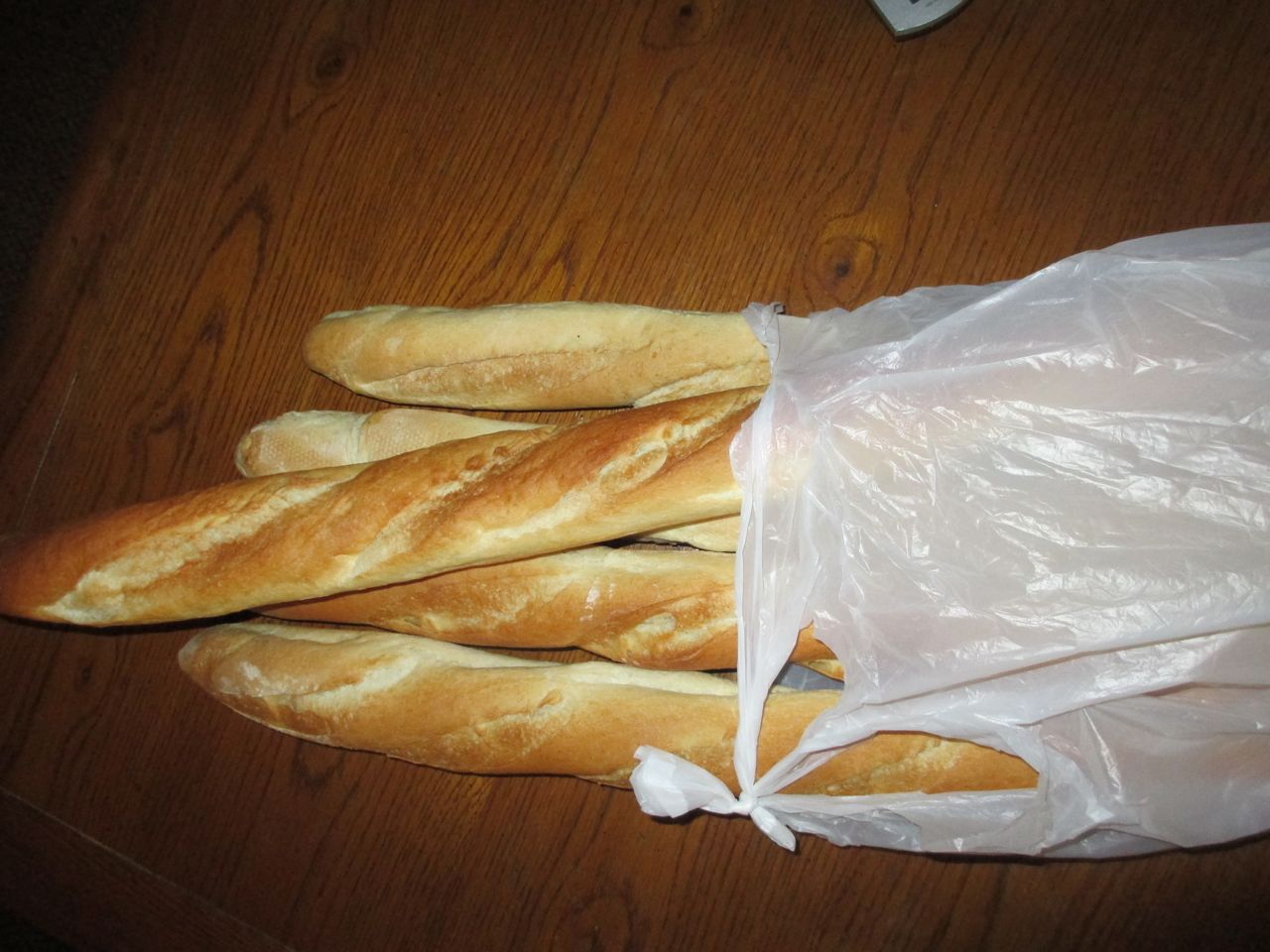
To top it all off, it’s a French style bakery and the pastries and bread are warm when the bakery guy brings them in the morning. Chocolate or almond pastries are tied for my favorite. Oh, and apple. And the plain is good too. We have a standing order for 5 loaves of French bread (just 60 cents each) every Tuesday and Friday. And no we aren’t big, fat

We always get enough just in case unexpected guests pop in.

pigs…they are skinny loaves and you never know when company might show up unexpectedly. The loaves are crispy on the outside and moist on the inside, and they taste good with anything, like peanut butter and jelly, butter, or gin. Well, gin goes with anything you know.

2. Malian driversI have yet to see one get ticked off or shoot the bird or scream profanities. Even if you pull out in front them. Or hit them. Honestly, we saw a car slam into a moto and knock it clean across the road. The moto driver got up and dusted himself off while the car driver checked to see if he was alright. Then they shook hands and took off.

Out of one lane, many.

To put this all into context, there are basically few/no rules of the road here. If you need to get into traffic you just kind of pull your car into the flow of traffic and the person careening head-on toward you will slow and flash their lights and let you in. On the roads here you can also drive in just about any direction, in just about any lane, or between the lanes, or in the shoulder. Everyone just kind of accepts the traffic chaos and deals with it–without emotion or feeling like they rule the road. Plus they drive sloooooowly. How I miss those giant SUVs that used to zoom up behind my little car in Florida, driving 75 MPH about 2” from my rear bumper, the driver all red-faced and mouthing unclean words because I wasn’t going faster. Good times.

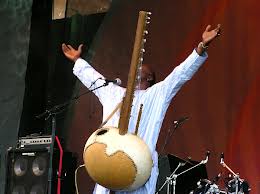
3. The Koraa traditional Malian instrument I love so much I became one for Halloween. It has 21 strings and sounds like a cross between a harp, banjo, and guitar, and maybe a zither too. And it’s made from a darn gourd! Then there’s the way you hold it….

4.  Beverage choices circa 1957: If you want soda, it’s regular Coke made with actual sugar (not corn syrup), sipped icy cold from the famously-shaped glass bottle. No diet stuff, no added fake cherry or lime flavoring, no caffeine-free. Just Coca Cola like Beaver Cleaver drank it. Actually we drink more water than anything else since (1) filtered water is free at school and (2) if you don’t drink a lot of water here you’ll faint.

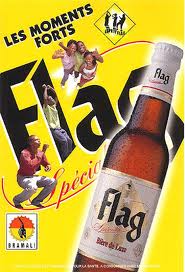
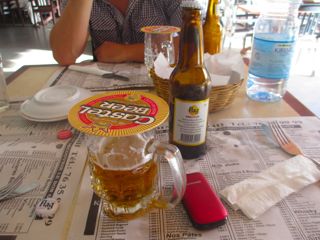
5. Flag and Castel Beer – For rehydration purposes, of course.

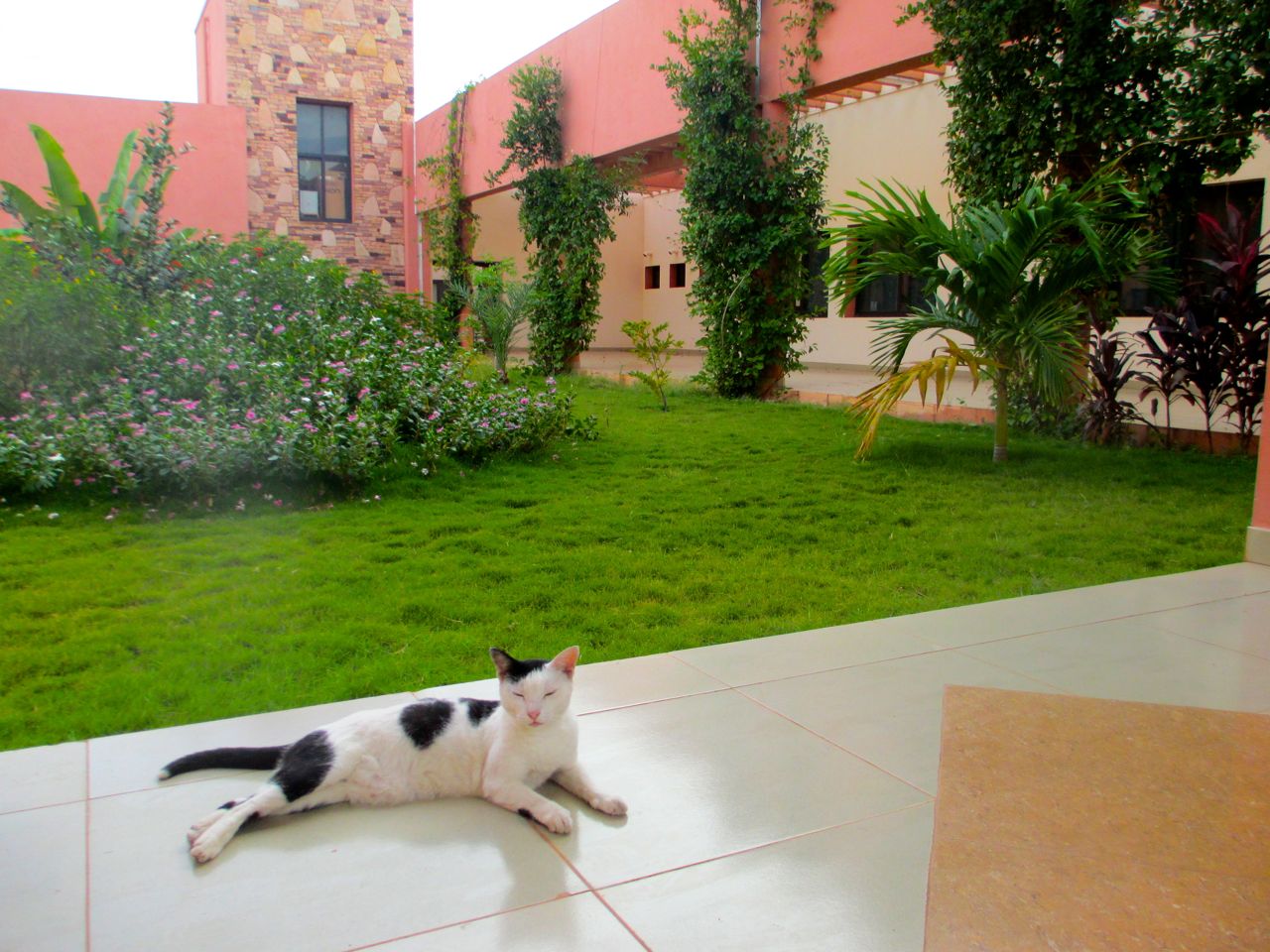
6. K’an Bεn, Our School Cat – No sad, caged hamsters at AISB. Nope, we have a school cat that roams the open-air interior spaces of our school and just loves to be caressed by the kids. He has a weird, endearing meow that sounds like a cross between a cat and Ethel Merman singing.

7. Gingembre – Other than gin, this is my preferred bottled beverage in Mali, a carbonated, sweet, ginger juice drink that has a peppery aftertaste that makes you cough a bit. But in a good way.

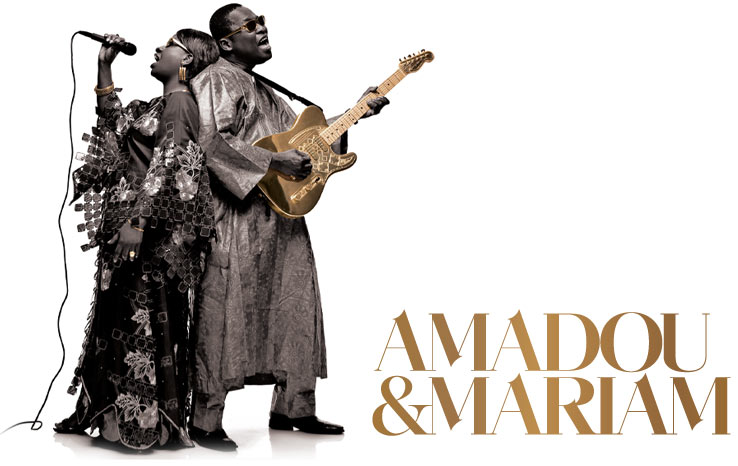
8. Amadou & Mariam – Malian musical duo–married and blind–who create “Afro-blues” music that mixes traditional Malian sound with rock guitars, Syrian violins, Cuban trumpets, Egyptian ney (flutey-type thing), Indian tablas (drums), and percussion from the Dogon (an ethnic group from central Mali). They sing in French and Bambara, have opened for U2, and the kids in my class know the words to most of their songs. I move my lips like I do, mostly so I can appear to be cosmopolitan.

9. The Sounds Outside of Our Window – Wacky bird calls that I swear are from the “Voices of the Deep Jungle” sound effects CD, the chanty-sounding Muslim call to prayer far off in the distance, the rattle of vehicles as they bounce over our bumpy road losing parts, neighbors greeting each other in Bambara (which sounds kind of like arguing sometimes, unless maybe they are arguing),

angry sheep being herded to the slaughterhou….I mean to the daisy-filled meadow to frolic and play, the clip clop of a horse or donkey pulling a cart full of lime green weeds/ watermelons/garbage/kids/toaster ovens…

10. Speaking French & Bambara – It’s a slow process and sometimes curse-out-loud frustrating, but we are slowly learning to speak two more languages. The school guards and custodians are informally teaching us Bambara each day (I have a massive cheat sheet), Jamey takes a French class at our school once a week, and I’m still plugging (and cursing) away with my online Rosetta Stone French course.

We’ve been here just 3 months and we can already use our newly acquired language skills to ask for gas at the full service station, order at a restaurant AND tell them I’m allergic to garlic, purchase a variety of bakery goods (I practice this one almost daily), read the text messages from our local cell phone provider (last month one message told me I could win a sheep in one of their contests), give instructions to our mechanic, guards, maid, and/or gardener, and tell the neighbor kids to get the hell off our lawn (just kidding—the 24 hour guards and the 8’ wall around our property seems to take care of trespassers).

So…..when the dog bites, when the bee stings, when I’m feeling sad, I simply remember my favorite things, and drink G&Ts like mad.

These are a few of my favorite things too…smart, creative students who keep me on my toes!

Chapter 15: Cause Every Little Thing is Ghana Be Alright

Ahhh, Fall Break in Bamako. The frost is on the pumpkin and the leaves are a symphony of autumnal colors. Okay, not really. It’s 90 degrees and sunny and any pumpkins around here are diced and added into a mutton stew.

It hardly seemed like we deserve a weeklong break already but in our Life 2.0, this is how we roll. We decided to join our friends/colleagues Thomas and Cindy and their two kids Kailou (13, and Jamey teaches him) and Jade (10, and I teach her) on a sojourn to Ghana, a quick little two-hour flight on Air Mali—which, I might add, served a full meal. Take that cheapskate airlines in the U.S.!

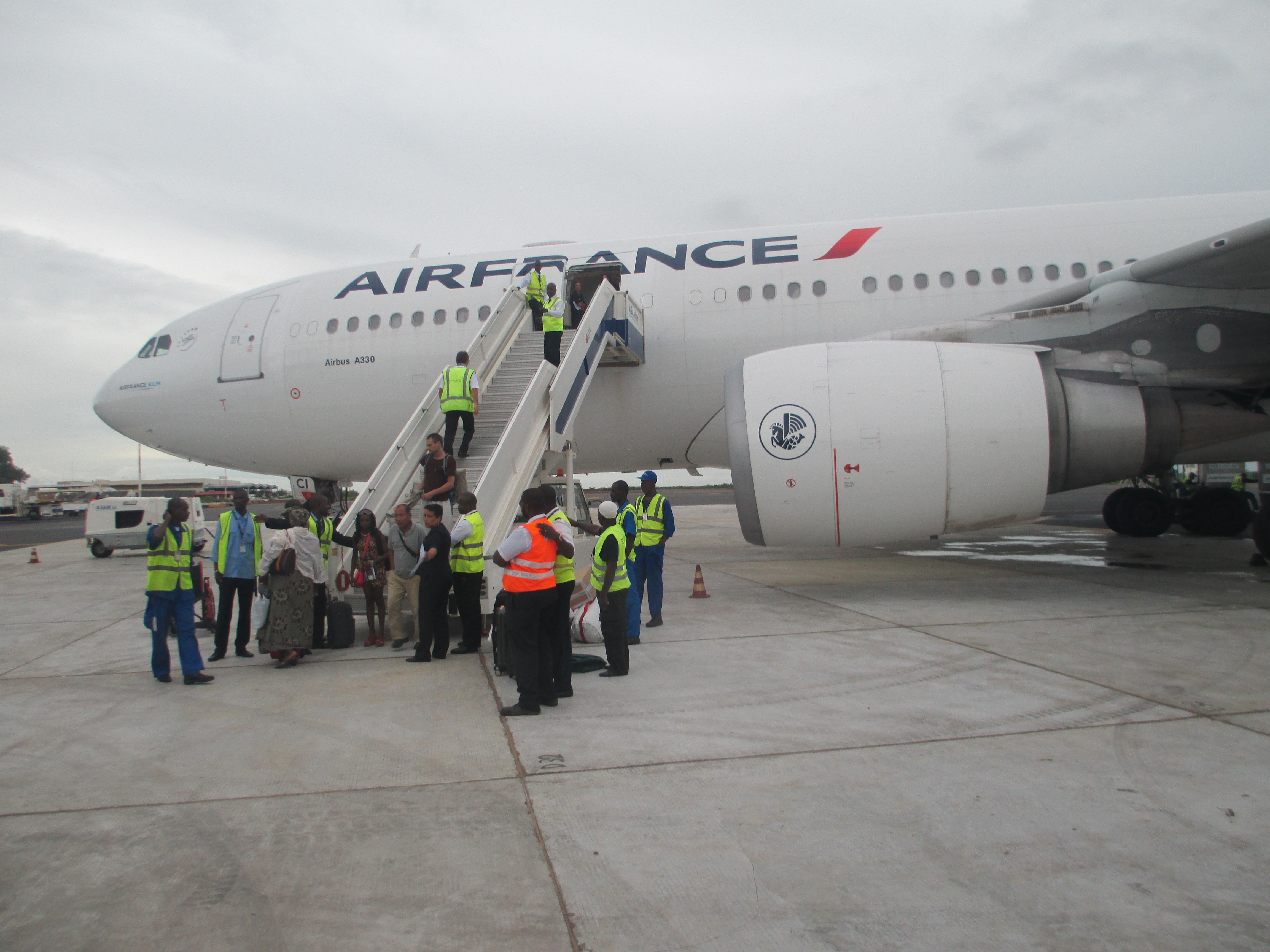
Boarding on the tarmac…still like this better than sweaty, claustrophobic jetways.

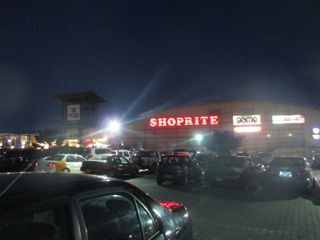
We landed in Accra, Ghana’s capital and a sprawling city that seemed to never end. The main part of the city looked much more modern than Bamako as I noticed traffic lights, a Woolworths, and (drumroll)……the Accra Mall! Well of course we asked our taxi driver to stop there since our shopping options in Bamako are limited to roadside stands selling goat heads or gas, and whatever the Lebanese grocery store owners buy from the Chinese wholesalers.

While technically the Accra Mall is a mall (food court, stores in rows, a massive new SUV parked inside that all the men were looking at, traffic clogged parking lot) the two anchors

Pseudo-mall, Accra, Ghana

were Walmart-style stores that smelled like new plastic and were filled with lots of Chinese imports made of plastic. The rest of the stores, lining two short wings of the mall, didn’t have anything we were interested in–not a pair of Gap khakis or an Aunty Anne’s pretzel place in sight. So we headed out in two rickety taxis toward our first beachfront hotel. Along the way we made a stop at a restaurant for some traditional Ghanaian food. I had Red-Red, which is another take on beans and rice and probably wasn’t a good choice for the long, bumpy ride ahead.

It was an interesting ride. We were tucked into two un-air-conditioned taxis. Francis, driver of the taxi I was in, had the radio turned up full volume to a talk-radio station spoken in Twi, a local language that to me sounds like people arguing. And he kept calling people on his cell phone as he weaved in and out of heavy traffic. Lots of tail-gating too. And did I mention there were no seatbelts?

We drove for an hour or so and it quickly became apparent that this is a super-dooper Christian country. There were roadside churches every couple of feet with names like “He is Coming Apostolic Church of Our Lord and Most Gracious Savior” and “Jesus and His Apostles Continuation Church of the Most Holy Redeemer of Jordan” and so forth. Lots of religious billboards too, advertising things like “7 days of Fasting and Celebration” which

The Savior finally got his PhD.

made me wonder just how much starving people could really party down. And the cars had adhesive letters attached to the rear windows saying things like “I am covered in the blood of Jesus” which we saw twice and actually both drivers appeared dry. We also saw “Dr. Jesus” which of course made me wonder how the Savior fairly gets a PhD since he would obviously be able to snap his fingers and a dissertation would just appear.

But most religiously striking of all were the names of the gazillion little booth-type stores lining the roads for almost every inch of roadway. No matter what they sold or what service they performed, they always worked a Jesus-y type of feel in there somehow. For example, there was “God is King Razor Wire Company” that featured a skull and crossbones logo. Also: My Hands are Blessed Sewing Shop, Bride of Christ Aluminum Works, Jesus is Lord Agro-Chemical, God Did It All Fashion Centre, Blood of Jesus Electricals, and I Shall Not Die Motors. If the road didn’t turn into a series of canyons I probably could have recorded more of these names, but the taxi was bobbing up and down like a buoy so I mostly kept my eyes closed.

An hour later finally arrived in pitch blackness at Big Milly’s Backyard in Kokrobite Beach, where we would spend our first two nights.

Relax, oh tourists. But not with drugs.

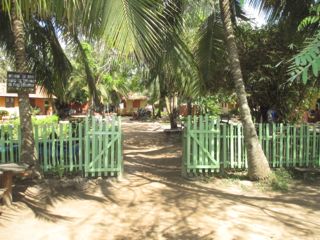
It’s a walled compound that backs up to a working beach, and includes a big outdoor bar, an elevated restaurant overlooking the crashing waves, and then a series of individual structures containing one or two rooms. Our place had a quaint front porch where we could sit and relax, but the room itself was tiny—really just room enough for the full-sized bed and a chair. There was a little AC unit that didn’t work well the first night but did the

Big Milly’s bar, front and center.

second night. The bathroom was a closet-sized alcove with a toilet and showerhead (no sink) and no door—just a see-through gauze curtain that was not an effective sound stopper, if you know what I mean. I should probably say that the room cost all of $25 and Big Milly’s caters to backpackers, so we knew not to expect Jacuzzi tubs and 1000 thread count sheets (they were tye-dyed here, by the way).

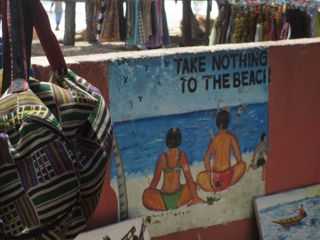
The next day was marvelously sunny and we were excited to hit the beach after being in landlocked Mali for the last two and a half months. I read a little notice on the back of the door that said the beach was safe to walk

…or you’ll be stabbed!

and the villagers were friendly “as long as you brought nothing with you.” Then it said, “For more details ask the receptionist.” So I headed to the reception building and asked the young Ghanaian man about the beach. Here’s how it went down:

Me: Can I bring my camera to the beach?

Ghanaian: No (said without looking up)

Me: Will it get stolen?

G: Yes. (still not looking up and speaking in a monotone voice)

Me: Really…

G: They will mug you. (said matter-of-factly)

Me: With weapons?

G: Knives. So is your room okay?

Jamey braves the beach.

So my parade was rained on a bit since I hadn’t factored in a knifing during this vacation. We did frolic in the water, without anything but ourselves and our bathing suits, and not one stabbing occurred. It’s a working beach so there was always something to see-the wooden boats coming ashore with nets full of fish and lobster and ladies carrying baskets of stuff on their head, like baggies of water to drink or a heaping basket of bras in a variety of delightful colors and patterns, such as camouflage.

We did have a fantastic dinner at the open-air restaurant overlooking the crime-ridden beach—a heap of fresh lobster that really just melted in your mouth. It made us forget all about the potential bodily harm that could happen just a few meters away.

Sit down, you’re rockin’ the boat..

All-in-all Big Milly’s had a weird vibe to it, as budget, backpacker-type places often do. There were two English dudes motorcycling across Africa who worked on their bikes right in front of our little house the whole time we were there. There was a serious-looking dreadlocked blonde gal lounging around who may or may not have “worked” there. There were locals playing what looked like speed checkers (not sure that’s a real

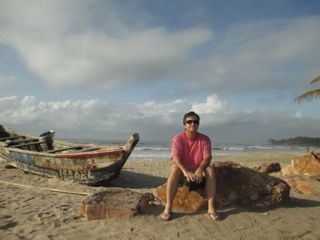
Quick pic of me and a boat, then back to the safety of Big Milly’s.

game) around the bar. There were signs saying “Smoking Area – No Marijuana – Cigarettes Only). When I was chatting with the receptionist when changing money, she told me she didn’t like Obama because he “legalized homosexuality.” And when Cindy and Thomas turned in some dirty clothes to be laundered, they came back still dirty, but folded. We were ready for the next hotel.

Off to Green Turtle Lodge

On Day 3 we had arranged for our very own vehicle to take us on the looong journey to the Green Turtle Lodge in Akwinaa Beach (with a couple of sightseeing trips in between), far to the west about 6 hours or more.

Here we are, still in the “this is going to be so much fun to ride in” phase.

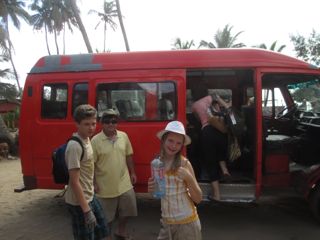
We were riding in a tro tro, the Ghanaian term for any public transport bigger than a regular taxi, and it’s usually a cargo van. Ours pulled in an hour late at 9 AM sporting a brilliant orange-red paint job over it’s rickety, rusting frame–what my students back home would have called a “hooptie” or what we might call a vehicle that we would prefer to take a picture of rather than ride in. While Ghana is an English speaking country, the driver didn’t speak it very well, nor did the two guys accompanying him whose roles we didn’t understand. But he assured us he knew where he was going, and off we went. In the exact opposite direction of where we should have been going.

Thirty minutes later we determined we were heading due east rather than west, and the driver swore we were going to Lake Volta in eastern Ghana, even though we had shown him on the map that we wanted to go to the Green Turtle Lodge in far western Ghana. The three guys (whom I’ll call Clueless Driver, Bitchy Co-pilot, and Pee-Guy) were perturbed but turned the tro tro around and back we headed to where we began, now a full two hours behind schedule. The tro tro was un-air conditioned and the windows rattled and the seats were tattered and not very cushiony and the traffic fumes filled the whole inside with a diesel-ish smelling odor. I was trying to imagine a worse form of transportation–maybe a razor blade-covered surfboard? A bike made out of poison ivy and King Cobras? A canoe made of human waste? Our tro tro was still worse.

Cape Coast palace, where tens of thousands of kidnapped Africans were held before being shipped off to a life of slavery.

After a couple of hours we reached Cape Coast, a somewhat picturesque seaside town that features the Cape Coast Palace, a 200-some year old structure that the Obamas visited a couple of years ago. It was originally the place where tens of thousands kidnapped Africans were brought, processed (e.g. branded), and sent through the “Door of No Return” to be herded onto ships for a grueling overseas journey to slavery–if they even survived the voyage. We walked deep underneath the structure where I immediately stumbled into a small water-filled trench, originally where human waste would have flowed. I tried to imagine what was going through the minds of these prisoners as hundreds of them were crowded into these dark, underground dungeons with not a breath of fresh air and no idea of what their future held. I couldn’t get out of there fast enough.

On the road again, we noticed Bitchy Co-pilot getting more and more irritated, turning around occasionally to say (I think) “This is very far!” or maybe, “I want to stab you” or whatever. We kept restating the directions and the destination, naming the towns we would pass through and exactly how many kilometers between each. Clueless Driver kept pulling over and asking random people on the road if they knew where Green Turtle Lodge was—even though we were hours away and it was a tiny remote hotel off the beaten track. Every time we stopped Pee Guy would hop out and urinate a few feet from the tro tro, with his back to us but still…eew. Seriously, I can appreciate cultural differences and all, but peeing 2 feet from a van full of strangers is just tacky unless you travel back through time to medieval days. It was probably even tacky then.

Roadside scenery

Now this particular routine continued for the next EIGHT hours, with Clueless, Bitchy, and Pee getting madder and madder. The roads turned bumpier, then it got dark and the tro tro windows were so filthy that it was like driving through pea soup fog (there was no wiper fluid, naturally). Just when it seemed that things couldn’t get worse, we went through a village with 5 foot wide mud roads that was having a giant street celebration complete with throngs of people and smoky air and a brass band (I’m totally serious…a brass band in remote Ghana) and they were all reaching into the windows and screaming and chanting.  I thought C, B, and P were going to lose it right there and plow through the crowd at full speed.

After they asked yet another random guy on the road about the lodge, we were directed down another pitch black, muddy, rutted road that eventually turned into a single path with thick jungle on both sides. And was it ever pitch black. Tar black. Ink black. The muddy path was full of deep gashes and sharp ridges, and that old tro tro creaked and swayed and hit bottom over and over. Between the angry crew and the Little House on the Prairie style road my stress barometer was reaching a new high. When Bitchy blurted out something about how stupid this all was, I finally engaged him:

Me (in a near scream): WHAT DO YOU WANT US TO DO?!? WE DON’T KNOW WHERE WE ARE. YOU DON’T KNOW WHERE WE ARE. QUIT TALKING!!

Bitchy (screamy tone): Poot da mooney on top, poot da mooney on top!

Me: Poot da what?!?

Bitchy: Poot da mooney on top, poot da mooney on top!

Me: What does that even mean?

Bitchy: Poot da mooney on top, poot da mooney on top!

Me: I don’t know what you are saying. Turn around.

Bitchy: Poot da mooney on top, poot da mooney on top!

At this point Pee-Guy grabbed my hand and shook it saying, “It’s okay, it’s okay.” As in, ignore the freak in the front. Thankfully a sign for the Green Turtle lodge appeared in the headlightss and we were there–after being in that ratty tro tro from 9 AM to 7 PM. We decided to give the crabby, clueless trio an extra $50 (which apparently is what “put the money on top” means) but of course Bitchy demanded another $10, to which we just said “GO AWAY” and dismissed him with a flick of the hand, just like in the movies.

Finally at the Green Turtle

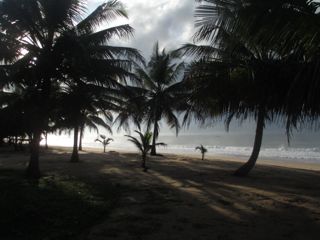
Empty beach for miles and miles…

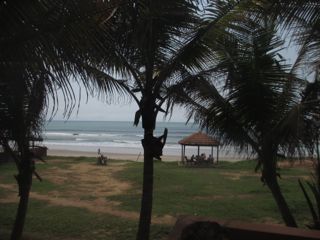
Once our tro tro disappeared into the darkness (thank God), we were led by a tall, be-robed man to our beachfront house at the end of the Green Turtle property. We literally walked along the beach to get there. It was dark but the moon was bright and made the coconut palm fronds sparkle in the ocean breeze. The sound of those waves crashing practically drowned out our conversations. The beach house was brilliant—a  long, covered  front porch along the whole front façade, 2 giant bedrooms at each end with big windows facing the beach (no glass, just a screen) and a steady ocean breeze blowing in,

Our beach home away from home

all solar powered lights and fans, pebbly mosaic floors, and a big bathroom with a shower surrounded by a rock wall. I was thinking that this might have been worth the last ten hours of torture. Well, at least until I saw the composting toilet, which looks like a toilet until you open the lid and peer down into the dark hole where all of the stuff just drops onto dirt. That part wasn’t especially pleasant, especially after a couple of days.

Made me wanna drink more…

All of us shared the beach house, formerly the home of the British couple (and their two kids) who ran the place. Apparently from the scuttlebutt we heard at the bar, this couple had put the place up for sale for 300,000 Euros and flown the coop a year ago to return to Britain. They still own the place but left a manager in charge along with a Ghanaian staff of 20 or so folks. It was evident that without the owners there to attend to the details, well, the details just weren’t attended to. Don’t get me wrong, it was still a magical place—miles of beach without a hotel, house, or person in sight (a few dogs and goats and an occasional sea turtle though), individual cabins/huts made of local materials and powered only by solar energy, the best bar ever featuring a surfboard with the Savior painted on it saying “Jesus Loves Cocktails,” gazebos on the beach where you could eat your meals,

Interpretive dance or a muscle spasm, can’t remember which I was doing.

oceanside hammocks, etc. But as we had to remember with the last place, this was far off the beaten path and budget priced–our house for 6 people was a whopping $50/night. I’ve paid more than that for a bottle of gin.

When we awoke the next morning it was raining, and that would normally bum me out. But it just felt so perfect! We just sat on the porch and chatted, watching the rain hit the slate blue ocean. We ran in the

even looks good in the rain…

rain to have breakfast in the bar–French toast with grilled plantains. The rain eventually stopped and we walked a mile down the beach to a seaside shantytown village called Akwidaa where their shacks were no more than 10 feet from the ocean, and where a crowd of local kids (some of them butt naked, and not just the little kids) gathered to watch these crazy Americans. Obviously not too many tourists made it to this faraway place and I kind of liked that. Of course just when I thought I was at the edge of the world in a place untouched by time we passed a stand selling Coke and Twix bars. And then one of the kids started rapping some Jay Z song.

Me with the village people

Three kids followed us all the way back to Green Turtle, offering to climb a palm and get us some coconuts. We finally said okay, up the palm they went, and minutes later we were sipping fresh coconut milk and eating fresh coconut meat. We gave them a couple of dollars and they left. Kailou, Jade, and I hit the beach again to build a sand castle. Then it soon became clear that our coconut providers had returned to the village and spread

Our coconut hunters

the word that the rich Americans were doling out big bucks! Come one, come all! Lots of kids came, surrounding us and our castle. One five-year-old even had a machete (thankfully for coconut chopping rather than tourist chopping). They kept asking for money and I found the best way to say no was just to sing show tunes loudly. I got through the better part of the Grease songbook before they gave up and walked away. “Those suh-uh-mer n-i-i-i-i-i-i-ghts…tell me more, tell me mo-oh-ore.” I love you Olivia Newton John. Seriously, this could be a great tactic for the army to use to deter enemies.

Sand castles and show tunes.

That night we had a delicious meal of grilled fish, chicken, and lobster in our own little gazebo smack dab on the beach. We had a lantern illuminating our table, and the only other light was the almost full moon. No more machete kids, just waves crashing on the beach. After eating we walked along the shore looking for sea turtles laying eggs, and it’s amazing how old shoes, food containers, and various other things that belong in a trash bin actually look like turtles from a distance. We just pretended they were.

The village people head back after enduring hours of show tunes.

Toward Kumasi

The next morning we had arranged for a better mode of transportation to take us on what we thought was a 4-hour drive north to Kumasi, the heart of the Ashanti culture in Ghana. The Ashanti are legendary warriors who kept the invading British at bay longer than any other group in Ghana. They are also known for their beautiful crafts and their Kente cloth, and are still “ruled” by a king who wears the coolest-looking outfits ever that they believe repel bullets, even though they are made of cloth and feathers and such.

Obviously a crippled donkey would be a better mode of transport than that awful tro tro we endured. Our ride this time was an upgraded van of the last decade without visible rust and still possessing an original paint job with a slight sheen. The driver (whom I’ll call Hoarse Guy) and his partner (Door Opener) seemed nice enough though barely spoke and/or understood English. The bumpy path that seemed to be such a nightmare two nights prior wasn’t as bad during the day in a vehicle with shocks. We were soon zipping down a highway and even with the windows open it was pleasant enough. I could handle four hours of this.

Except it was eight hours. And seven hours of that was on a deteriorating blacktop road that was pockmarked with potholes 8 or 10 inches deep. Hoarse Guy, who spoke with a gaspy, airy voice that was probably difficult to understand in any language, was also thinking he was Speed Racer. He would roar 70 MPH down this awful road, swerving to avoid potholes, driving on the wrong side of the road into approaching traffic, driving onto the rocky unpaved shoulder, well, you get the general idea. The only thing that could be worse is if some weird moth-like creature landed on my foot while we were riding along, bit me, and drew blood. Okay, that happened too! As Hoarse Guy started passing a giant truck on a hill, I had enough. I shouted from my back seat that he needed to slow down and drive more carefully or I was getting out and not paying him a dime. He whisper-talked something and waved his hand, and after that he was less of a danger, but still swerving all over the road.

The best parts were when we followed a giganto truck spewing diesel fumes, and the smoke filled our van, mixing with the dust that was flying through the air too (I had to wipe off my iPad every 30 minutes or so to remove the dusty film). I asked him to turn on the AC so we rolled up the windows and sat in a blistering hot tomb for 30 minutes until we decided the AC didn’t work so well. Hello diesel and dust and various other smells that wafted in (plastic burning, campfire smoke, animal poo, and flowers for a just brief second. I have been on a public bus in the wilds of Peru, in a crazy taxi in crazy Cairo, Egypt, and in a pickup truck on a steep and rocky mountain road in northern Thailand, but this particular trip definitely topped the list of the worst rides ever. I was relieved that at least the two person crew wasn’t belligerent like the last bunch, with hoarse guy remaining silent (or at least inaudible) and Door Opener guy just opening the door for us whenever we stopped.

Our lunch pit stop, where the food smelled like manure and wet cows.

Oh yeah, the pit stop! How could I forget? We asked if he could stop at a restaurant around lunchtime and Hoarse Guy was quite perplexed. He would say that we were approaching a town with restaurants and then we we got to an area that looked sort of like a town we would say, “So is this the town?” And he would whisper-talk, “No, we passed it already.” Then we would repeat our request to eat at a restaurant. This went on for some time. Finally we saw a sign for “The Royal Hotel and Restaurant” and made him pull over. This open air restaurant had a TV blaring with a Chinese kung fu movie. The hostess said they only had rice and foo foo with either fish or goat. I was sitting this one out as it all had garlic in it (my deadly allergy) and my stomach was tied in knots from the ride. When the food came it smelled like farm odors, maybe sweaty and/or butchered livestock and manure. Mmmm mmmm good.

We finally arrived in the town of Kumasi at rush hour, though we didn’t know where our hotel was located. After some pointless driving around which we certainly were not in the mood for, I noticed a large hotel that could be a landmark. Thomas found it on the map, was quickly able to see where we were, and guided Hoarse Guy to our place, the Kumasi Catering Guesthouse.

In Kumasi

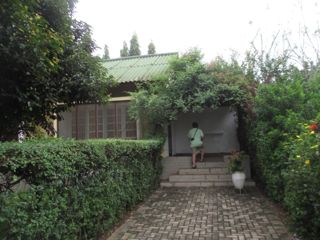
Our guesthouse unit, nestled in a garden.

I liked this place the second we pulled in. It was a walled, leafy complex with little bungalows nestled into shady gardens. The room was comfortable with sweet views into garden areas and……it had a TV, cold AC, and free wifi! As much as I bitch about technology ruining my life, these bits of technology made me very happy at this moment. We sprawled on the bed letting the cold air fill the room while we read through a weeks’ worth of Facebook postings and drank icy Cokes. The Internet was fast as lightning, a luxury we don’t have in Bamako, so we downloaded things like crazy, AND watched YouTube clips without any any buffering. Ah, the simple things in life can be so satisfying. That evening we walked to Vic Baboos restaurant where they had American, Chinese, or Indian food. I opted for sweet and sour chicken and a really large Ghanaian beer that took the edge off quickly.

Making foo foo…mashed up casava (and fingers if the pounder isn’t careful)

The next day we headed out in two taxis to the Ashanti King’s palace, a quick five minute drive. But somehow our taxis became separated and Thomas, Jamey, and I were dropped off in a spot where the others were not waiting. Without phones we had no choice but to wait around, and after 20 minutes we found the others who had been dropped off at another entrance. The palace was a colonial style house that was the former residence of the king—he now had a sassy modern home just behind that looked like a house you would see in a basic gated community in the U.S. But the old place was cool—lots of history and life-sized wax figures here and there that would freak us out every time we walked in a room.

Eyes are the window to our soul, and this dude’s soul is wacked out!

Next we headed off in two taxis to the Cultural Center to visit the Jubilee museum and have lunch. Another 5 minute ride, but my taxi with Cindy and Kailou arrived and the others didn’t. Surely they were just caught in traffic and would be pulling up any second. An hour later, just as we were going to call the American Embassy and report a kidnapping, they pulled up. Turns out their driver took them to Jubilee military park on the outskirts of town where they encountered a big parade and lots of traffic.

We blew off the museum in the interest of time and had lunch, then walked to find the famous “Okomfo Anokye sword,” a sword that has supposedly been in the ground for 300 years that many have tried to pull out (including, supposedly, Mohammad Ali).

C’mon, pull out the sword and ruin a centuries old kingdom. Or just drink some schnapps.

If you do pull it out the entire Ashanti kingdom is supposed to collapse, so I’m guessing they aren’t rooting for anyone to be successful. It was bizarrely located in a hutlike structure on the grounds of a hospital. In order to get there we had to pass through the hospital mortuary area and guys pushing carts with metal domes over them and bodies underneath. We paid our $1.50 to get in the hut and sure enough, inside there was a little wall surrounding a small pit in which a sword handle protruded, and empty bottles of schnapps laying around it. Not sure what the Ashanti-schnapps connection is, but we also read that you can get an audience with the current Ashanti king if you bring along a bottle of schnapps. At least we now he has fresh pepperminty breath.

Our final stop was to be a hat museum, a private collection of some 2000 hats from around the world. This time our two taxis stayed together and arrived together…success at last! And the hat museum had closed a year earlier. So it was back to the guesthouse for more TV, Internet, cool AC, and icy cold Coke (I wasn’t complaining). We again had dinner at Vic Baboos (though we did hike around looking for other restaurants) and this time a group of young Americans was clustered at the door. We struck up a conversation and found out they were Peace Corps volunteers in Ghana. They asked us where we were from, and we told them we lived in Mali. “You live in MALI? Wow…..” one replied.

You know when you impress Peace Corps people, the ones who actually live in huts in villages in the middle of nowhere and walk miles to get water from a well, you have earned some street credibility. We told them things in Bamako were fine but I could see they thought we were sooo brave for living in a post-coup nation with Islamist terrorists roaming the northern half of the country. I wanted to tell them how I had to dodge machine gun fire on the way to work every day, and use Kung Fu to keep the terrorists at bay, but I’m not sure I looked so Indiana Jones-ish in my matchy-matchy Original Penguin outfit. They also advised us to take a bus back to Accra rather than a tro tro since the 6 hour ride was REALLY bumpy. Just the outlook we wanted to hear.

The next morning I awoke early and decided to check the bus schedule for the next (and final) day of our trip. As often happens when Googling, I found a blog about traveling in Ghana and how one could fly between Kumasi and Accra. FLY! In just 45 minutes! I checked the website and not only was there availability, but the cost was only 40 bucks a ticket! I ran like the wind to Thomas and Cindy’s room with the news, and even thought they were still in bed they were excited at the prospect of missing out on a 6 hour bumpy bus ride in lieu of a zippy little flight. We decided to leave that afternoon rather than stay in Kumasi another night, so we bought our tickets online and found a beachfront hotel for our final night in Ghana.

Back to Accra

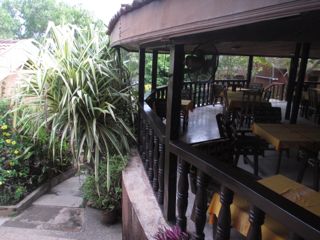
Restaurant at the new hotel, open air and stocked with alcohol.

The flight to Accra was a dream–fast, efficient, and safe, and we were even able to read our iPads and Kindles the entire time, even when taking off and landing. A couple of taxis were waiting to take us to the Alfia African Lodge, a quaint compound of 22 units on the beach. This being the big city, the price was 4 times what we paid for a night at our other budget hotels, but the beach was fun although littered with trash that I just pretended was big seashells. Dinner was to die for, another open air restaurant with ocean views, and super tasty, creative fare. I had mango curry chicken with a dessert of coconut lemon syrup cake (when all 4 words of a dessert make me salivate I know it’s gonna be tasty), washed down with almost a liter of milk stout, a really dark stout made in Accra that almost tastes like beef.

Hotel decor.

Back in our hotel room, which had a view of the ocean if you craned your neck far to the left, we drifted off to sleep with a smile on our face. Then we awoke at 1 AM sweating because the AC had stopped and it felt like we were locked in a metal shipping container in the middle of the Sahara. We tried to turn on the fan, but nothing. And the windows didn’t open. I attempted to call the front desk, but the phone didn’t work. Goodness, had the zombie apocalypse just happened while I was dreaming for the past two hours?

I dressed and started out for the reception area, and found the security guard who informed me that the front desk was closed and would open at 6 AM, and they could help me then. No, no, no I said. We need a new room now, not in 3 hours. “No poss-ee-bull,” he said. I asked him to call the owner. He chuckled. He said he would find help and left, but after 40 minutes I saw him slowly wandering around the compound again, not even thinking about us.

Accra beach with its big, big seashells

I started in again and didn’t let up and he eventually sent me to security guard number 2 who I think was a clone of the first guy, or maybe just the first guy playing another role to confuse me. “Go to sleep for 3 hours he told me, then we fix,” he offered. No, no, no I said again. “I’m going,” he said to me. “Going where?” I asked. I’m going,” he repeated. Was he blowing me off? After a lot of back and forth I figured out that he was trying to say “I’m going to be right back. By now it was 3 AM and we were sitting sweaty in a tomb of a room since going outside meant risking malaria-carrying mosquitoes.

At 3:30 AM he returned with a somewhat disheveled looking guy with grey dreadlocks who I guess was the owner, and he was very kind and apologetic. He said he had another room for us and to leave everything in this room for now. The new room was smack on the beach with the best views and had the chilliest AC ever, arctic really. We slept soundly for what was left of the rest of the night.

View from room #2

The next morning, our last in Ghana, we decided to splash in the ocean one last time amidst even more “seashells” that arrived overnight. We had another tasty meal in the restaurant and headed to the Accra airport. I now sit at the departure gate ready for the 2 hour flight back to Bamako, and school in just 15 hours. Bumpy roads, carnivorous moths, machete-wielding toddlers and all, it was a Fall Break to remember.

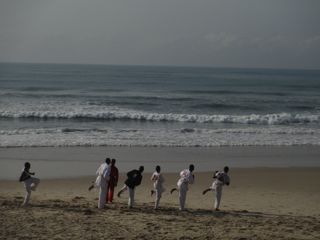
Tae Kwan Do on the beach.

Chapter 14: Baa Baa Dead Sheep, Have You Any Wool?

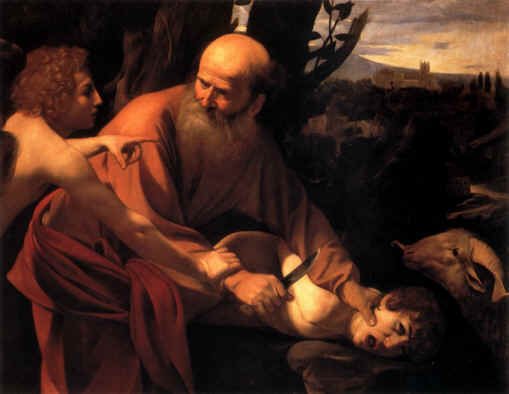
Malians will soon celebrate Tabaski, the most important religious celebration of the year. Known as Eid al-Adha in the rest of the Muslim world, this is the “Festival of the Sacrifice” that commemorates Abraham’s willingness to kill his son for God, another charming, pro-family parable that Christians and Jews also include in their holy books.

Dad, how about you just ground me for a week?

Even as a kid I found this one to be a hard sell…it’s not okay for cult leader Jim Jones to tell his followers to drink poison Kool-Aid as a sign of obedience, but it’s okay for God to tell a father to kill his kid as a sign of obedience? I was pretty sure I couldn’t be friends with, much less worship, anyone who encouraged me to stab or poison someone.

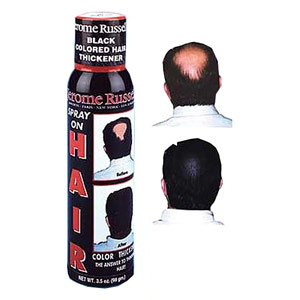
Now listen, it’s not a secret that I am no fan of organized religion. I don’t even like to talk about religion. Never have. Even when I was part of one for many years, I considered it a private thing that was nobody’s business but my own. Which is why it creeps me out when people hawk their religious beliefs like Ron Popeil on late night TV trying to sell his GHL-9 Hair-in-a-Can-Spray (“Forget those ratty-looking wigs and toupees! Get a full head of luxurious hair in just seconds with a single touch of a spray nozzle!”). News flash! I really don’t want to know why your religion and your particular savior is better than another (“Forget those ratty-looking Buddhists and Muslims! Get eternal salvation in just seconds with a tax-deductible donation to our Christian church!”)

Back in my Florida I was pretty savvy at identifying the religion hawkers as they slinked through my neighborhood looking for convert$. Two wholesome-looking boys with white, short-sleeved shirts? Mormons with their holy undies and their spirit baby-making god on the Planet Kolub. A group of four people in frumpy clothes, mostly minorities, with a child in tow?

Source: AP

Jehovah’s Witnesses about to convince you not to celebrate your birthday. Cute-ish 20-somethings with fashionable jeans and hair styles? Non-denominational Christians from the hip megachurch with the rock band and Jumbotron screens and their “Seriously dude, Jesus is so awesome!” lingo. Icky, icky, icky.

When I was a sophomore, flyers suddenly appeared all over school inviting everyone to a Halloween event at the fairgrounds outside of town. Free food/admission/bus, loads of scares…what teen could pass that up? And my did it ever turn out to be scary—in ways I never expected! First there was a long walk through the inky black woods where the sponsors had created scenes of gruesome horror: disemboweled bodies still writhing in pain, devilish-looking monsters feasting on children, ax-wielding freaks jumping out to scare us out of our wits.

Can I get an “amen?”

Afterwards we were herded into an exhibition hall where even scarier things awaited…a Baptist church group preaching to us for nearly an hour telling us that if we weren’t “saved” our lives would be very much like that horror walk we just went on. They goaded us to come to the stage and “accept-Jesus-Christ-as-your-Lord-and-Savior” or regret it for the rest of our lives (writhing, disemboweled bodies or Jesus Christ…it’s up to you!). I was only 15, but even then I knew these religious shysters had pulled a fast one. A really creepy, inappropriate, disrespectful, and probably illegal fast one I might add.

This religious boasting thing really is uniquely American and almost always involves Christians. I’ve not seen this odd behavior in any of the 40-some countries I’ve visited. You don’t see religious bumper stickers in Thailand (“Buddha is the reason for the season”) or Morocco (“Allah is my co-pilot”). In India I doubt they say, “Vishnu Bless You!” when you sneeze. I’ve never read a Facebook post that says, “Ganesha is great!” or heard a Japanese person say, “If they just allowed the Book of Tao is schools these days we wouldn’t have all of these problems.” In my experiences, the rest of the world (excluding

crazy fundamentalists who are just, well, crazy) just doesn’t seem to find it proper to boast about religion.

Which brings me back to Mali. While Mali is a Muslim country, it is a very moderate Muslim country that actually considers itself a secular nation (and again, of course I’m not including the wacko Islamic extremists causing havoc 1000 miles to the north of here, imposing Sharia law and stoning people).

Roadside mosque outside of Siby, Mali.

I’ve been around dozens of Malians every day for three months and not once—not even one single time—has any of them told me Allah was awesome or that the Qur’an had the answer to all of my problems or that I’d better get myself down on that prayer rug and face Mecca…or else! It’s a beautiful and classy thing to see a people so secure in their beliefs that they don’t need to act like a freakin’ carnival busker to advertise their faith.

Even more endearing, the Malians are the absolute least judgmental folks I’ve ever encountered. They don’t criticize other religions, hold you to a standard set by their tenants of faith, or pass judgment on your life. I’m not an authority on this, but I’m thinking that a married, male couple sleeping in the same bedroom here in Bamako is something Islam doesn’t look kindly upon. But again, not once has a Malian given us a condescending Church-Lady stare or treated us like we were “inherently disordered” (as the Pope describes gay people—as he wears his bejeweled gown). As a matter of fact, it’s just the opposite. Malians have been gracious like grandma at Christmas time, always generous beyond what’s expected, authentically kind, and extremely genuine.

Now Tabaski is the most important holiday in Mali, a country that is 90 percent Muslim, and it involves all kinds of actions and preparations. People ask for forgiveness from those they have faulted over the year. They have family dinners. They pray. They give to the poor. For those of us with household help, it’s customary to give your maid an extra month’s salary. Fathers give money to their families to buy new clothes, jewelry, shoes, and to get their hair done.

baaaaad to the bone

Fathers who can afford it must buy one sheep (or several if they have more than one wife) that they will offer as a sacrifice on October 26th, the day of Tabaski this year. On Tabaski one-third of the their sheep’s meat is eaten by the family, another third is given to relatives and friends, and the final third is given to the poor and less fortunate.

Sheep are everywhere this time of year, and of course the prices go up as Tabaski gets closer. Malians often save their money all year long to buy a sheep that they will clean up and keep inside their house in the days preceding the holiday. This year sheep prices range from $150 and up,

roadside sheep market

with some large rams going for five or six times that price (and this in a country where the average worker’s salary is $1500 a year). Just down the road the family that owns the mini-mart (which makes Mr. Drucker’s General Store on Green Acres look like a palace) have the most beautiful, brilliant white ram tied up right outside their door. I can only imagine how many bottles of orange Fanta they had to sell to buy that nearly cow-sized creature.

Since this religious holiday is celebrated throughout the Muslim world, it results in the annual slaughter of 100 million animals in just two days (is it just me, or is it peculiar that 100 million animals are killed to commemorate a father’s willingness to kill his son?). Sheep are the go-to slaughter animal in Mali, but other countries sacrifice cows, goats, lambs, and camels.

school sheep, for now; dinner, later

Even the two sheep that were keeping our grass low at school weren’t immune from all of this. On Friday morning I was showing a PowerPoint about earthquakes in my classroom when our director rushed in, glanced at the windows, quickly pulled one of the curtains closed, and dashed out. Was she worried that the light from the window was obscuring the screen? Making sure all of the curtains were evenly arranged? Nope. Later she told me that the ceremonial slaughter of one of the school sheep happened in the playfield just outside our classroom window, and she wanted to make sure the kids couldn’t see. Supposedly it’s done in a quick and humane manner, but I’m thinking a PowerPoint about seismic waves is probably better for kids to watch than a sheep’s neck bleeding into a hole in the ground. Just my opinion.

Friday evening we went to our director’s home to attend the school’s Tabaski party, being held early since we are on fall break next week when the real Tabaski happens. The main course at dinner was, you guessed it, Mr. School Sheep Who Was Killed Right Outside Our Window.

Our director with school custodian Lassi, winner of the sheep raffle at our Tabaski party

The second school sheep was there too, but alive and tied to the fence. He was raffled off to a Muslim staffer. A young custodian won, and in my head he is going to raise this sheep as a beloved pet that he dresses in cute clothes and hats. I have to say it was rather odd watching everyone tear into their roasted mutton as the mutton’s former friend was nervously watching from a few feet away.

It’s customary to dress up in traditional garb for this type of event, so Jamey and I donned the new boubous we had

Jamey and I sproting our traditional boubous in a non-traditional polyester fabric.

purchased at a market in Siby a few weeks ago. This pants and tunic combo can be quite comfortable if it is made from a natural fiber. However, we opted for cheap boubous made of polyester that seemed to trap body heat like a terrarium, especially with our current weather conditions. Mali basically has three seasons: hot (March – June), rainy (July – October) and “cold” (November – February when daytime temps only reach into the 80s…brrr!). But oddly, October includes a brief “mini-hot season” so currently the temperature reaches into the upper 90s with high humidity, creating terrarium-like conditions under our boubous that are perfect for growing orchids, ferns, and fungal diseases. However, the Malians so appreciated the fact that we were wearing these traditional items of clothing (which are traditionally not polyester), giving us lots of “tres jolie!” and “c’est bon!” type of comments (very beautiful, it’s good) that almost made us forget the sweat streaming down our back. Fashion before comfort I always say.

teachers and student dressed for Tabaski celebrating

Despite knowing that the food had been frolicking in our schoolyard a few hours earlier, it was an enjoyable Tabaski party. The Malian band was superb and we all

traditional Malian music kept the mood festive

ended up dancing under the stars for quite some time. If polyester could actually absorb liquid my boubou would have been dripping wet after this physical activity, but it maintained its crisp, unnatural form throughout the night.                    And while I don’t share the Malian religious beliefs, I’m happy to be part of their Tabaski celebration. I’m just mirroring their approach to life, treating people respectfully despite their religious or moral beliefs. Just don’t make me eat the school pet.

everybody dance now!

Chapter 13: High Noon In the Garden of Short-Handled Tools and Donkey Poo

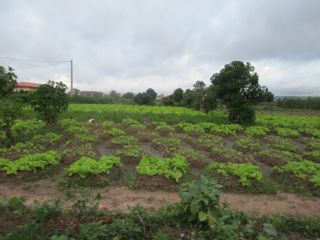
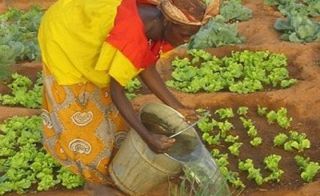
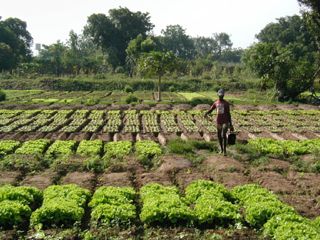
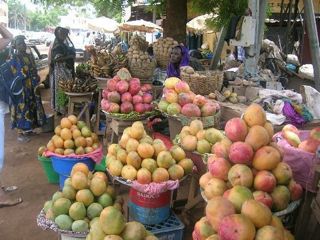
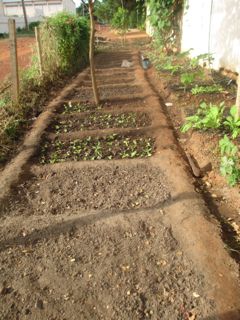
A really cool and very practical thing about Bamako is that people don’t let a square centimeter of land go to waste. If it doesn’t have a building on it they either put sheep or cows on it, build a kiosk on it where they will sell something (eggs, bicycle tires, haircuts,


Bananas, corn, eggplant, lettuce, mangos, and more, right in the middle of dusty, fume-filled Bamako. Photo from: http://philweblog.blogspot.com/2011_03_01_archive.html

Coke bottles of gas, unrefrigerated meat), or plant a garden there. I especially love the garden thing. You can be on the road in the middle of Bamako in the midst of absolute chaos—traffic, fumes, dust, 4-story buildings hugging the road, crowds of people stomping around everywhere—and in a 2” crack along the road someone planted a row of corn.

And why not? As we learned in elementary school science class, plants clean the air, give us oxygen, provide food, and are a lot more pleasing to gaze at than a pile of

Roadside garden in Bamako. (photo: http://philweblog.blogspot.com/2011_03_01_archive.html)

bloody fish for sale that are covered with flies that moments before had landed on a big pile of donkey poo. Come to think of it, there actually was a vendor with a pile of fly-covered fish adjacent to the row of corn I spoke of earlier.

Somethings fishy around here.

But thank goodness those shiny green stalks glistening in the Malian sun have left a more indelible mark on my mind than the poo fish.

Now I’ve always had a thing for gardening anyway. Both sets of grandparents lived on farms for a good part of their lives and had bountiful gardens that I just loved to frolic in (hmmmm, maybe that explains all those odd rashes I had as a young boy). I can picture myself in tiny Mendon, Illinois with Grandpa Fessler showing me how to carefully pick the fat red strawberries off the plants, or how to gently dig into the soil to find potatoes, which was way better than searching for Easter eggs. French fries or mashed potatoes as an end product trumps a stupid plastic egg any day of the week. Yay for saturated fat!

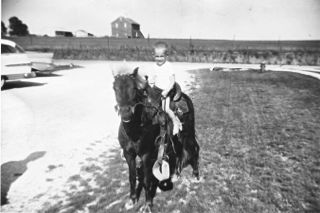
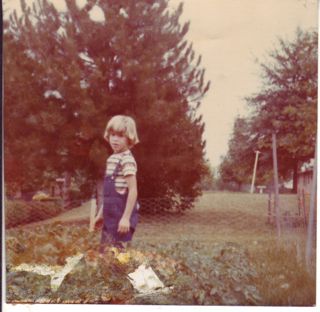
That’s young me at Grandma and Grandpa Fessler’s, ready to ride to the garden and harvest crops (okay not really–my grandparent’s neighbor randomly brought this pony over once and they plopped me on it for a few seconds)

I can remember Grandma McClelland’s lush garden in even tinier Meyer, Illinois. Between gardening and making pies and having the Mississippi River a block away, spending a week up there was the ultimate. The best part was that raspberry vines covered the rusty metal fence that bordered one edge of her garden, and we would pick a bucketful and go right inside and make raspberry pies. Sweet berries, butter, sugar, and dough, and then some more butter smeared on top, and then some more sugar sprinkled on that. Eaten with ice cream of course. And washed down with a Frosty root beer. I was on such a sugar high I could have detassled all the corn in a 50-mile radius of her house.

My own parents always grew things too, despite the fact that they left farm life and became city slickers at a young age. I remember a grape arbor on the back of my childhood home, and mom and Grandma Fessler using the grapes we picked to make jelly. I’m not sure they ever knew that their star grape harvester (that would be the young me) put more

My brother Todd in our 70s garden

grapes into my mouth than into the bucket. Eat ‘em now, or eat ‘em later, what was the difference I reasoned. We always had tomatoes growing in the summer, and although we didn’t always grow sweet corn I somehow made it magically appear on the kitchen table on many days. Okay, so I picked it from the farmer’s field next to our cul-de-sac (yes, I learned French at an early age). I just figured it was payback for all the times he sprayed his fields with DDT or Agent Orange or whatever, and it drifted into our house where we breathed it in deeply and probably blacked out. I just can’t remember clearly.

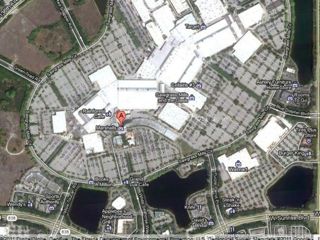
And of course my bachelor’s degree is in Landscape Architecture so I did take this love of nature and gardening a step farther than most do. Except rather than enhance the land with nature as I thought I’d be doing, my jobs with Florida landscape architecture firms had me designing large shopping malls and walled suburban enclaves that obliterated nature,

It’s mall-tastic!

save for the spindly palm trees that would ultimately line the rows of parking, providing no shade and dropping giant fronds on cars. The shopping centers and mini-mansion developments we designed for our clients destroyed every pine grove and shady marsh in sight. Then we named these shopping centers and housing developments “The Shoppes at Pine Grove” or “The Villas at Shady Marsh.” Stewards of the land, that’s what they called us.

So when it comes to preserving nature, I’m an advocate. That’s why I really dig (oh God, here come the puns) the grow-stuff-anywhere-you-can mentality here in Bamako. Our short 4-minute drive to work, which used to be a 10-minute walk before we grew lazy, has us passing nothing but small fields of produce
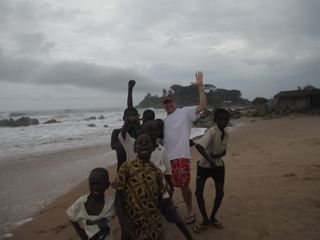
roadside view on the way to school

such as rice, corn, sorghum, and the most vibrant lime green lettuce. Men and women are working these fields when we are on our way to school at 6:30 AM, at high noon when I glance out of the 2nd story window of our chilly library, and when we are driving home at 3:30 PM (15:30 if I’m trying to sound like a local). No wide brimmed hats, no Banana Boat SPF 50 sweat-proof sunscreen, no breaks to enjoy an icy Coke and a bag of barbecue Fritos.

And “working these fields” does not involve any equipment invented since medieval times. They use nothing but handmade tools that you would see the peasants using around King Arthur’s castle, all of them short handled and requiring one to bend over to use. That’s a weird thing here. I know for sure that shovels and hoes and rakes with long handles have been invented, but not one of those things is in sight. Even the custodian who cleans my classroom uses a broom that’s a bundle of course hay-looking stuff tied to a 6” wooden handle that requires him to bend over to sweep, just like Cinderella or the witch in Hansel and Gretel. Every time I see him use that I picture my broom back in Florida with its own jingle touting the merits of its long shiny handle (“O-Cedar makes your life easier”). Of course within 30 seconds his fairy tale stage prop broom has stirred up a Saharan-style dust storm and I run from my classroom gasping for air.

no rain, no hose, just a bucket (photo: OXFAM)

I mean, it can’t cost too much more for 3 feet more of wooden handle, can it? I really want to run out into those fields with a branch I broke off a tree, lash their tiny handled shovel or rake to it, and show them how to avoid back problems in later life. For the work they do, a long handled tool would be heavenly. Because it’s the rainy season now, all of the fields they plant are done in raised-bed style. That means they manipulate the soil to create a patchwork of raised rectangles, maybe 3 feet by 2 feet, with channels in between that carry away the massive amounts of rain. If it doesn’t rain, which it hasn’t done in the past week or so, they fill a watering can (another fairy tale stage prop-looking device) from the well in their field (also known as a very deep hole they dug not surrounded by any type of fence or rock wall that would prevent one from falling down there) and hand water every square centimeter of their field, one can at a time.

That’s a lot of backbreaking work that makes me appreciate every bite of carrot or piece of lettuce I chomp down on here. And speaking of eating the produce here, it is absolutely the tastiest stuff ever. Our maid Fati makes our dinner from the loads of fresh vegetables and fruits she buys for us every week. The potatoes are more flavorful, the carrots sweeter, the bananas don’t cause heartburn, and there is this sweet potato-ish root vegetable that makes fries that I dream about at night.

In Bamako the potatoes are buttery and the mangoes are sweet. (photo: Alpha Ghana)

However, before you eat any vegetables or fruit here you have to follow a little routine. You fill the sink with water and add 2 capfuls of “eau du javel” which I thought had such an attractive French name but really just means “bleach.” You soak the produce for 30 minutes or more, give everything a good rinse, and then you’re good to go.

Unless you want surprise explosive diarrhea (which is the topic for another blog post) this is a step you don’t skip. Apparently the well water they use to irrigate their fields here isn’t exactly like the bubbly fresh underground springs that Perrier uses for its water. A drop of Bamako well water under a microscope would reveal a full-on bacteria jamboree.

It’s a bacteria hoe-down! (photo from lifeslittlemysteries.com)

And the soil could also contain various types of poo, which I won’t detail here. Of course there are none of these worries in the States because produce there is coated with pesticides and herbicides and might involve genetic mutations and all of that that makes it much, much healthier.

On a side note, I read that scientists have discovered that we have several handfuls of bacteria, fungi and other microbes in our body which compose up to 3 percent of our body mass. So if you’re a 200-pound person, up to six pounds of you is actually bacteria and such. One more reason I use plenty of eau de javel.

Now this is the time when I slip in the fact that we have our own gardener, Oumar, a young Malian who also works part time for our school’s director.

Oumar, chic gardener to the stars (or to the teachers)

Not that I don’t enjoy personally getting my hands dirty or sweating as I plant things, but when someone will do the sweating for you for just $50/month, my direct involvement lessens. And Oumar does all of this manual labor while maintaining a very hip and stylish exterior–mirrored Aviators, cuffed jeans, casual flip flops. He always looks like a Gap ad. If I was digging in dirt in the African heat I would look like an ad for Hillbilly Handfishin’.

While looking natty, Oumar has lined our wide porch as well as our rooftop deck with clay pots of hibiscus, bromeliads, ginger, and other plants we had back in Florida.

The skinny space next to our house where Oumar is creating the Garden of Eden, sans magical talking snake.

The front porch and one of our guard cats.

He’s maintained our compact front lawn as a soft carpet of deep green grass that could be a putting green (if we knew which end of the golf club went up or down). He somehow found and transported on his moto two 5 ft. tall dracaenas in heavy clay pots that we now have in our living room. And he is especially proud of the topiary-like work he does on an arch in our yard made entirely of a shrub, which makes us feel like we are making a grand entrance from the carport to our front porch each day. If he sprinkled the walk with rose petals my life would be complete.

But wait, that’s not all! Besides all of this Oumar has used a skinny space (between the wall that surrounds our home and the potholed road) to

The ocra, our least favorite vegetable in the world, grows the best.

create a vegetable garden that Martha Stewart would envy! Before we left Florida Jamey went to Home Depot and bought a gazillion

Our little patch of heaven–and just on the other side of the wall sheep and donkeys and an occasional child use the road as a bathroom.

packets of vegetable and fruit seeds that we brought with us. Oumar was ecstatic when he saw these and immediately set about digging and hoeing and raking—using tiny-handled tools. He made more than 20 raised beds in this space where you couldn’t even park a car or a donkey cart. We aren’t exactly sure what he planted—definitely some lettuce, okra too I think, corn (or a weed that looks like corn), watermelon–but it looks fantastic and sometimes that’s all I care about.

One of Oumar’s gardening tools, probably not made by Black & Decker.

Oumar doesn’t speak a lick of English so he just talks to us in French as if we understand, saying the same sentences over and over as if repetition will solve our comprehension problems. Sometimes we do understand, sometimes we take the iPad outside and use Google Translate with him, and sometimes we

The romanticized view from our garden to the muddy potholed road.

just nod and say “Oui!” Nevertheless, he has created a flower-lined garden that is surely

The topiary arch that we march through triumphantly each day.

the envy of the neighborhood, and I can’t wait to chow down on our first harvest. He is, however, very much like a teenage child who has realized his parents have money: Can I have $10 to buy more compost? I can buy more flowers and pots for another $20. Can I get $40 for a little lawn mower—it will look so much better. I finally, with the help of Google translate, had to use the parenty-sounding, “What!? Do you think I’m made of money?” right before I gave him $10 dollars for some more hibiscus. Damn kids.

Chapter 12: Lebanese Coifs, Phallic Instruments, School Beer

Enjoyed some more “firsts” this week. Actually, now that I think about it, moving from South Florida to a landlocked, developing West African country pretty much means everything we do here will be a “first” for awhile–the first time we saw a pile of smiling sheep heads, the first time we rode with an armed soldier in a taxi, the first time we had explosive diarrhea. Ah, misty water colored memories. Here are a few more firsts…

My First Cut

I had my first haircut in Africa this week. I was worried about this particular grooming regimen because the only “salons” I had noticed were tollbooth-sized wood and tin shacks along the road with hand-painted signs that made them sound much fancier than reality, like “Le Salon des Cheveux Mal Coupée et Traitements Mauvaise Couleur” which translates to something like The Salon of Miscut Hair and Bad Color Jobs.

Random salon in nearby Siby sporting a fancy name and floating head.

Inside these places I could only see dirt floors and a single wooden chair with a light bulb hanging from the ceiling, much like in an interrogation room. And definitely no AC. Or air, really.

So I let my hair get a little longer than usual, which I noticed in the morning when I labored to make my bangs stay flat rather than turn into Shirley Temple curls. It was obvious that I couldn’t put a haircut off any longer. Fortunately our teaching colleague Paul also needed a cut and offered to guide us to the stylist he used, a young fellow from Lebanon with his own salon. Now of course I’m picturing the tin shack without oxygen as we pull into a little courtyard and see a very Americany-looking salon façade, very smartly designed and featuring a sign illustrated with non-African heads with lots of flowing hair and pouty little lips. Inside it was like we were transported to a salon in Anytown, USA. There were ornamental wrought-iron chairs with fancy cushions, a big glass coffee table piled with fashion magazines, hair products galore, and a few Malian salon gals in trendy outfits and coifs gossiping (okay they were speaking in French so I couldn’t tell if it was really gossip, but the tone was definitely gossipy). There was also a flat screen TV showing Men in Black 2 subtitled in Arabic, so it wasn’t exactly like home but close enough.

The 20-something owner spoke a little English (“You want short, no?”) before he went to work on my hair like it was his last day on earth. It was almost all scissor work and he moved in Edward Scissorhands fast motion and, gladly, in a very precise fashion. My hair texture is as fine as fine can be, but somehow he was able to add more texture than I’ve ever had (though one of my students commented the next day, “It looks a little fuzzy.”).

Roadside salon in Bamako.

He cut it short, really short, but I dug it. Next came the scalp massage that Paul said was the reason he keeps coming back to this place. I’ve never had a scalp massage and am not sure I knew there was such a thing, but now I’m hooked like a crack addict. That young Malian shampoo girl worked my head for 20 minutes like it was a glob of bread dough, at one point even taking a call on her cell phone while still using both hands on my scalp (Jamey told me another gal held the phone for her, so it was nothing alien or sinister after all). I’m sure that this vigorous massage caused my brain to develop more than usual and probably made my hair grow stronger. And all of this for just $11.

My First Midnight Music

On Saturday we went with a group of our colleagues for dinner at the French Cultural Center in Bamako, a pleasant little outdoor courtyard space with a metal detecting security checkpoint at the door. For the first time in 52 days we were in a space entirely filled with non-Africans. That was just weird and totally made us feel non-special so we ate fast to get the hell out of there to someplace where we would again stand out from the crowd. Actually we ate quickly because there was a concert next door we were attending by a Malian musician named Habib Koite. He and his band have toured the world many times, and he even played on Bonnie Raitt’s latest album. He is one of Mali’s most loved and most famous performers so we were psyched as ever to be attending our first Malian concert (see video below).

As we discovered when we started researching Mali a year ago, this country is known for its amazing musicians and really cool instruments like the kora, a 21 to 24 stringed banjo-harpish instrument that has a gourd body held at crotch level while you hold the neck out and away from your body (I know what you’re thinking and yes it does kinda look like that).

Is that a kora in your pocket, or are you just happy to see me?

Also the bala, which is like a xylophone except made from many little gourds, and the n’taman (also called the talking drum) that is held up by your shoulder and played with one curved mallet and your hand and changes tone somehow. Finally we would see all of this in one fell swoop. Just one teensy problem though. This concert was slated to start at the exact time we are usually crawling into bed. And Malian musicians are known to start late and play for a loooong time. If there

Dried gourds never sounded so good.

was Red Bull in Mali I would have had a few (six packs) to prepare.

The auditorium in the French Cultural Center is a beautiful place (you know how those French people are about architecture). It was very intimate–we were no more than a few yards from the stage. Habib Koite made his entrance, head full of tiny dreadlocks and a smile that lit up the place. Then he talked and joked for a while. Kind of a long while. In French. When he would say something and the crowd would chuckle, we of course chuckled right along. “Ha ha ha,” I’d say to Jamey. “That Habib is quite the jokester” as I looked around to see if anyone could tell we were faking it. The crowd was an even mix of ex-pats and Malians, including some VIPs, such as the Minister of Tourism (who I’m guessing doesn’t have a whole lot to keep him busy in these post-coup days) and the French ambassador.

Habib Koite

Habib started playing an acoustic guitar around 9:30 when I am normally entering into REM sleep and dreaming that I am flying over Paris or walking naked through a church. Thank goodness his playing was amazing–it took my breath away for a second and made me forget all about slumber. He sang with this deep, rich, throaty tone that almost didn’t sound real, and it gave us the chills. Then his band members came on stage one-by-one and started to play their instruments. Good so far—lots of action and interest and gorgeous world music (sort of a mix of African, jazz, and pop) to keep us alert. And it got better! On the second song a young lady popped out onto stage in traditional bazin dress and did African dancing to the music. I guess it’s redundant to say “African” dancing since she is African and she was dancing. Really any dancing she does would be considered African dancing now that I think about it. But nevertheless, it was a visual and auditory treat and the last thing I was thinking about was dozing.

But the music and the bantering with the audience in French went on for quite some time. Jamey’s head began to lower towards his lap during hour two (11:30 PM) and I found myself needing to bounce to the music in a very exaggerated way to keep the blood flowing and my tiredness from taking over. I was sure the people around me thought I was having some sort of attack.

Habib Koite and his band Bamada

There was a non-African woman in front of us recording the concert on an iPad, and annoying as that was, the bright light from that device did keep my senses alert. But as it got later even that couldn’t keep my very heavy lids from dropping and dropping. Finally near midnight Caroline, our school’s director and our ride, gave the “let’s go” signal and we snuck out the back. Don’t get me wrong, I loved that music and enjoyed this authentic Malian experience immensely. It was just really, really late with no end in sight. I’m thinking that concert could still be going on even now, 2 days later.

My First Assistant

For the first time ever, I received a fulltime classroom assistant last week since my student population has “ballooned” to 16. I’m the talk of the school for coping with this ungodly crowded classroom–which of course seems like a cakewalk compared to the 24 to 35 kids that were crammed in my classroom in Florida over the past 15 years. My new assistant is a young man originally from Ghana and with a great sense of humor. He is very Christian (he worked that into the conversation fairly quickly, plus he was reading Bible verses on the computer) which makes him a bit of an anomaly here in this very Muslim country. But que sera sera, I say. I was just happy for the extra help, regardless of which holy book he followed.

Now Jamey and I have not made any big announcements about being a couple, but anyone with a functioning brain could probably figure this out without much trouble–even a very religious person whose faith teaches them that we are sinning freaks of nature who will burn in hell. So I was wondering how long it would be before this became a topic of discussion with my assistant. Well, we made it to recess on Day 1 before the old “So can I ask you a question?” happened.

Sir Elton provides background music during my awkward discussion.

An Elton John song was playing on my iTunes, which I thought was appropriate. “Sure, anything,” I replied as I mouthed the words to Goodbye Yellow Brick Road. “Are you married?” he asked.

That’s a tricky question to answer actually. After being a couple for 26 years we did travel to Iowa this summer, one of the states that allows same gender marriage, and tie the knot. So yes, we are married. However the federal government doesn’t recognize this, probably because preventing gay marriage is much more of an urgent and important issue than ending the war in Afghanistan or getting the economy back on track. Which means we still have to file income tax as a single people, losing all the benefits a married couple get. So I answered, “Yes and no” and decided that if he was going to be in my classroom all day he might as well know the whole story. I summarized (which just happens to be the reading skill I’m working on with the students) in the most neutral way possible. Throughout my explanation he continued looking at his computer screen, probably searching frantically for a biblical passage about stoning to death men who are married in Midwestern states.

A few minutes passed, a Lady Gaga song came on iTunes—sort of sealing the deal—and he said, “Now who did you say you were married to?” That was my favorite sentence of the day. But believe it or not we got along swimmingly for the rest of the day. I’m sure we are his first personal contact with an actual gay couple, so maybe we can rid him of the stereotypes he has about gay people. Note to self: Give Gaga, Sir Elton John, and show tunes a rest for a while.

My First Alcohol at a School

School beer just tastes better.

After that experience I needed a drink, and I didn’t have to go far! Our faculty was invited to the school library Friday afternoon to meet the new board members, and a whole table of food and alcohol was waiting for us. It’s odd drinking a beer in the very spot where I checked out some resource books on earthquakes just hours earlier. But I enjoyed it very much. And the brownies too because nothing goes together like beer and chocolate. The new board at our school is great, primarily parents along with a representative from the U.S. Embassy. As I imbibed I was chatting up a board member whose daughter is in my class. He and his wife–who is second in command at the American Embassy–are an Indian-American/Asian-American couple with two really smart daughters (stereotypically an obvious statement I suppose).

Interestingly, coasters are used on top of glasses here, to keep flies out of your beer.

I asked him if his daughter liked my class. He said he knew things were going to be just fine when she came home the first day and said, ‘My teacher put a pen under his nose like a moustache and spoke in a French accent!” Hope they shared that one with the ambassador….

Chapter 7: Cock-a-Doodle-Don’t

Just when we were getting used to our very personable rooster, he literally flew the coop. At least that’s what we think Fati (our maid) said in French to us this afternoon. Or she cooked him—hard to tell with our low level French comprehension.

Our rooster, just before going on holiday.

I did enjoy seeing this little rooster come to the glass front door every morning to get our attention. We wish him well on his adventure –or- hope he provided nourishment for an impoverished family, whatever the case may be. I’m pretending he’s on a little vay-cay.

We’ve just completed a full teacher-only week at AISB (American International School of Bamako). Today I was sitting at my classroom desk freaking out over scheduling, curriculum, classroom interior design, etc. when I looked out the window, saw the Niger River, and thought, “Holy crap! I’m in Africa!” Amazing how school stress can make you forget you’re in a third world country on another continent. This stress is different than what I experienced in the U.S. though. By this point in Florida I would have been surrounded by piles of FCAT test data (the high stakes Florida test) letting me know which of my students may not pass

I can see the Niger from my teacher desk. And some playground equipment.

the next FCAT in 8 months, deciding which students are most likely to pass and are actually worth the extra investment of time, being told not to schedule field trips or anything else remotely creative or enjoyable or to definitely NOT teach social studies and science–subjects not on the 4th grade FCAT–until April 2013 when the three week FCAT testing window is over, and being reminded how my salary, my job, and my health will suffer if my students don’t produce high test scores. Ah, the good ol’ days. At least now my stress only involves deciding which creative activity to do first, and how to create an inviting classroom in the light-filled, cavernous space assigned to me.

Our first week faculty meetings could not have been more different from what we were used to back in Florida. Our director actually apologized for keeping us so long at our first meeting–which went a whopping 70 minutes and actually involved time for teachers to talk about their vision for enriching the lives of students….as opposed to staring blankly at PowerPoint slides of color-coded test data and dreaming about less stressful career options, like alligator wrangling.

Growing a living maze in one of the school courtyards. I imagine some kids could get lost in there for days.

The answer to many teacher questions was “Just use your professional judgment,” something that made me do the happy dance in my head because it meant that this school considers me a professionals and capable of making judgments on my own! Every morning there were fresh French pastries, and at lunch the school cook, Fanta (yep, just like the soda), prepared a meal for the staff. She even made me a special garlic-free portion of every meal due to my allergy and unwillingness to have explosive diarrhea during Week 1.

My split class so far has nine 4th graders and eight 5th graders. They include the Danish ambassador’s son, children of officials with the Dutch, South African, Indian, and Nigerian embassies, a child of an African Union Commission official, and a Microsoft Mali exec’s kid. No Americans yet since DC hasn’t given the all clear sign for American Embassy dependents to return here, but that could happen in a couple of weeks. Apparently the US are always the last return because of so much paperwork they require. Go figure.

Our getting-to-school routine is a welcome change. As we come out of the front door our watchman dashes to greet us and open the gate. Then we walk about 7 minutes down an orange clay road which, if it’s the rainy season as it is now, may include an impromptu stream and series of car-sized puddles. We pass a couple of unfinished soon-to-be fancy two-story homes (although I’ve never seen anyone

Jamey takes the lead on our 7 minute walk to school.

working on these yet), fields of rice/corn/lettuce, two mules, various Malians either on a moto (scooter), bike, or walking–and in the case of women or girls, usually with something large balancing on their head, a couple of shacks made of sticks and scraps of plastic sheeting that are about the size of a walk-in closet and they house whole families. We greet everyone we pass with a “bonjour” and they seemed kind of surprised that we take the time to speak to them. Once we get to the school the guards and drivers out front greet us with all kinds of French and Bambara phrases (how’s it going, did you sleep well, you have mud all over your shoes) and then practice remembering which of us is Jamey and which is Jeff. This process is reversed on the way home, except that when we walk into our house it is sparkling clean and all of the dirty clothes we left are washed and ironed in a nice stack, including socks and undies, the dirty dishes we left in the sink are washed and put away, and our muddy shoes from the day before are clean and lined up at the door. It’s like being 8 all over again.

After school yesterday one of the teachers organized a Friday happy hour at a local hotel on the river.

Happy Hour on the Niger with our worldly colleagues

We caught a ride with fellow teachers Thomas and Cindy and their two kids as we don’t have a car yet (although we did just agree to buy one left by a teaching couple who didn’t return this year). Hard to imagine that we will soon be navigating the craziness on these main roads! First, there aren’t curbs on these TWO-lane roads that seem to accommodate three or more lanes of traffic, which consists of SUVs, giant trucks, gobs of motos (they zip around your vehicle on the left and right side—just inches away from you, and dart from the side of the road at any given minute.), carts pulled by donkeys, small beat up yellow cars that are actually taxis ($2-$3 a ride), locals crammed into green, open-sided vans that sort of represent a bus-like service but without set stops (as the vehicle slows down a guy shouts out where it’s going and people clamber to get on), and all of this happening within a haze of dust and exhaust. Lining every inch of the road on both sides are buildings (masonry or ramshackle stalls) selling things or just open areas where people are selling more stuff like gas in jars or 80s looking sofas and side chairs, all just plopped in the dirt and fumes. And there are people everywhere, just walking, or herding goats, selling phone cards, milling about. The robes they wear are bright and how they keep them looking so clean amidst all these clouds of dust is a mystery to me. This could be a great commercial for Tide I think.

A donkey cart merge.

On this particular ride with Thomas and Cindy last night, we detected an unusual sound as we made our way along the chaos. After pulling over we noticed the shock had fallen almost completely off and was hitting their tire. So we waved down a couple of taxis. Cindy, Jamey, and I rode in a taxi already occupied by a soldier in the front seat, his rifle wedged between his legs. We took a short cut through a market area where sheep butchering was going on, and where I glanced at piles of sheep intestines, heads, and other assorted body parts. Never a dull moment on a taxi ride through Bamako.

A happy hour sunset over the Niger.

Of course all of this craziness contrasts nicely with our eventual destination, a lovely hotel with a covered deck extending over the river where we sat quietly enjoying drinks and watching the sun sink into the river. Not a sheep intestine in sight.

Of course just sitting with our new colleagues is a treat because they are all fascinating people who could write books about all they’ve done. Just in our small group of Americans last night was someone who grew up in Nepal, another whose mom works for the State Department and who went to high school in Moscow, the Danish ambassador’s wife and son who have also lived in Thailand and Ecuador (I’ll have the son in my class), someone who worked in the Peace Corps in Niger, sisters from the US whose family moved to Mali years ago and whose mom runs a store offering crafts from women’s cooperatives in the region, and another who has taught at international schools around the world for 20 years and who rock climbs and teaches yoga. Sure beats sitting around chatting about the last episode of True Blood (though we did that too). We ended up at an Indian restaurant with the most amazing food and garishly decorated crown molding. And the Indian waiter spoke excellent English and French and had no problem leaving the garlic out of my delicious dal (spicy lentil stew served over rice).

And because I’m a teacher, here is a little lesson on a big Islamic holiday: During the past 30 days the Malians have been observing Ramadan, the Islamic holy month where they fast from sunrise to sunset (no liquids or food, which I didn’t realize at the faculty meeting as I snarfed down a croissant and coffee while sitting next to our Malian bookkeeper). It officially ends with the sighting of the new moon (there is actually a moon

Courtyard near my classroom. Flower Power!

sighting committee who makes this determination). On the way home last night our taxi driver told us the committee had spotted the moon. This means Eid ul-Fitr, Festival of Breaking Fast, begins and lasts through Monday, so our Malian staff at school as well as Fati our maid will have the day off on Monday. There will also be lots of family meals, sweets, wearing of new clothes, the giving gifts to children, prayer, and giving to charity. There is something about killing a sheep too, but I’m going to leave the details of that part out of this lesson.

And I’m sure our rooster will return once the celebrating is over.

Chapter 5: Good Golly Miss Mali!

So we’ve been in Bamako for almost 2 days and I am just now writing my first in-Mali blog post…partly because we don’t have Internet connected at our house (maybe by this weekend), partly because we’ve been occupied every waking second (more on that later), and mostly because it’s difficult to even begin to describe what we’ve experienced in just 36 hours. It’s like a party of sights and sounds is going on in my head and I’m the really, really drunk one someone has to guide around. But let me try to kick this off.

When our Air France flight started its descent into Bamako, the rain clouds had just passed and the sun was out so we could clearly see the landscape below. The soil was the color of Snooki’s skin, that unnatural orange that sort of glows in the light. The vegetation was vivid green, and next to that Jersey orange it was like a pop art painting. The airport was not a huge building, maybe from the 60s, and we departed the plane from a staircase down onto the tarmac (also very 60s) where a modern bus whisked us 30 seconds away to the terminal.

Unloading on the tarmac, just like in the old days.

Caroline, our school’s director who is originally from Australia, was meeting us at the airport but didn’t know if they’d let her through to the visa/passport area where we would be for a bit. So I was prepared, having written a few French sentences on a piece of paper in case I needed them: “Our director is waiting just outside if you have questions,” and “Does the AC get any colder than this” and other essential information. Most of the foreigners (and yes we were also surprised that we weren’t the only non-Malians entering the country) were directed to a tiny office to present our visa to a couple of youngish Malian army women saying many things in French. So in this room the size of a bathroom stall were a group of uniformed French soldiers, a couple of 20-something kids with backpacks, a CIA-looking guy with slicked back hair, Jamey and me, and the two army women. Everyone else apparently understood the directions and were gone in a few minutes. And there we stood as the women asked us something and we just smiled, Thank goodness it was at this time when Caroline bounced through the door with the originals of our visa and handed them over. We were through step one.

Next we zipped through passport control with nary a hitch and then collected our luggage which appeared just as we walked up to the moving belt. Even the big box was there containing the plastic orange dog we bought in Paris, not a dent anywhere. Siri, one of the school’s drivers, quickly loaded everything on carts and we were off through the airport. Caroline was marveling at how fast and problem-free this process was for us, and how just the week before her flight was 6 hours late and it took her more than an hour to clear customs and get her bags. And then….another Malian army woman stepped in to ruin our party. She pointed at the box I was wheeling and said something that maybe was “What’s in the big box you drug smuggler” or something to that effect. Of course how do you tell someone in a poor country that it’s a plastic orange dog by a famous Finnish designer that we bought in Paris that surely cost more than this soldier’s entire monthly salary. I told her it was an “object d’art” which was in one of my Rosetta Stone lessons or maybe it was something I saw in a movie. She didn’t get it. Then Caroline said “chien” (French for dog) and barked.

The offending dog, at its birthplace in Paris.

Maybe the soldier thought it was a live dog or maybe she was in a bad mood, but she made me follow her to another room, this one with an older Malian army woman with flawless makeup and a pretty big attitude. There was also a guy in a shiny robe-type thing doing calculations on a pad, and various male soldiers coming in and out saying something in French. The army woman ignored Jamey and me as we stood before our box with a plastic dog, so we just smiled. Suri, our driver (which I think has the same name as the child of Tom Cruise and Katie Holmes), came in and said something in French to the woman and she did not seem amused. She barked at him and he began opening our box, slowly unveiling the plastic orange dog. To say she was dumbfounded is an understatement. We didn’t understand her, but I’m sure she was saying something like, “What in the hell is this? You think I’m going to get a promotion for finding an orange plastic dog?” Suri and army woman went back and forth and the conversation was heated. I kept tryng to interject with bits of French saying “it’s for children,” and “it’s just a toy and of course it didn’t cost 145 euros even though that’s what the price tag on it says.” She banished Suri from the room and they locked the door.

Army woman punched something into a 60s looking adding machine and held it up while she said lots of things in French. The machine showed the number 50,000. Was this the number of lashes we were going to get? The dollars she wanted from us? The temperature outside? I kept saying “I don’t understand” in French while Jamey suppressed a smile, apparently finding this whole thing amusing. The shiny robed guy used broken English to say something about “CFA” (the unit of currency here that we had no clue about in terms of how it compared to dollars or euros) so we figured out she was charging us some kind of tax to bring this in. I said “euros?” and she punched in another number, 76, and held it up. We knew that mean over $90 dollars and at this point I was ready to pay just to get out of there, so I began to take the cash from my pocket. Then Caroline burst through the door again, timing her arrival perfectly. She doesn’t know much more French than me, but another soldier who knew some English explained that army woman was really ticked because Siri had insulted her, which may or may not have been true. Caroline apologized for his actions and the woman waved us away with our box and without paying a ransom.

Come to find out, we are at the tail end of Ramadan and the Malian Muslims fast between sunrise and sunset—no food or drink. Plus they get up early to pray and stay up late eating and drinking so they get little sleep. So in other words, they are all pretty cranky about now, and army woman was no exception. But we had survived with euros intact and we were on our way.

We were glad it was still light because there was much to see on the drive to our house, which I must mention was in an ice cold air conditioned van. Ahhhh. The whole scene outside was very movie-set-like. Women in bright robes balancing gigantic things on their heads, like containers and cloth wrapped bundles.

Bamako street action.

Motor scooters careening around everywhere (and they don’t wear helmets). Little open air stands lining the roads full of vendors selling everything and offering every service, from haircuts to autobody work. Donkey carts pulling wagons of corn. Huge Mercedes semi trailer trucks barreling along, horns honking. It was too much to take in, especially after just watching a quiet, sweet little rom com movie with Ewan McGregor on the flight here. But we were loving every minute of it.

The “road” leading to our house was orange clay and after a few days of rain looked more like the Niger River, except with more bumps. It was dark by the time we pulled up in front of our walled compound, but we could see our gateway stoop was adorned with a large concrete chicken. Interestingly, rather than using addresses, you can identify your home with a unique sculpture, so we are the Maison de la Coq (House of the Cock/Chicken). And that’s kind of funny.

Our compound’s guard came out to greet us and carried our bags through a lush little garden to the porch that runs the length of the house. We saw right away that this place is big, really big. The part of the house you enter from the front door is three spaces, living, dining, and kitchen. A giant living room big enough for Gabby Douglas to do floor

Gate to our house and garden with our large chicken standing guard.

exercises. Lots of windows too, and rattan furniture. Dining room with very formal-ish wooden table and chairs (secondhand from the American Embassy here; anything that is formal-ish and dark wood is probably a hand me down from the Embassy). Double ceiling fans and a long, skinny remote-controlled AC unit at the top of the 10’ tall walls. The kitchen is very blue, every wall surface covered with midnight blue ceramic tile. But it has a American-sized fridge and a gas stove. It has a pass-through from the dining area so the space flows well. But geez is it blue.

Off of this three-part space is a long corridor, with the master bed/bath coming off the left side and 2 guest bedrooms and guest bath off the right. The master bedroom is gigantic too, about the size of the apartment in West Palm Beach we lived for the past year. We moved the furniture around a few times so it didn’t look like an auditorium, and it looks fairly comfortable now. The queen-sized bed has a sort of canopy structure over the top draped with a mosquito net which many people use in case one of those critters gets in the house. The master bath is a little scary, also very blue with tile floor to ceiling. We are trying to decide what furniture to put in there to fill the space since it’s echo-y, and echo-y is not good for a bathroom if you catch my drift. The guest rooms on the other side of the corridor are each half the size of the master and work perfectly as extra storage for our things.

Lots of things happening on the outside. On top of the house is a roof deck the size of the whole house, and it includes a thatched-roofed cabana. There is a small maid’s quarters if the maid lived on premises, but since ours doesn’t this is used for laundry and a bathroom for the maid, gardener, and guards. The whole yard is surrounded by a 6’ tall wall and lots of plantings, most of the same plants we had in South Florida. There is a metal door/gate going to the street that the guard opens and closes as we come and go. And the best part of all is that we inherited 2 very cool cats and a rooster who sounds like he needs to clear his throat before he crows. Supposedly there are chickens too but we didn’t see any.

Other teachers live in homes just adjacent to us and have a pool that we can use anytime, but they are just now arriving in the next days and we haven’t met them yet. We just needed to sleep at this point!

Chapter 3: Escape from Planet of the Tests!

Since my previous posts have explained our reasons for going to Mali, West Africa to teach, it’s time to introduce our new school: American International School of Bamako.

AISB front entry of the new campus overlooking the Niger River

Here is the official description from our school handbook: The American International School of Bamako (AISB) is an independent, coeducational, private day school which offers a full U.S. educational program from pre-kindergarten (age 3) through grade 12. The School was established in 1977 to serve the needs of American and international community students seeking an English-Language education. The school year is divided into two semesters.

My students will be from North America, Europe, and Africa, primarily the children of either embassy workers or NGOs like Save the Children. They will all speak English, though there will be some who require ELL services.

A brand spanking new campus opened in April 2011. The new campus includes spacious classrooms for all primary grades, a secondary campus with student lounge areas, athletic facilities, science labs, two computer labs and a wirelessly connected campus, library and performing and visual

Malian Prime Minister at AISB’s opening

arts facilities, all on five hectares all overlooking the Niger River. The ribbon-cutting ceremony was quite the big deal, attended by Malian Prime Minister Madame Cisse, as well as the Malian Minister of Education and the U.S. Ambassador from the American Embassy.

At AISB there are about 200 students in K-12. The faculty includes a full-time school director, Caroline Jacoby (originally from Australia), secondary principal Randy Neen, 25 full-time and 2 part-time teachers, including 17 U.S. citizens and 10 teachers of other various nationalities. All professional staff members have university degrees or teacher certificates and more than half the faculty hold Master’s degrees.

AISB students wearing the school’s African pattern

The school schedule is nearly identical to the schedule in Palm Beach County. The AISB school year is approximately 176 days and comprised of 2 semesters divided into 2 quarters each. School runs from late August until early June. Three long holidays occur during the year, one in October, one in December and one in April. The school day begins at 7:30 a.m. and ends at 2:20 p.m.

Besides he 3-week winter holiday and 2-week spring holiday, there are a few school holidays that we don’t have in Florida, including Sept. 21-22 (Mali Independence Day), October 20-29 (fall break), January 24 (Muslim Holy Day), January 31 (Muslim Hold Day), May 1 (International Workers’ Day), and May 24-25 (Africa Day Holiday).

I knew this school was the place for us when I read the school’s mission statement and belief’s statement. For the first time in years I won’t be part of a school system where the goal is to get kids to pass the big state test at the end of the year! I will be able to actually teach with the needs of the kids in mind. Unlike Florida, my pay won’t be based on student test scores, I won’t be forced to spend days/weeks/months preparing kids for a single test, and I’ll even have some sense of autonomy in my classroom. Teachers with autonomy? What a concept.

AISB Mission Statement

The American International School of Bamako is committed to providing a challenging, enriching, English-language American-based educational program which encompasses holistic student development in a nurturing, student-centered, multi-cultural environment.

AISB Beliefs Statement

– We are a community of learners in which education is a cooperative endeavor involving students, parents, staff and teachers.
We believe in encouraging resourcefulness, creativity and self-expression.
– We will give our students the tools necessary to become life-long learners.
– We believe each person is a unique individual with dignity and worth.
– We believe in providing a supportive and safe learning environment.
– We believe our students should develop an awareness of and a respect for different cultures, locally and globally.

AISB main lobby

I did the hot pink highlighting above because that’s a huge statement, something most U.S. schools can’t say anymore. I can actually focus on giving kids a holistic education steeped in creativity, and depth, and with a global perspective. I wouldn’t be able to do that in the U.S. (or at least not openly).

And while the school is based upon the American Educational System, it has unique “international qualities” due to its setting in the Republic of Mali, in French-speaking Africa, and due to the diverse international backgrounds of the school population. Modifications to the basic American program complement the school’s international setting and population–such as French Language instruction and the inclusion of Malian culture, history and geography in the curriculum. How cool is that?

Chapter 2: Hello, Mali

If you read my previous post, you know the backstory about our obsession with being abroad (and yes that’s “abroad” not “a broad”). So here’s how we went from dreaming to doing.

January 2011: While presenting at a conference in Orlando, noticed another presenter’s bio said “lived and taught abroad for 17 years.” Interrupted her lunch to get the scoop. Told us that she and her husband (with kids in tow) taught at international schools in 7 different countries, including Kenya. American style schools, tax-free salary, housing and everything else provided, and no high-stakes testing. What?! Told us to Google “International Schools Services,” (ISS) the organization they went through to do this.

February 2011: Paid fees to join ISS. Both of us were approved after filling out 3 zillion application papers. Even though it was the tail end of the recruiting period for the 2011-2012 school year, began emailing international schools across the globe. Lots of jobs in the Middle East, but discovered their laws weren’t exactly supportive of couples like us (e.g. Saudi Arabia: same-sex sexual activity punishable by death, prison, fines, and/or whipping).

March 2011: Skype interviews with international school in Kenya! Looked promising until our research revealed 14 year prison sentences for gay people. Didn’t work out after all, we breathed sigh of relief. Made big chart of scary countries to avoid.

Niger River, Mali

April 2011: Decided to get serious–if we were really moving abroad we needed to unload our worldly possessions. Put our house up for sale in the worst real estate market ever. Sold full price within a month to former editor of Architectural Digest magazine (as a guest house, mind you). Sold decades worth of our “stuff” at an estate sale. Learned you can actually survive without 10 boxes of Xmas decorations, massive collections of Fiesta ware/turtle figurines/1950s furniture/metal lunch boxes/etc, and 37 kinds of cookware. Sad to see others buy our stuff just to add to their stuff, but happy to take their cash! Even scanned scrapbooks/photo albums to make digital versions, and chucked the physical versions. Our load is lightened and we’re ready to rumble.

June 2011: Moved to a 700 sf furnished apartment in happening part of town, walking distance to everything. Came with our clothes and art. With weekends free of lawn care, Home Depot trip$, and home maintenance torture we concentrate on snagging international teaching gigs. With dwindling opportunities for the 2011-2012 school year, decided to focus on 2012-2013 possibilities. That recruiting season would start in the fall.

September – December 2011: Planned to attend a recruiting fair but in meantime emailed dozens of international schools we were interested in, all located in countries where we wouldn’t be flogged, fined, or hanged because we were a male couple of 25 years. Many amazing possibilities (exotic locales with warm climates a plus, of course). Had Skype interviews with international schools in China, India, South Africa, Korea, western Africa (Mali). Nothing solid yet.

American Embassy, Mali

January 2012: Received another email from Head of School at the American International School of Bamako (AISB), in Bamako, Mali saying they were still interested. Had another Skype interview at 5 AM our time (thank goodness the video wasn’t working), said they’d let us know in a day. The next day we got an email that started with this:

Dear Jeff and Jamey,
It was a pleasure talking with you both yesterday. We feel that you would both be excellent additions to the AISB faculty and community and as such I would like to offer you positions at AISB for the 2012 -2013 school year. The contracts will be for two years. Jamey would be teaching MS/HS science which would encompass; Grade 8 science, Grade 9 conceptual physics, Grade 10 Chemistry, Grade 11 Biology and AP Biology (probably) or possibly AP Environmental Science. Jeff would be an elementary classroom teacher teaching grade 4.

A two-year contract that includes housing, medical, moving expenses, and even an R&R trip to Paris!

Before we accepted we consulted with a director we befriended during our international search, a super helpful person who knew a lot about most of the international schools. A colleague of this director sent this statement about AISB:

I have worked with the Directors and several Boards at the American International School of Bamako during the past three years (in governance workshops and in their last head searching).  It is a great little school — the community is small and friendly, as is the staff; teachers and administration are professional; the new school director, Carolyn (who is Australian) is excellent; parents consist of many expatriates from many different countries (mainly from North American, Europe, and Africa), working mostly in development and diplomatic organizations; Malians are very friendly, outgoing, with a strong visual and performing arts culture.  Bamako, Mali is also hot all of the time, dusty winds part of the year, poor people and undeveloped infrastructure. To me, positive attitudes at the school and among Malians, all of which are in abundance, more than compensates. I’d go there in a heartbeat.

Excellent director, nice people, AND a strong visual and performing arts culture?! It’s like Glee Africa!

The Great Mosque of Djenne, Mali

Then we checked with the travel website Lonely Planet. Here’s what they said:

If you only visit one country in West Africa, make it Mali. This is a country as rich in historical significance as it is blessed by an extraordinary array of sights, not to mention being home to many of West Africa’s major cultural groups.

Mali’s natural wonders range from the deserts of the north to the fertile greenery of the south, with the Niger River weaving a path through the heart of the country. The lucrative trade routes of the Sahara once made the region the world’s richest, and the Niger, one of the grand old rivers of Africa, still provides Mali’s lifeblood. To journey along it (preferably on a slow boat) is one great journey.

Not far from the riverbank, the extraordinary Falaise de Bandiagara rises from the plains. It shelters one of West Africa’s most intriguing peoples, the Dogon, whose villages and complex cultural rituals still cling to the rocky cliffs. A visit here is utterly unforgettable.

Some of Africa’s greatest empires also rose from the Niger’s hinterland and bequeathed to Mali some of its most dramatic attractions: the legendary city of Timbuktu – whose name has never lost its remote allure – and the gloriously improbable mosque at Djenné are merely two among many. Even in places where the landscape seems too barren to support life, you find Mali’s famous elephants sharing the Sahelian soil with Tuareg and Fulani nomads.

There’s almost as much to hear in Mali as there is to see, with a musical soundtrack provided by some of Africa’s most celebrated stars. Whether you dive in to Bamako’s wonderful live music scene or time your arrival to coincide with the country’s two world-famous music festivals, Mali’s diverse rhythms will soon have you on your feet. 

SOLD! We signed the contracts and began to plan our exit strategy.