Unknown's avatar

About 2seetheglobe

Just a kooky guy looking for adventure across the globe, hoping to influence the next generation through my out-of-the-box teaching, and hoping to influence the current generation through my out-of-the-box shenanigans.

Chapter 11: Just Cross Over the Crevasse on the Spindly Tree Branches Precariously Positioned There

When we lived in West Palm Beach, we were always so thankful to the Jews this time of year since Rosh Hashanah and Yom Kippur meant days off from school. As luck would have it we also had Friday off here in Bamako, although it was for non-Jewish reasons. The Malians celebrate their 52nd year of independence from France September 22, though I’m happy to report that French bakeries are still thriving here, as is the French language (though after I continue to labor through those Rosetta Stone lessons I’m not sure if that is a plus or not).
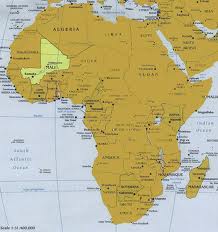
So with a day off we decided to let our hair down and join a group of our teaching colleagues on an overnight outing to southern Mali, about 50 kilometers from Bamako. It was close to here that the Empire of Mali was born in the 13th century. Among the hilly woodlands there are about 20 villages with some dating back to the Middle Ages, which make my former “historic district” neighborhood from the 1920s seem like chopped liver. It’s also home to the beautiful Arch of Kamadjan, a massive natural stone arch at the top of a stony hill.

The Arch of Kamadjan, seen from far, far away

Legend has it that a king cut the arch into the hill using his sword. I am sure Paul Bunyan and Ironman also assisted as this baby is massive. I was sure it would collapse on the day we decided to picnic underneath it, but I’m still here typing so you know that didn’t happen.

I purposely avoided asking a lot of details about this trip since many of my colleagues are very active, sporty types who opt for really adventury-ish type things that we tend to, um how do I say this, not do ever. Seriously, we thought we were pretty wild last week staying up to 10PM on a school night watching two Mike & Molly repeats on a Saudi Arabian channel. I did think I overheard someone mention that we were staying in “huts,” or maybe, I reasoned, we were going to be eating at a Pizza HUT. Sure, that was it.

We decided to drive our newly acquired Honda CR-V that our Malian mechanic Bill (that name can’t be real) just finished working on, fixing the AC (woo hoo!), replacing filters and fluids and whatever, and best of all throwing in matching sporty black and red (with flame motif) seat covers, steering wheel cover, and seat belt shoulder pads. If we were teenage boys in the U.S. in 1985 we would be SO popular right about now. Bill even Armor All’d the dash, so we felt ready to conquer the world.

Mooooove you darn cows!

We set out in a caravan of 3 vehicles at 10AM Friday morning, with a quick stop at the travel agency to pay for our tickets to Ghana for fall break next month. We appeared to be the only non-black people on the streets of this city of 2 million people so we were a bit of a spectacle. Since Jamey and I haven’t left Bamako since we arrived 44 days ago it was quite interesting to see how different it looked outside of the city proper. There were 4-lane highways with a concrete median, almost like we would see back home. Well except there was an occasional random donkey or long-horned steer standing on the concrete median in the middle of all that speeding traffic. And guys walking into the highway with what I thought were plastic tennis rackets except they were electrified devices for zapping flies (note to self: buy one of these for our roof deck ASAP). And there really aren’t “lanes” of traffic per se. While there are painted lines in the center these are ignored and sometimes there is just one big lane and sometimes they create 3 or 4 lanes when the motos squeeze in there (BTW, our group discussed what we saw the moto drivers carrying and this included: a stack of 10 chairs, two pelicans—which I might add are not birds that live within 1000 miles of Bamako, and a stack of tires with the driver playing the peg of a ring toss game).

No Photo Shop involved!

Our waterfall destination

As we got further out of town the road became just 2 lanes (or so) and the landscape opened up to reveal magnificently green fields punctuated by massive orange and grey rock hills that look like they just popped up randomly out of the ground. Jamey offered a scientific explanation but I was distracted by something shiny in the distance and I can’t remember what he said. These hills don’t gently rise. They abruptly jut from the ground and their faces show crazy patterns and shapes. As we got close to our overnight accommodations we saw a waterfall cascading over the top of one of these outcroppings and were told we would be swimming under this, just like Brooke Shields and Christopher Atkins in Blue Lagoon!

We drove off of the main road onto a rutted clay “road” not unlike the one we live on in Bamako. But this was lined with mud brick buildings (surely not like the “huts” we would be staying in, I was thinking) and lots of rural villagers who stared at us and smiled and waved when we waved.
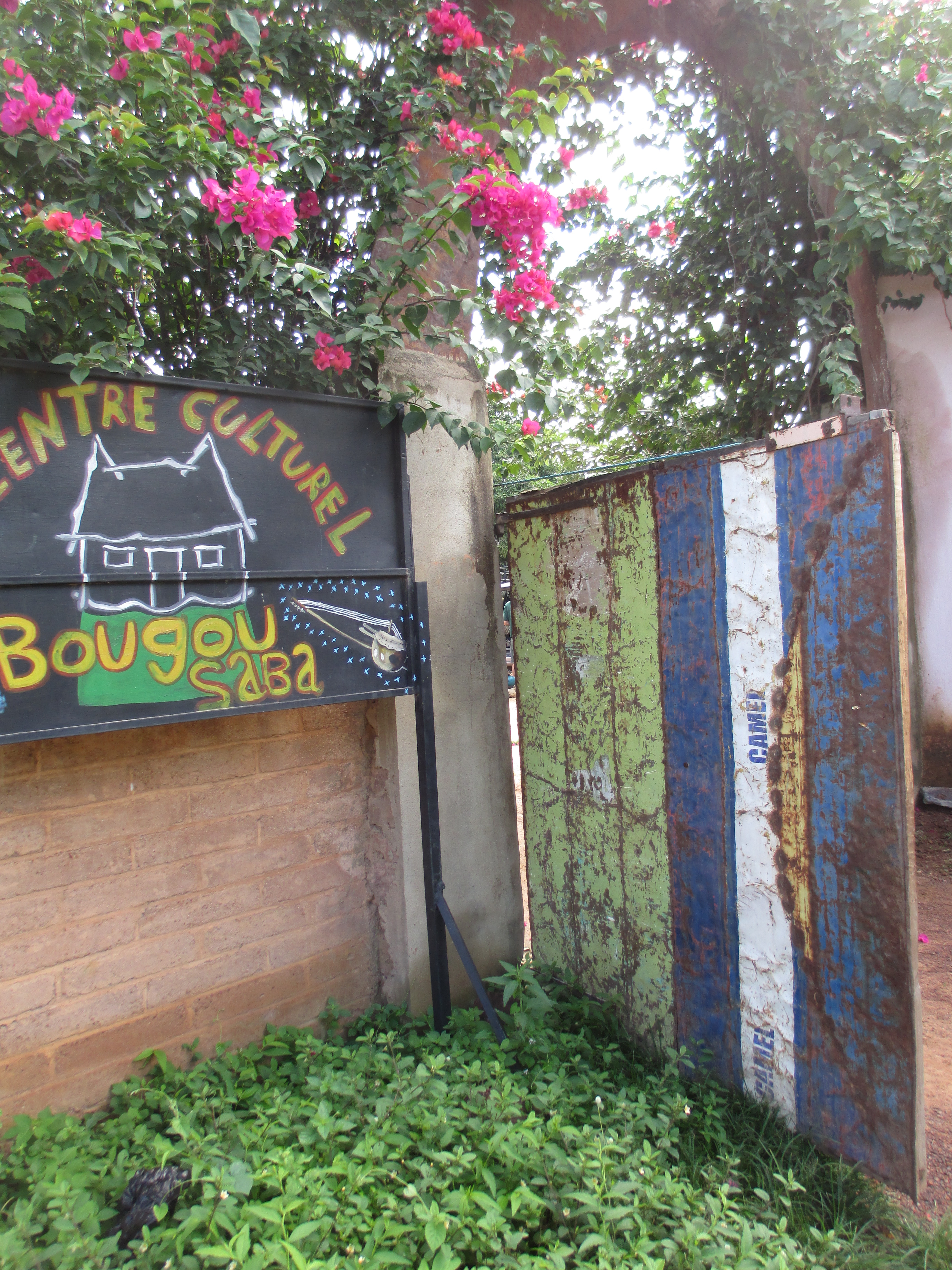
Huts-Are-Us

A half mile down the road, through a field with donkeys grazing, was the entrance to our encampment, Centre Culturel Bougu Saba, which I believe means “huts without running water.” The French owner threw open the metal gates which were framed by fuchsia bougainvillea, and we all drove in. It was actually beautiful—rustic, but picturesque. There were indeed a series of mud brick huts with thatched roofs and doors painted with African figures. But they were charming. Inside each were two beds canopies of mosquito netting, mosaic tile floors, and an overhead fan. The rest of the compound included a little bar and covered eating area, a large open-air multipurpose area with huge peaked thatched roof and carved wood pillars, and a bathroom area with composting toilets (you can Google it).

It also included privately walled but open air showers that curiously did not include a shower head . This is because you ladle water from a big blue 55-gallon drum into a bucket, carry the bucket into your mosaic-tiled shower area, and use a plastic mug to pour water over you as you shower. It sounds labor intensive but I have to say it was a delightful experience doing this at 6AM this morning as the sun rose and the birds serenaded me with some crazy birdcalls. The water and the air were refreshing, even though I stressed a bit deciding if I had scooped enough water to condition my hair as well as shampoo it too (don’t worry, I had just enough water to do both).
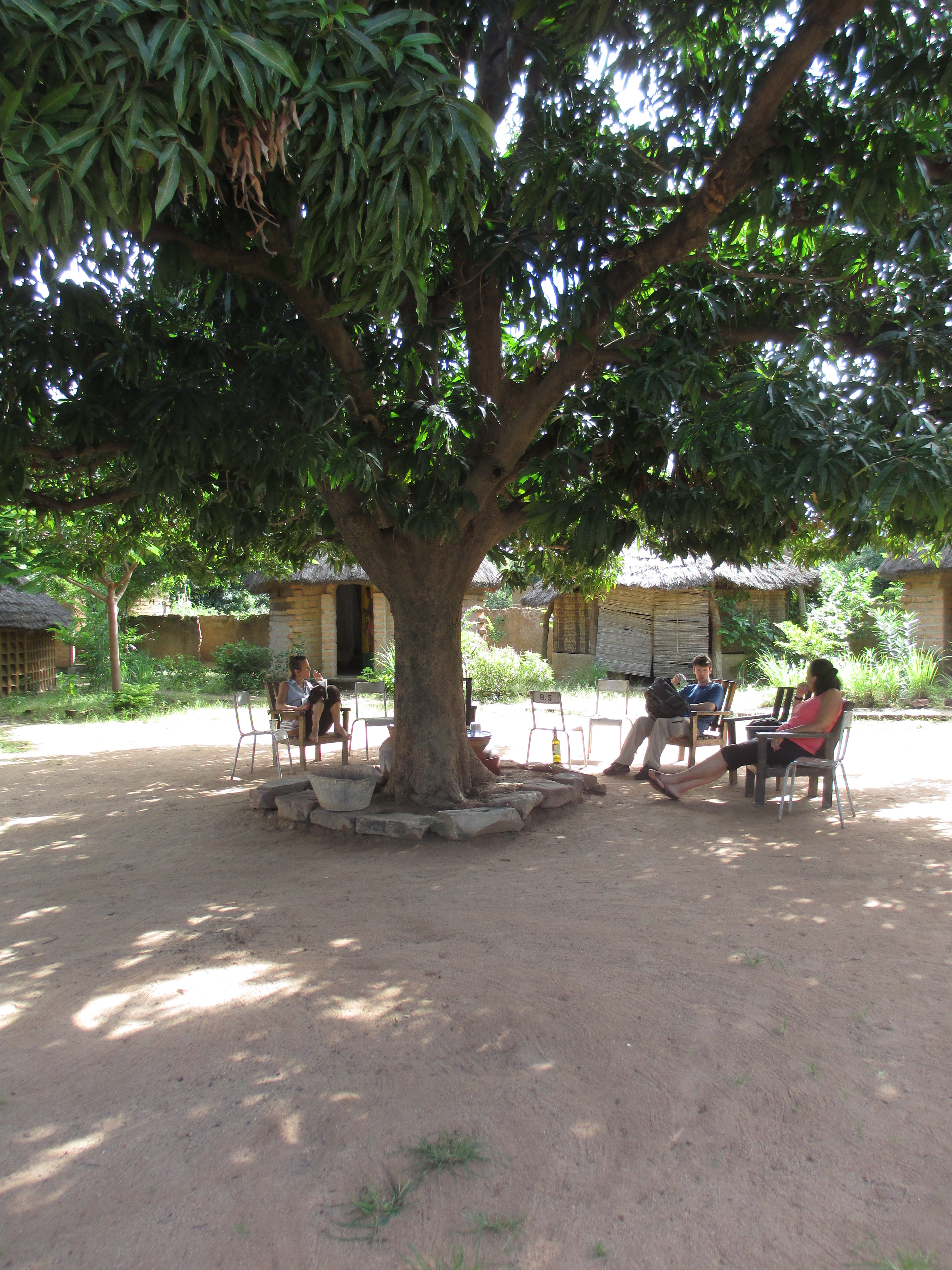
Under the spreading mango tree

We didn’t dawdle here at the compound very long as we had a full agenda for Friday, an agenda neither Jamey or I even knew the details of, and this as I explained earlier was on purpose. Our first inkling that this was going to be an adventury type day was when they told us to not bring our vehicle as it doesn’t have 4-wheel drive. So we jumped into the other manlier vehicles and took off to the arch for a picnic lunch. Unlike the St. Louis arch, this stone arch is not close to convenient parking nor does it have an elevator to get to the top. So we first rode up a clay pathway that were even more rutted than the road we live on in Bamako, if that’s even possible, where an occasional moto would appear coming at us around a sharp turn. We really looked like bobble head dolls in the car and I am very thankful I didn’t have to pee during this ride.

Just a little picnic lunch on a cliff

About halfway up our colleague driver stopped and said there was a trail at this point and we could continue riding in the air-conditioned SUV or we could walk the rest of the way. That’s like asking me if I’d rather have a Coke or a cup of glass shards dipped in rat poison. Two occupants opted for the walk and I’ll give you a hint that they weren’t from Florida. Once we reached the final stop for the vehicles I couldn’t see any stone arch cut by a magical sword. That’s because we needed to HIKE to it, and that’s a word that Jamey and I shy away from. because when we went on a little HIKE in Thailand it actually ended up being 6 hours through 100 degree, mosquito-infested, muddy jungle on steep slippery trails, and then we ended up in a remote village sleeping in a hut where I smelled campfire smoke all night (see last blog post about my aversion to campfire smoke, and no I wasn’t a Boy Scout obviously).

Under the arch (which did not fall on us)

This was no 6-hour Thailand hike thankfully, just a 10 minute climb up a rocky path. And plus one of our colleagues was on the trail with her baby in a backpack thing, so I figured if she can do it my lazy old self surely could too. When we got to the top it was certainly worth the expense of energy; the sweeping view was magnificent. We could see the flat plains which are lime green during this rainy season time of the year, dotted with lollipop shaped trees in a darker green. Then we could see the rocky hills jutting out of the ground in various spots, along with tiny villages here and there. We were in the shade on a flat rock ledge immediately below the stone arch, and it was here that we have our picnic lunch! Peanut butter and jelly on freshly baked baguettes never tasted better. We even had Pringles (hello 1985 again), some almonds (I figured that was a healthy-looking option to counteract the Pringles), chocolate chip cookies, bananas, apples, and Evian water. The others seemed to stand precariously close to the edge while chatting with each. Jamey and I hugged the rock wall as tightly as possible as we ate.
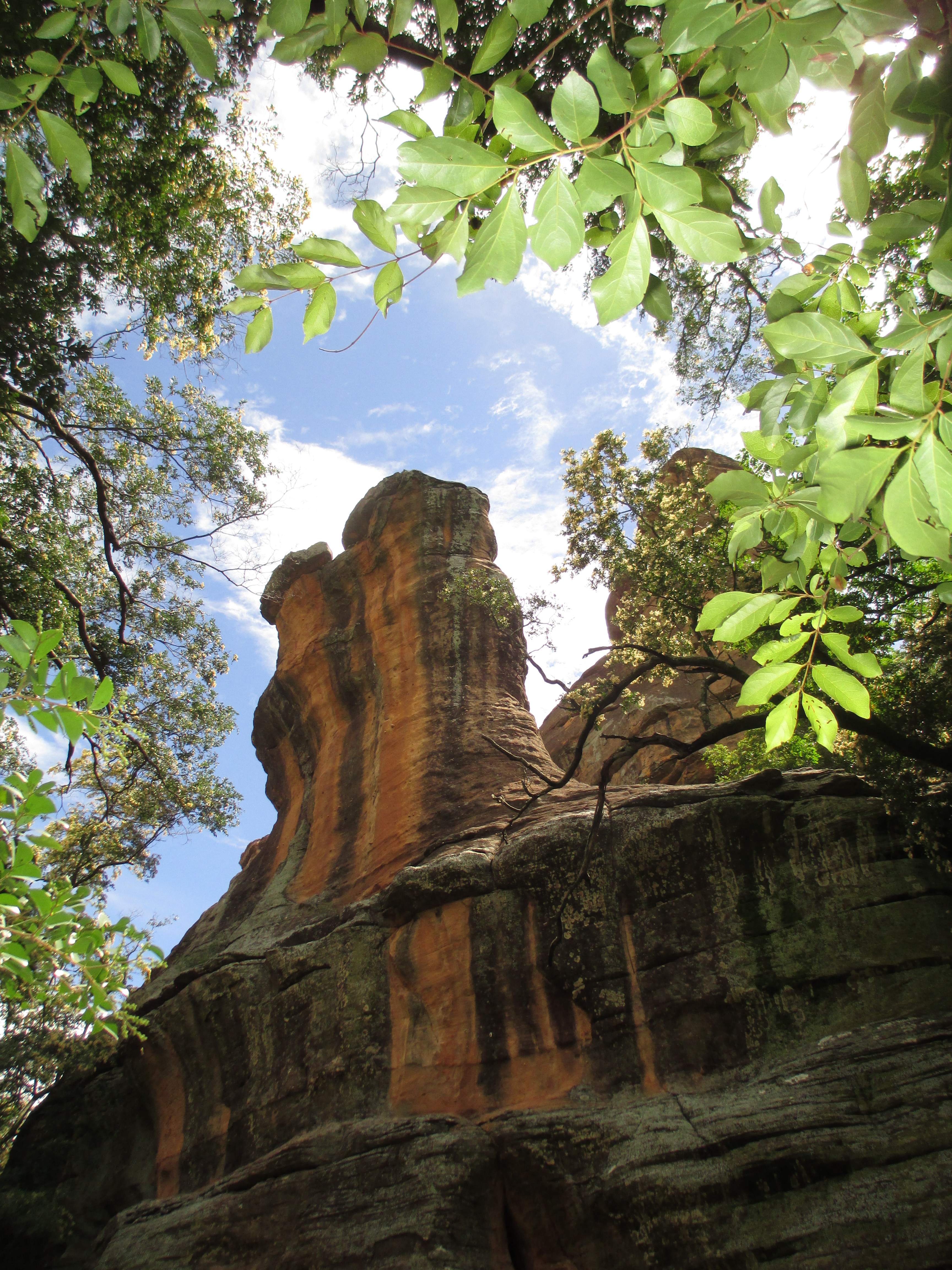
Crazy rock outcroppings caused by erosion

While we ate I noticed a group of boys gathered a few meters away (I’m trying to get into the whole metric thing they use here, so bear with me). They basically were watching us like we were putting on a play. Our colleagues who had been here before said this always happens, and that if you are a rural villager watching our antics is like watching a sitcom. They stayed with us throughout the day, along with their strong scent of body odor.

After lunch we had some options: rock climbing, hiking, or watching the rock climbers. Obviously the last option sounded attractive to us, but a colleague said it was just a short romp on an easy trail to get to the TOP of the arch where the view was even MORE impressive. We thought that sounded good and followed them to the “easy trail” that didn’t seem to be a trail at all, but areas of 4-foot tall grasses that surely were hiding various species of poisonous African snakes and such. But we kept moving on. Then it was up a mini-cliff of sharp rocks that didn’t seem to be secure, and up another little cliff that required us to wedge our shoe into tiny notches on a branch to propel ourselves upward. Then it was through a crevice in the rocks that I swear if I had eaten one more Pringles I would not have fit. After some more twists and turns that I didn’t pay too much attention to (more on that later) we came to a steep rock wall face that we shimmied up.
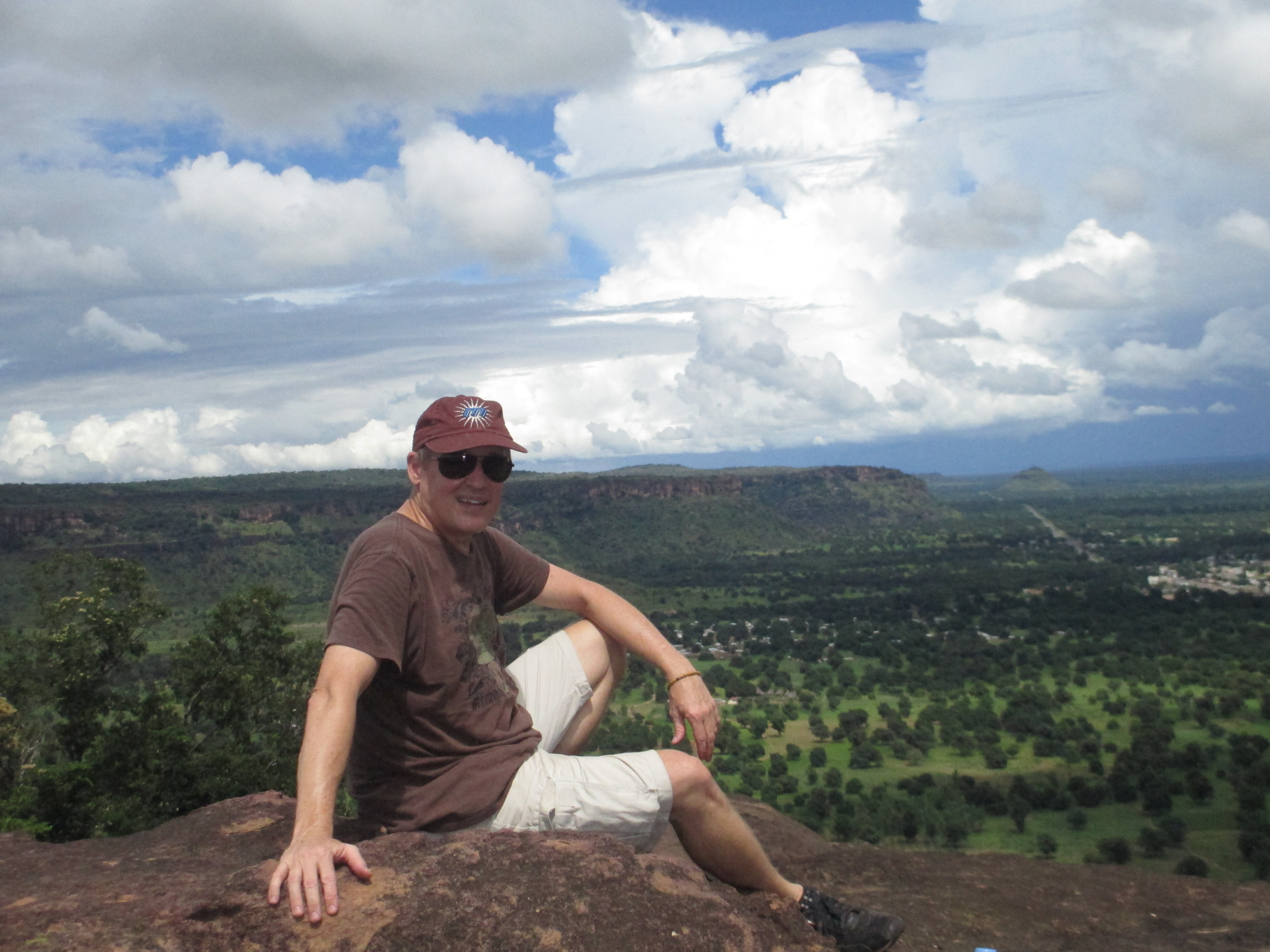
View from the top

After picking the grass and seeds from my teeth and hair I did take note of the stupendous view in all directions and was thankful we had risked our lives getting here because at least the photos would be awesome. Then our colleague says, “Now we just cross over this little bridge and climb that,” as she pointed to another steep rock face that seemed to go to the moon. The “bridge” was 6 tree branches laying
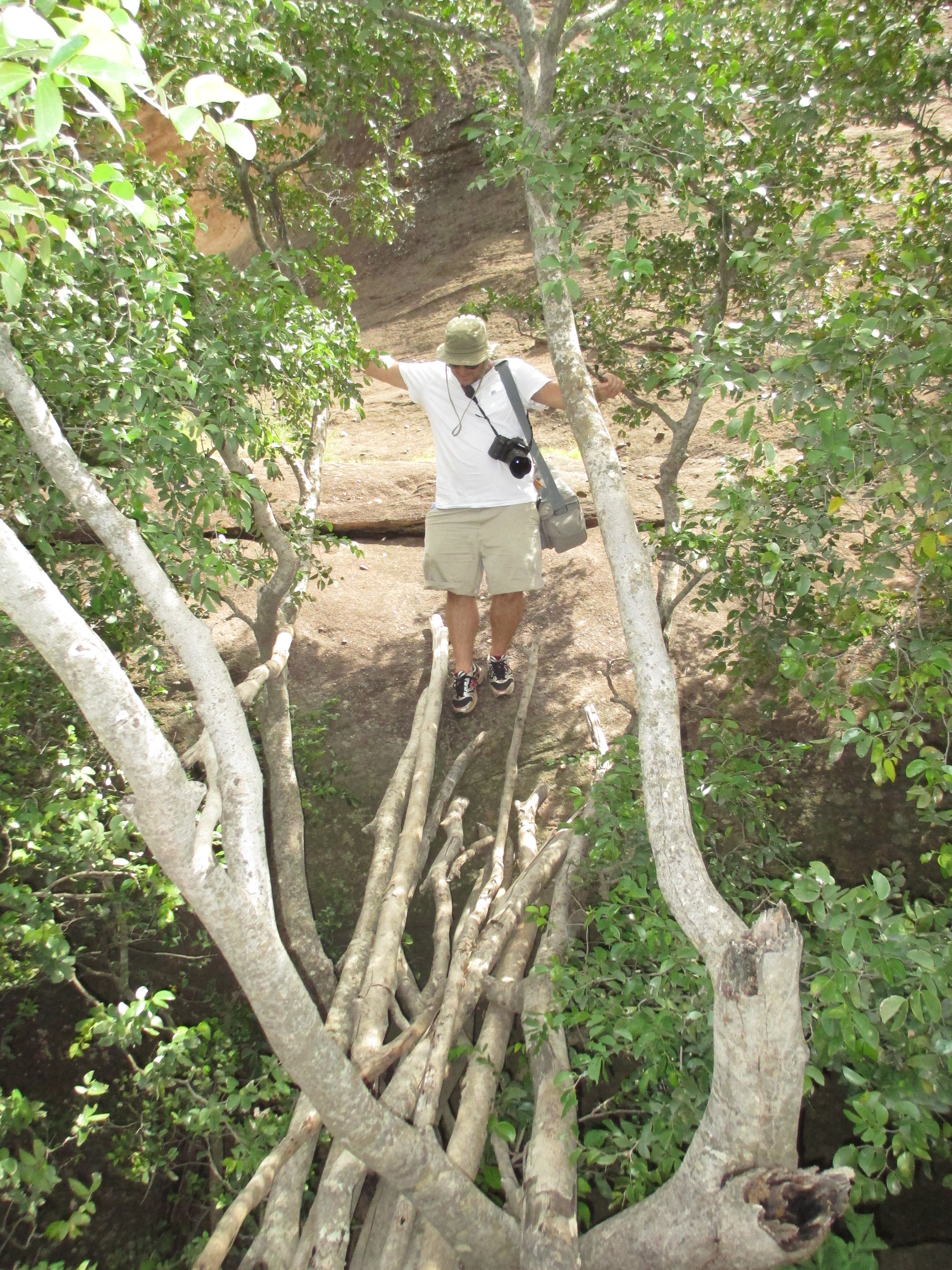
The “bridge”

across a crevasse. No handrails or safety net. But we crossed, and were relieved to see that we actually would not have plunged hundred of feet if we fell, just dozens of feet, maybe breaking an ankle rather than our whole spine. At this point I thought our colleagues were wondering if we were total losers, so I shimmied right up that next wall face ahead of them. Then I remembered how my travel pal Ilean and I had shimmied up a giant rock outcropping on the beach in Brazil, only to find ourselves unable to get down until a group of surfers rescued us. And there were no Brazilian surfers up here.

So sweat beaded up on my face, and our colleagues decided they weren’t going any higher since they had done this many times. They said, “You know the way back, right?” and of course I said yes and smiled and then threw up a little in my mouth as they bounded over the tree branches back to camp. When they were out of earshot I yelled for Jamey who was taking photos from a lower level. I told him I was stranded and he suggested I scoot down on my butt, ever so slowly. Now I don’t want to be dramatic but had I taken a little tumble I would have rolled off a really tall cliff and my death would have been the stuff of legends. But scoot scoot scoot I did, leaving a little skin and cotton material along the rock face as I made my way back down. I was shaking a bit, and I could hear my heartbeat in my ears, but I was alive. And of course you guessed already that we got a little lost going back but eventually we made it back acting like this had been a hike up an easy trail, just like they told us.

Jamey makes like Spiderman and scales a wall, except without using the web-stuff that squirts out of his wrists.

So how do we follow up this act of bravery? By rock climbing of course! Jamey started it by agreeing to scale a vertical rock wall, and doing so with relative ease. The climbers were all clapping and saying how manly and adventurous he was. Well damned if I was going to be the big weenie sitting on a rock filing my nails! So I also harnessed up, put on the tightest-fitting climbing shoes, and made my way up the same wall. Yes I scuffed my knee and knocked my head on an outcropping, and maybe almost peed myself a little at the top when you have to lean backwards and trust that the rope doesn’t break and the person holding the rope doesn’t trip or sneeze, and you zip downward toward the ground. But we both have to admit that it was a pure adrenalin rush and we totally see why people do this. Jamey wants to do more, and maybe even I do too.

Finally we headed to the waterfall, which also required a perilous walk up and down slippery trails full of sharp stones jutting upwards. Again the colleague with the baby on

Jamey (red trunks) and me (orange trunks) get pummeled by the falls.

back was ahead of us so we endured the hike. And goodness was the payoff worth it. The water fell from hundreds of feet above. There wasn’t an idyllic little pool of water below like in Blue Lagoon where we could swim naked like Brook S. and Christopher A., but rather sharp rocks covered in slippery moss. But even that anger didn’t stop us from maneuvering to those cascades of water where we let it slam down onto us, chilly but refreshing.

We ended the evening all gathered around a big table in the courtyard of a local restaurant that looked exactly like something I saw in Disney’s Animal Kingdom except real.

Dinner at an outdoor restaurant in Siby, illuminated by a single bulb powered from the battery of a parked motorcycle. Not flattering for the complexion.

We ate delicious couscous, chicken, and a great sauce and talked for hours. Back at the compound we sat in chairs under a big mango tree and sang songs as a colleague played the guitar. Sleeping was okay at first since the fan kept us cool. But the electricity stops at midnight in the village so I awoke to a hut with air so close and still I was thinking I had been laid to rest in a tomb. Not much sleep, but the mug shower the next morning woke me up.

The next day, on the drive back home we stopped at a village hut where they were baking bread, a bread different from what we get in Bamako.

Bread going in the oven…

It’s denser and even more delicious, not that I thought that was possible. We bought 5 baguettes for 500 CFAs (1 dollar!) and immediately started chewing on one like a dog with a rawhide.

…and the bread out of the oven and ready to go into our mouths.

Next we visited a place where women were making shea butter from the nuts, and where I performed a little magic trip for a group of little boys outside. (I’m pretty sure they think I am the king of the village now). Finally we spent an hour walking through their Saturday market where they sell fruits, vegetables, machetes, grappling hooks, live fish in a bucket, cloth, pans, delicious fried

Saturday market in Siby, much more exciting than the U.S. mall and a tastier food court.

dough and potatoes, baskets, and where Jamey and I bought boubous, the traditional robe/pants set that we will sport on Africa Day at school. Pictures to follow.

I do some street magic for the kids, and they think I’m a sorcerer.

Rock climbing, hiking across crevasses, mug showers, huts…have aliens taken over our bodies? I did spend a fair amount of time buffing my nails once we got home as all of that adventure took its toll, so I haven’t gone completely to the dark side yet. But there’s always next week….

Chapter 10: Kids…Watch Out for the Boiling Water and Caustic Chemicals

On Thursday I took my class on the first field trip of the school year. We visited a women’s cooperative where they create bazin, a hand-dyed polished cotton unique to Mali and known worldwide (well, except I had not actually heard of it, but I don’t get out much).

Rocking a bazin on the runway in Mali

Bazin is the mainstay of Malian fashion, used to make the boubous, which in my opinion is the best name ever for a robe and could provide much fodder for a sitcom:

Man: Those are some extremely nice boubous, ladies! And they hang so nicely on you.

Girls: (Recoiling in horror) What?! How rude!

Man: I meant your traditional Malian robes made of bazin, silly.  (CUE LAUGH TRACK).

Anyway, this fabric is absolutely stunning and I was dying (pun alert) to see how it was made as I heard the process was fascinating and backbreaking. My American Embassy contact who is the Community Liaison Officer–or CLO (pronounced “cloh” for those of us in the know) hooked us up with a local woman who owns a facility just across town. This resourceful gal started a small bazin operation a few years ago with just a few workers and now has more than 100 people working for her.

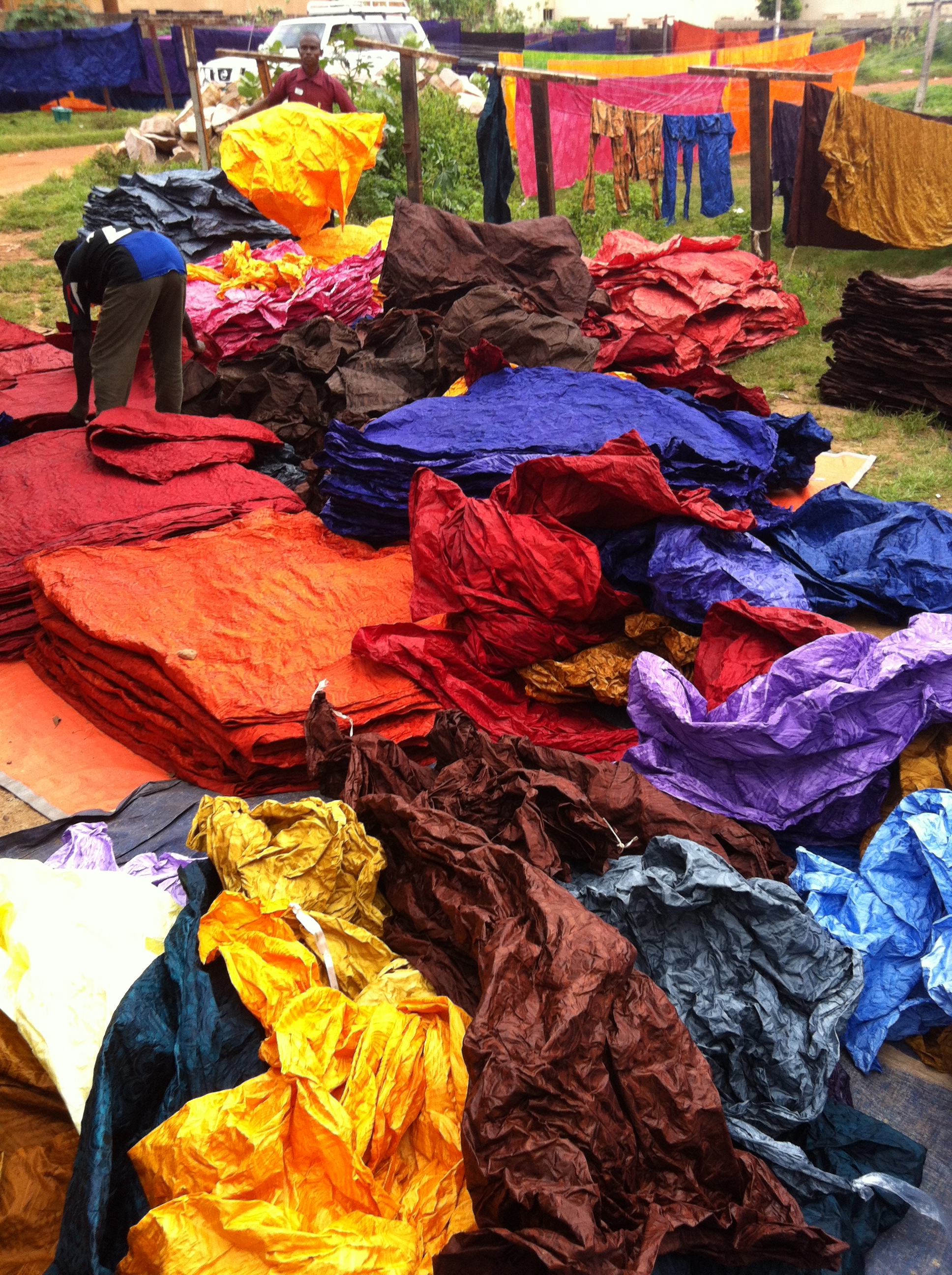
Fabric to dye for…

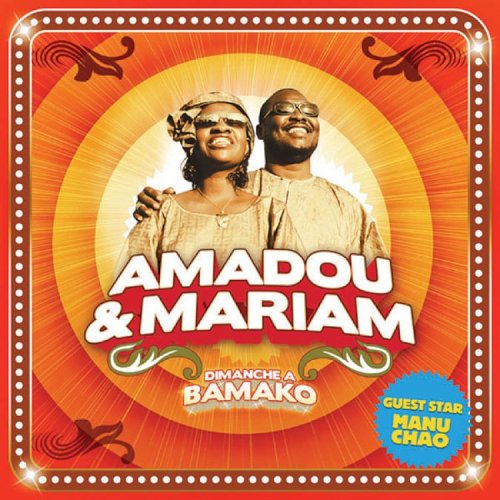
I knew I could work this in with some cultural lessons so we set a date, and thankfully my colleague who teaches grades 2/3 did a lot of the paperwork and organizing so I would just basically show up with my class. Before we went I found a couple of YouTube videos about the local bazin industry, and at this point I’m thinking there is a YouTube video on everything ever invented or mentioned since the dawn of time. My students were chomping at the bit after seeing these videos, especially knowing that this would be a participatory experience–although the details of that were a little fuzzy (more on that in a minute). I also found a great song in French by Malian singing duo Amadou & Miriam that talked about bazin. I used Google translate to put the lyrics in English so we could analyze them but the kids made more sense of them in French. I, of

where the action happens (owner in foreground)

course, nodded and moved my lips as if I was reading and comprehending the French too though I’m not sure they bought it. Then I gave them an assignment: On the field trip they should document their experience with photos, videos, and writing so that next week we can create a music video about bazin, using the Amadou & Miriam song as a background. We will incorporate their photos, video clips, and poetry they will write once we return. They were quite hip to this idea, as well as the fact that we would be out of school for a large chunk of the day (that thrill is a universal one). On the day of the trip we loaded up 26 second through fifth graders, 4 teachers, 6  parents (2 Belgians, 1 American, 1 Canadian, 1 Japanese, and the Malian Prime Minister’s wife) into two small buses.

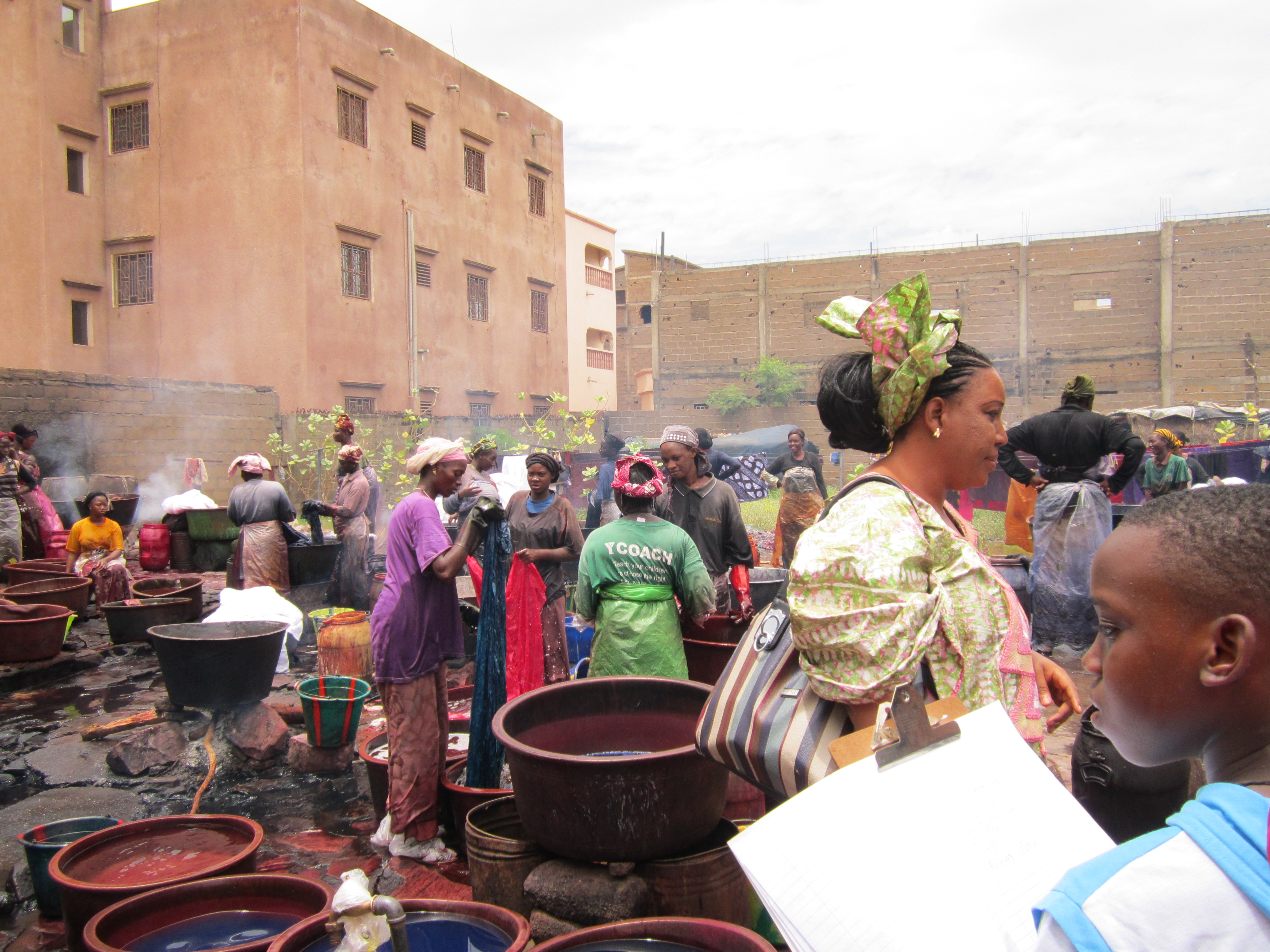
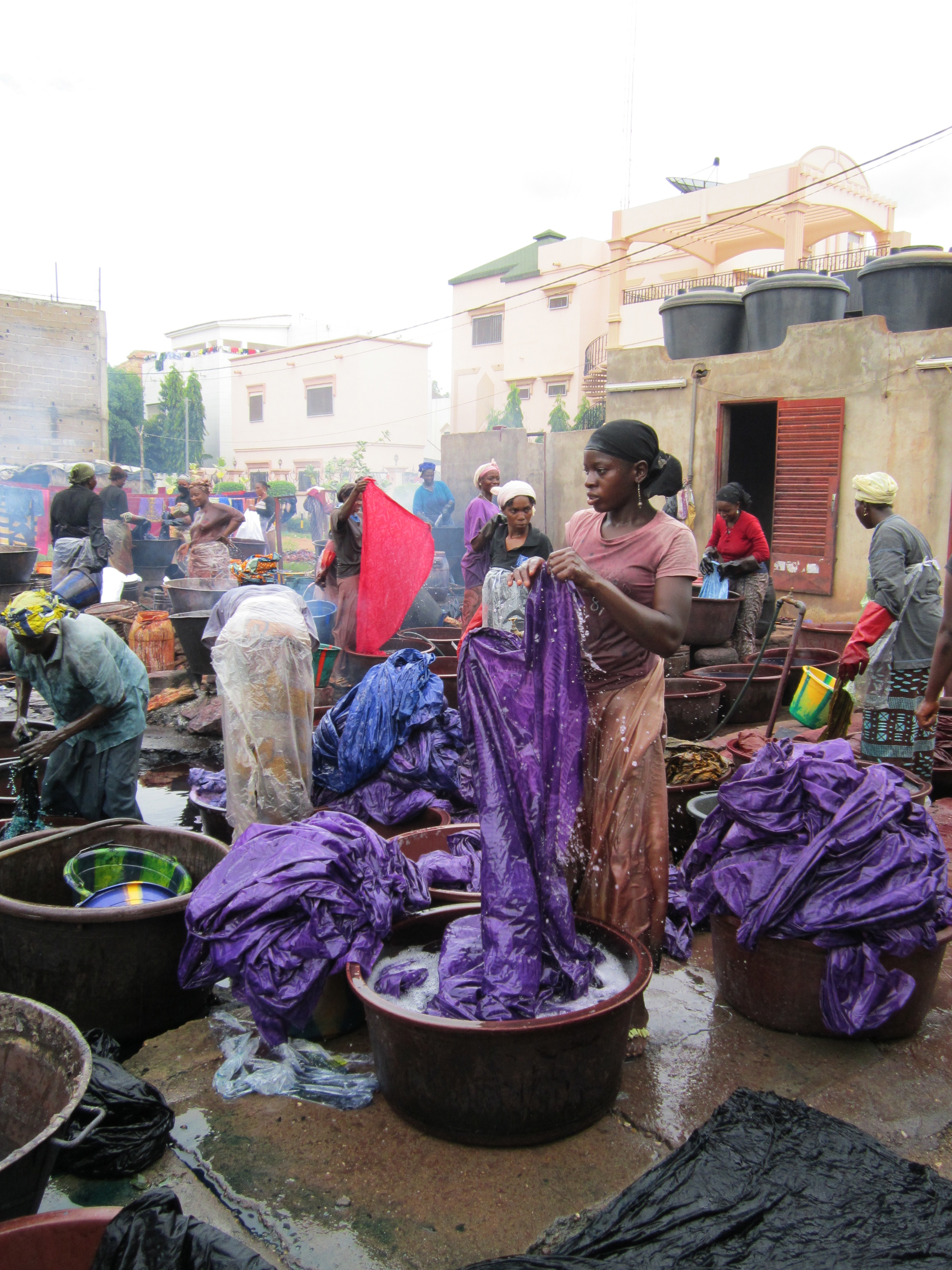
boiling water, sulphur fumes, campfire smoke, and lovely dyed fabric

Now in terms of prior field trip experience, I am a seasoned chaperone of jaunts to high quality art museums, fancy theatre venues, and turn of the century Palm Beach mansions. I’m used to dealing with fancy docents, exhibitions of Renaissance art, and Broadway touring companies. So keep these lovely images in mind as I describe our day at the bazin business. After a quick lunch on the grounds of the American Club, the buses dropped us off on a moderately busy, unpaved road. Which was the venue. Seriously. We stood in the road for a large part of the afternoon, dodging motos and taxis and SUVs and

freshly dyed and waiting for the drying line

the occasional donkey and making sure the students were not run over/trampled. The bazin facility was on both sides of the dirt road. On one side was a building with not many windows or interior lights and a really long hall that the kids disappeared into. I believe this was where the white cotton material was stored or folded or something, but I accidentally left my Ray-Bans on so I couldn’t see a thing.  Somewhere in there I did score a free ink pen with the company’s name on the side. I don’t think I stole it, but it’s a possibility. The exciting part of the visit (and by exciting I mean like when a hungry tiger escapes into a zoo packed with visitors) took place across the street. This was the open air dyeing

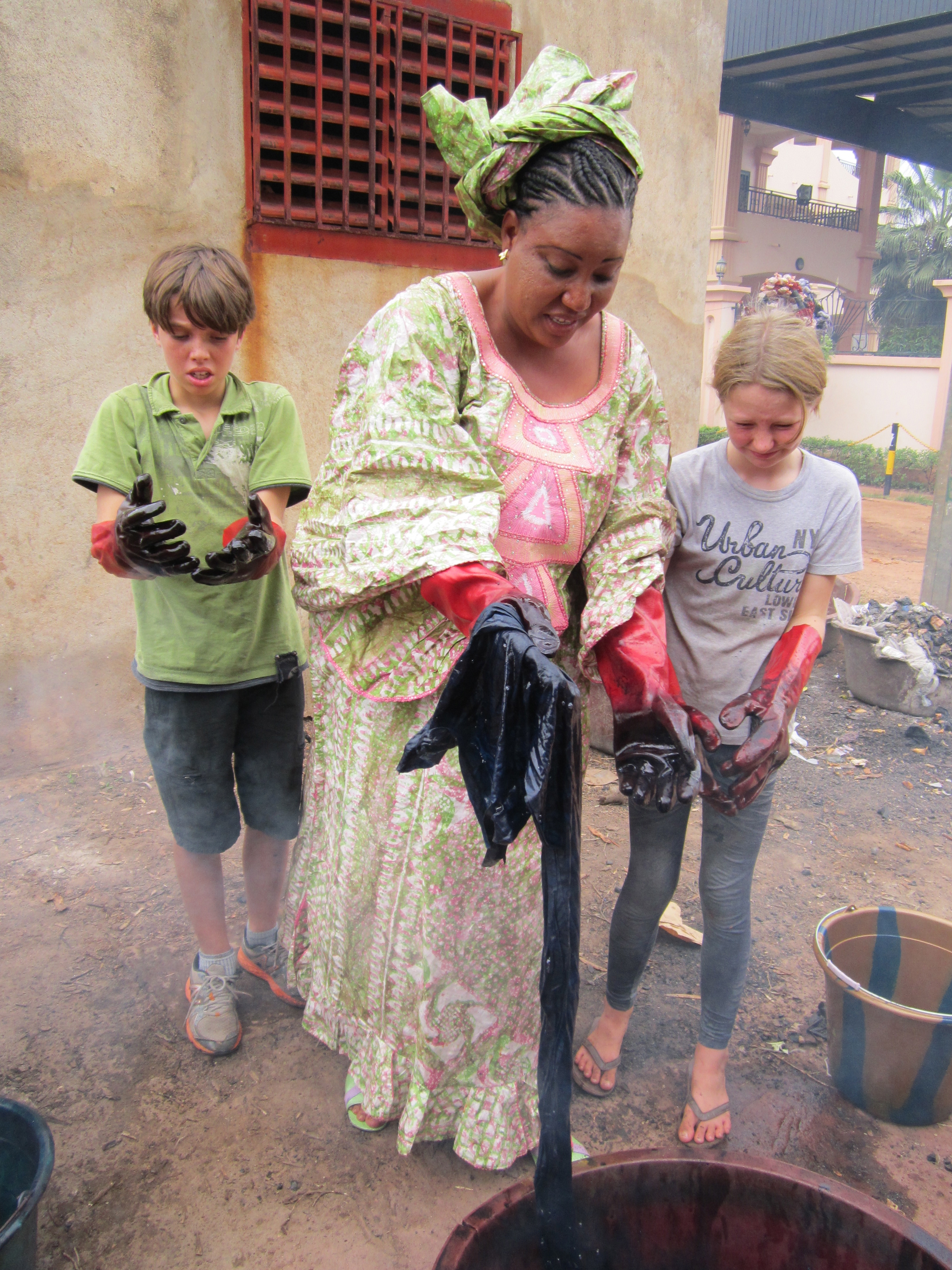
Mr. Fessler! My hands are melting! My eyes sting!

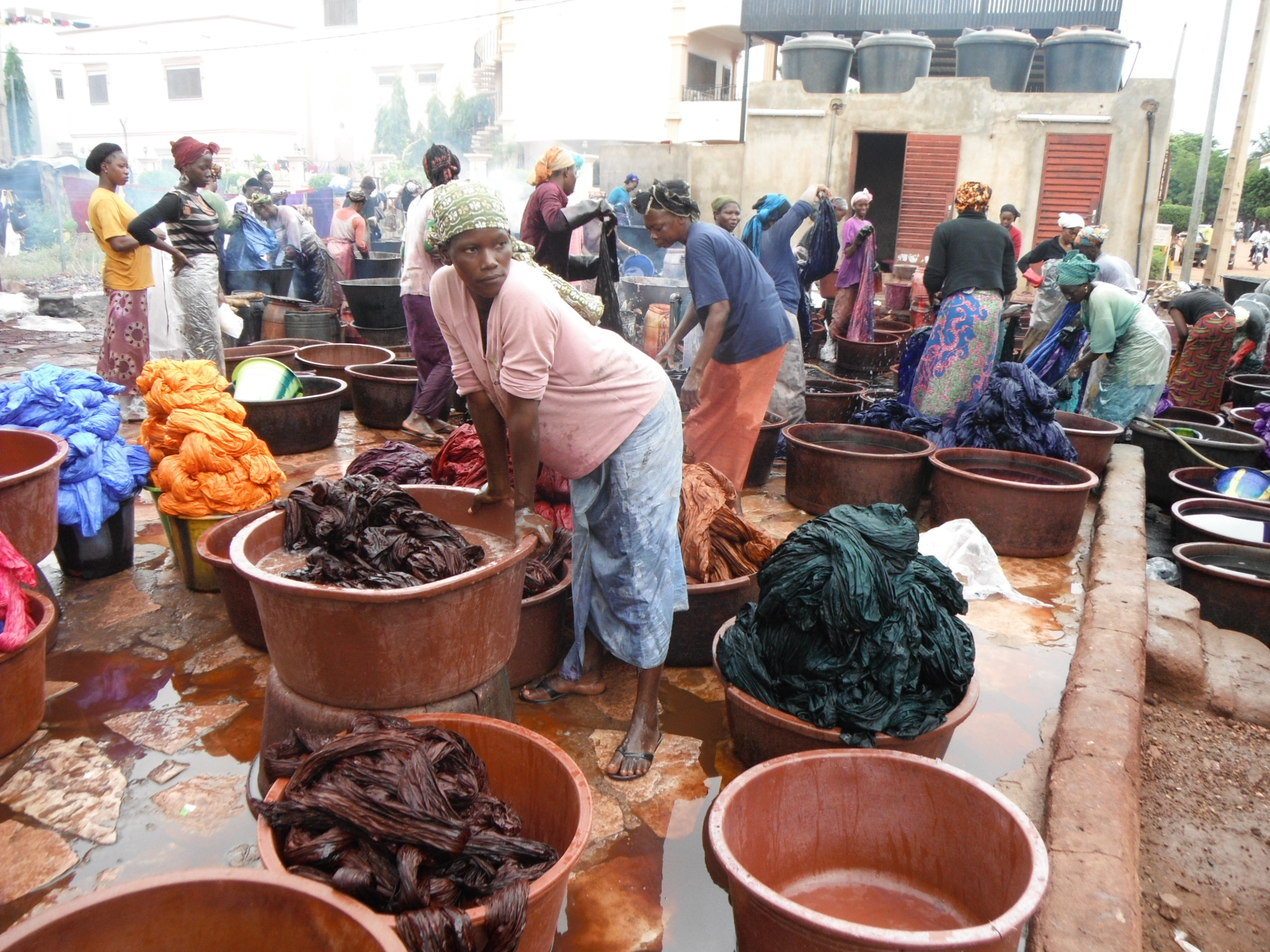
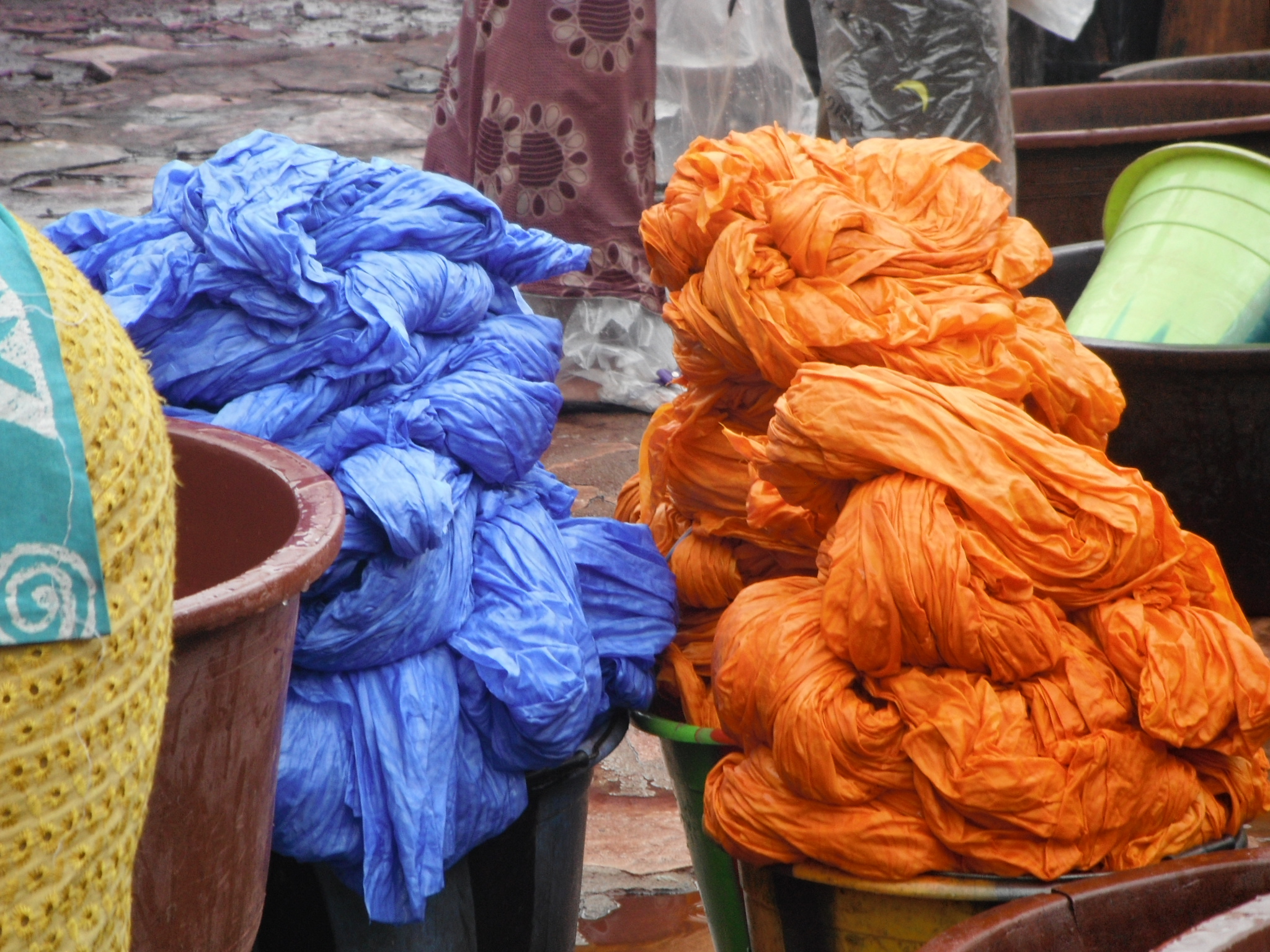
grounds filled with Malian women hunched over giant black cauldrons heated by smoky wood fires. The cauldrons were full of boiling water, a sulphur chemical that bonds the color to the fabric, and various rich hues of bubbling dye. Everywhere there were stacks of freshly dyed wet fabric, plastic packets of that sulphur-based white powder, and lots of muddy puddles in many different rainbow colors. It was a massive beehive of colorful activity. The women wore elbow length rubber gloves and were constantly dunking brilliant white cloth into the water, or lifting out the colored results, or wringing it out, or pouring dye from one pot into another, or dumping the remaining dye onto the ground where it went into, um, the groundwater. Aside from the fact that smoldering campfires on their own produce one of my least favorite odors, there was the added scent of sulphur. So it wasn’t exactly like a romp through a lavender field in Provence. And really, what better place for a group of 7 to 10 years old to play for the afternoon?

Each woman actually specializes in a single color.

The owner, a tall stately woman, was resplendent in a fancy boubou and head wrap. She began explaining this whole scene, albeit in French. One of our parents started to translate, saying, “So she says that this is like a training school as well as a bazin business.” Before he could finish his French-speaking son, one of my students, offered his own version of the translation. He piped in, “She takes in women who don’t know how to do anything AT ALL!” Kids say the darndest things. Despite the dangers of third degree burns and various respiratory illnesses, I still have to say this was an amazing site to see. The women folded the fabric into intricate shapes, triangles, squares, wiggly lines, and whatever. Then they dipped parts of the folded fabric into different dyes. It ends up in a color that looks like a cross between vomit and chili—until they dunk it in water and then it turns into a completely different brilliant shade. When it’s unfolded it has crazy, repetitive patterns that you can’t even begin to figure out.  The kids were dumbfounded (or maybe woozy from the fumes). One of my students said, “There is so much action here I don’t know what to write first!” I wondered, writer’s block or chemical-induced brain damage?

Clothes drying never looked so artful

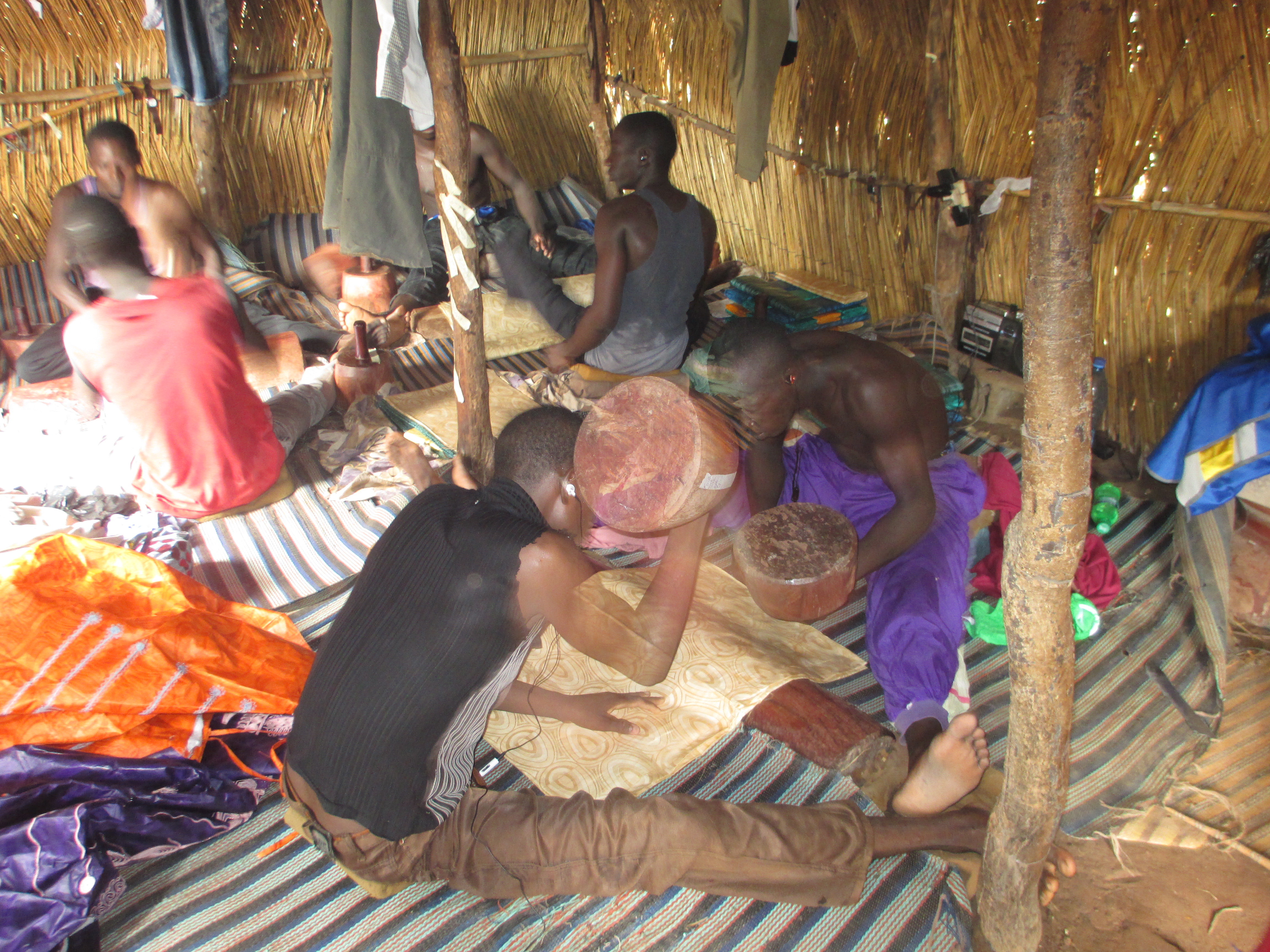
Next they hang the freshly dyed fabric on lines across the street to dry, which makes for quite the beautiful scene. After that they are stamped with some sort of resin and taken to two huts in the back of the property where a group of six guys place the fabric on a curved piece of wood, then pound the hell out of it with a mallet that looks like something Wile E. Coyote would try to hit the Roadrunner with. They slam those mallets down one after the other, never hitting each other (at least while we were there) but coming awfully close.

The pounding guys…it gave me a pounding headache

And oh yes, in case you’re wondering the kids were inches away from this action and also got to pound things with the mallets. But wait…there’s more! Each student received a piece of white fabric and a pair of gloves. Then they got to dunk their fabric into really hot dye-filled water. I held my breath this entire time, mostly because it smelled really bad but also because I was super nervous I would witness a scene from Final Destination 6. Thankfully there were no horror movie-like events, and we all made it back to the buses in one piece, skin intact (I did a head count of the kids twelve or thirteen times to make sure nobody had disappeared into a vat of orange dye).

Bubble, bubble, toil and trouble….

All kidding and caustic chemicals aside, this was an incredible experience that really showed the kids how self-empowered African women use their artistic talent to rise above poverty. In a country like Mali, one of the poorest in the world, this is a big deal. Of course my students were worried about the health concerns these women face, as well as the environmental impact of the dyeing business. I told them these are exactly the kinds of problems they will be solving when they are adults, balancing human and environmental needs, and they better do their darn homework so they are well-equipped to deal with these pressing issues (hello teachable moment!). Plus it’ a great way to pass the buck to the next generation.
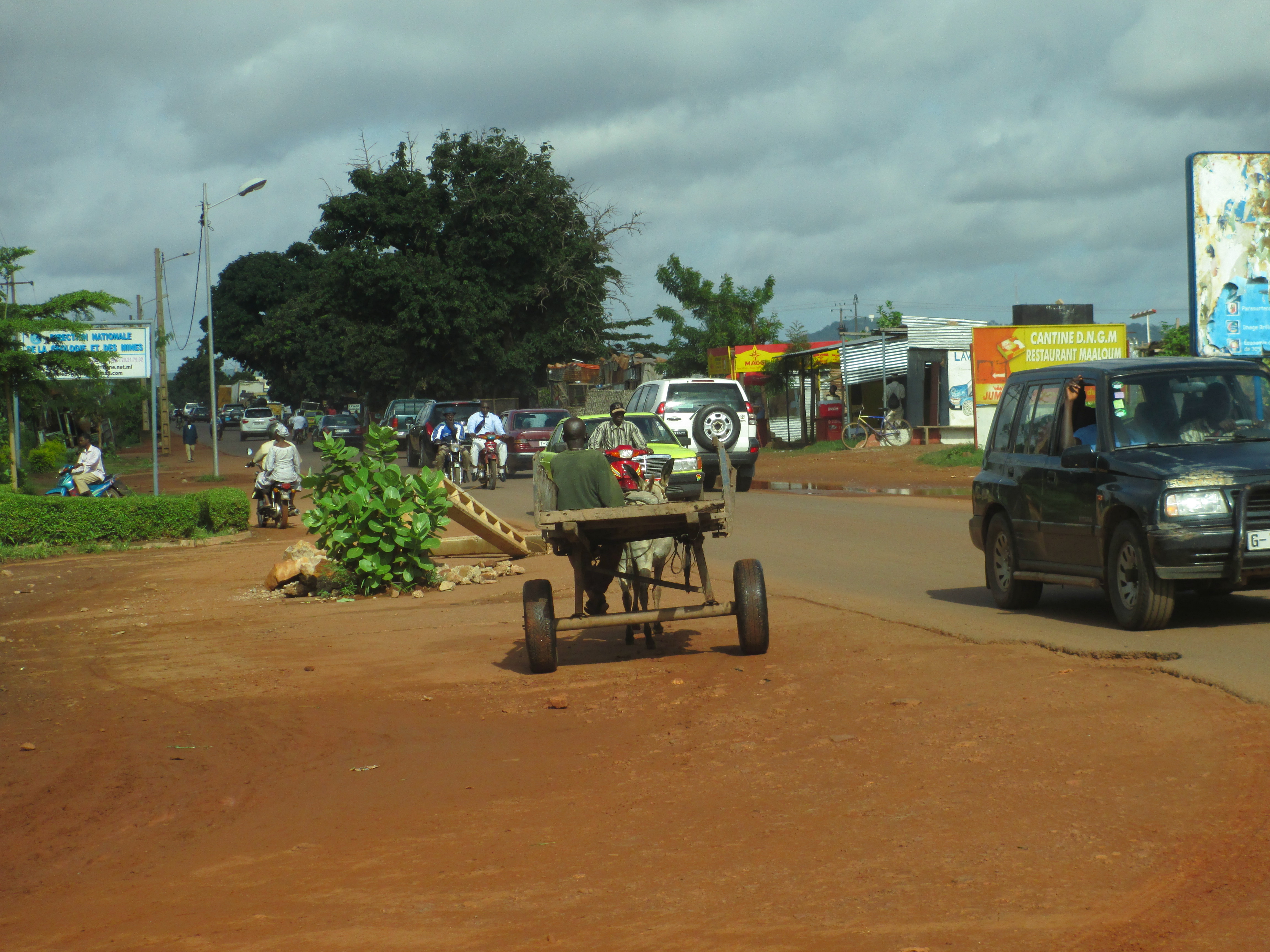
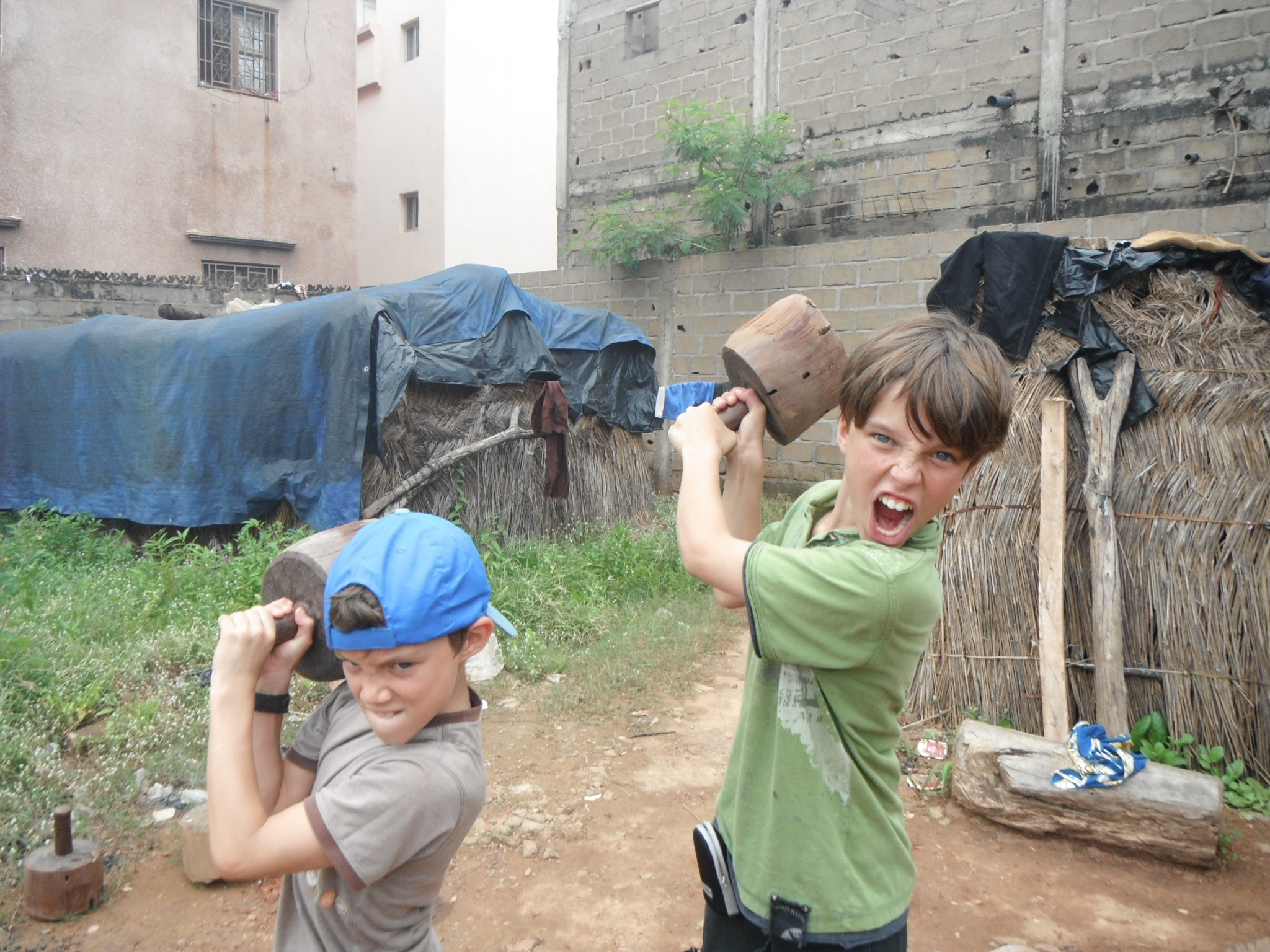
My student Milo and his brother Oscar use the pounders on something other than cloth

Today, a day later and the odd smells finally gone from our skin and hair, we are still marveling over everything we saw. The kids started writing their poems today and I have to say they didn’t miss a sight, sound, smell, or texture (I had reiterated that a sense of taste would NOT be part of this assignment). I’ll post a link to the finished music video when it’s complete—it should be quite the masterpiece. Obviously breathing in caustic chemicals did wonders for our creative abilities.

Chapter 9: Maid in Mali

Me and Fati, the best maid and cook in the whole wide world.

Last week we negotiated a salary and a list of responsibilities for Fati, our Malian maid. The school had paid her through August, and it was up to us if we would keep her for the remainder of our time here. So basically, did we want to clean our own toilet and slave over a hot stove and wash and iron our muddy clothes and mop the expansive white tile floors and grocery shop and scrub the shower and pack our own lunches and clean our muddy shoes and make our bed and feed the cats…or have a full time maid do it all for us for $1 an hour? After an agonizing 2 seconds of discussion we decided to welcome Fati into the family.

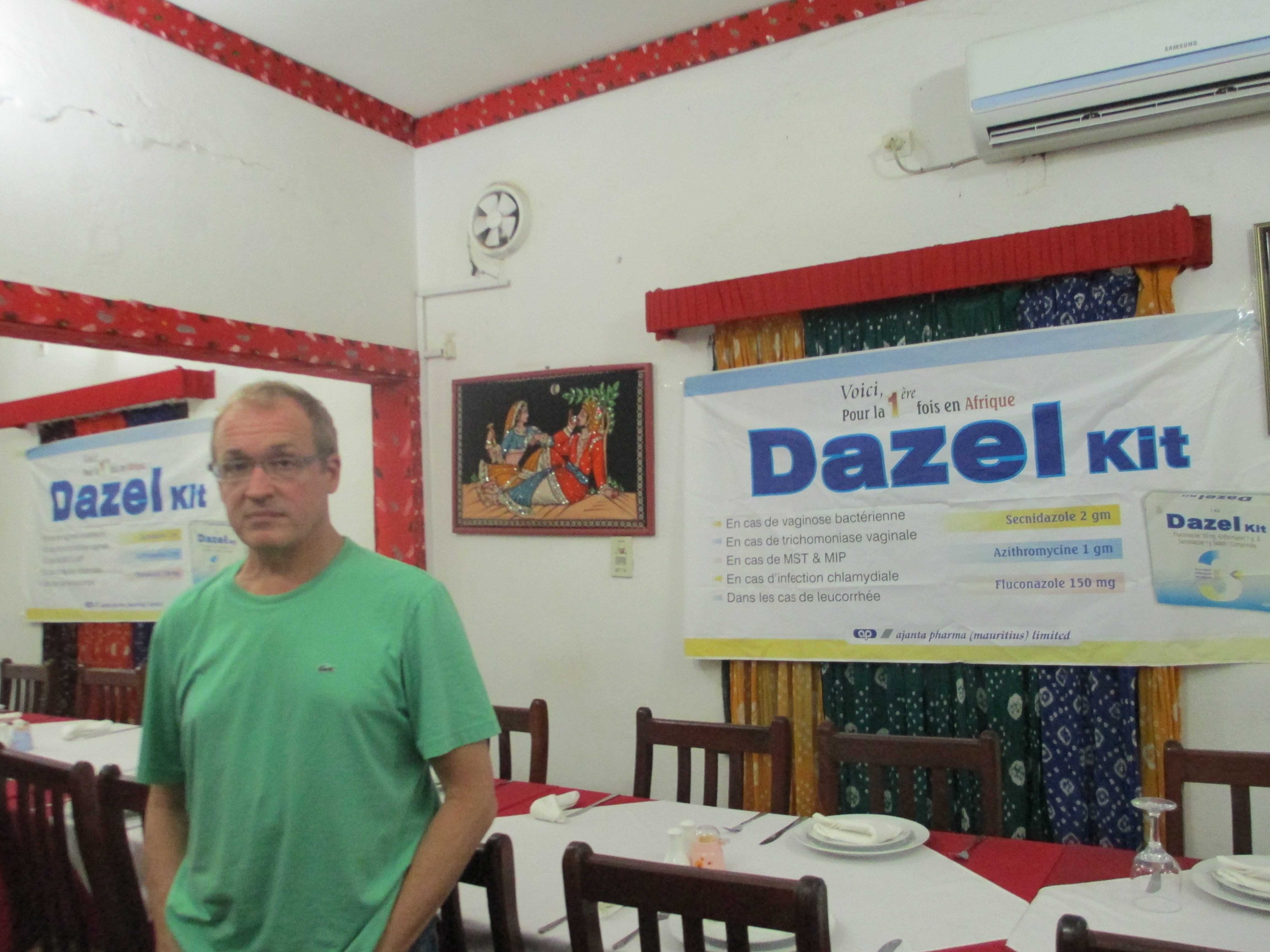
Here’s me in the Indian restaurant, posing in front of a sign advertising vaginal cream.

Fati doesn’t speak English and we can say about six French sentences so far–none of which are useful in negotiating a contract unless it involves “I am allergic to garlic,” “Where is the toilet?,” and “Want to watch me eat this entire baguette at one sitting?” The Malians in Bamako also speak a local dialect called Bambera, and Jamey and I are learning a few phrases a week from the school guards who have made it their mission to teach us. But we still can’t say enough. So our fluent-French-speaking colleague Robin kindly offered to help us out.

Now the Malians are extremely gracious and mannered, and under no circumstances

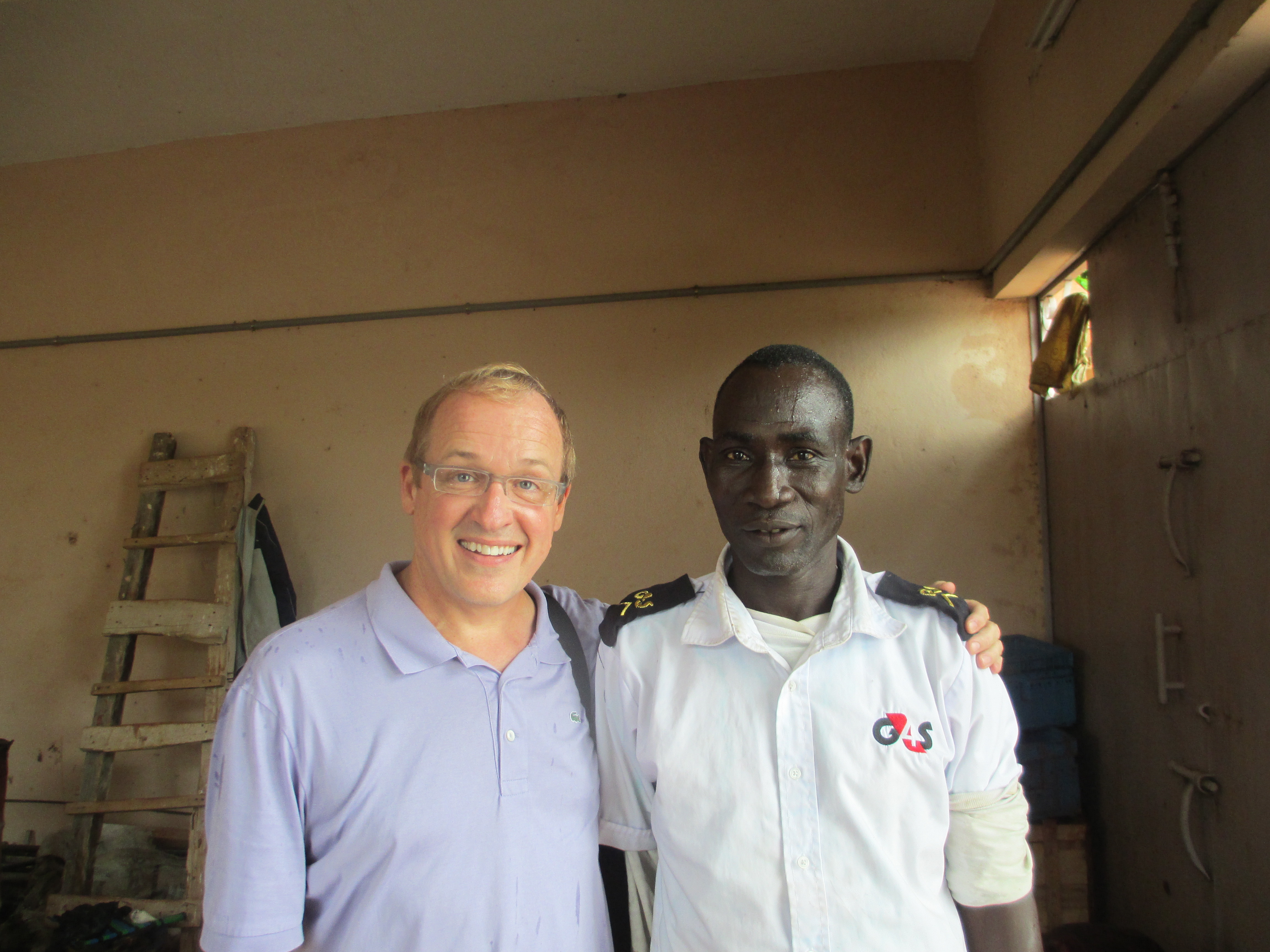
Me and Niambele, our day shift house guard.

would they ever express negative feelings toward you, even if they were offended by something you did. So it was hard to tell if Fati was happy with our salary offer (which was pretty much what she was paid by the last family, and they had a 3-year-old that she watched in addition to everything else she does for us). Plus we were also a little concerned that working for a male couple might freak her out a bit since Glee and Will & Grace aren’t exactly must-watch TV here in Bamako. But when Robin translated Fati’s comment, it was something about how nice we were and how happy she is to be working for us and how she looks forward to getting to know us better! These are my kind of people.

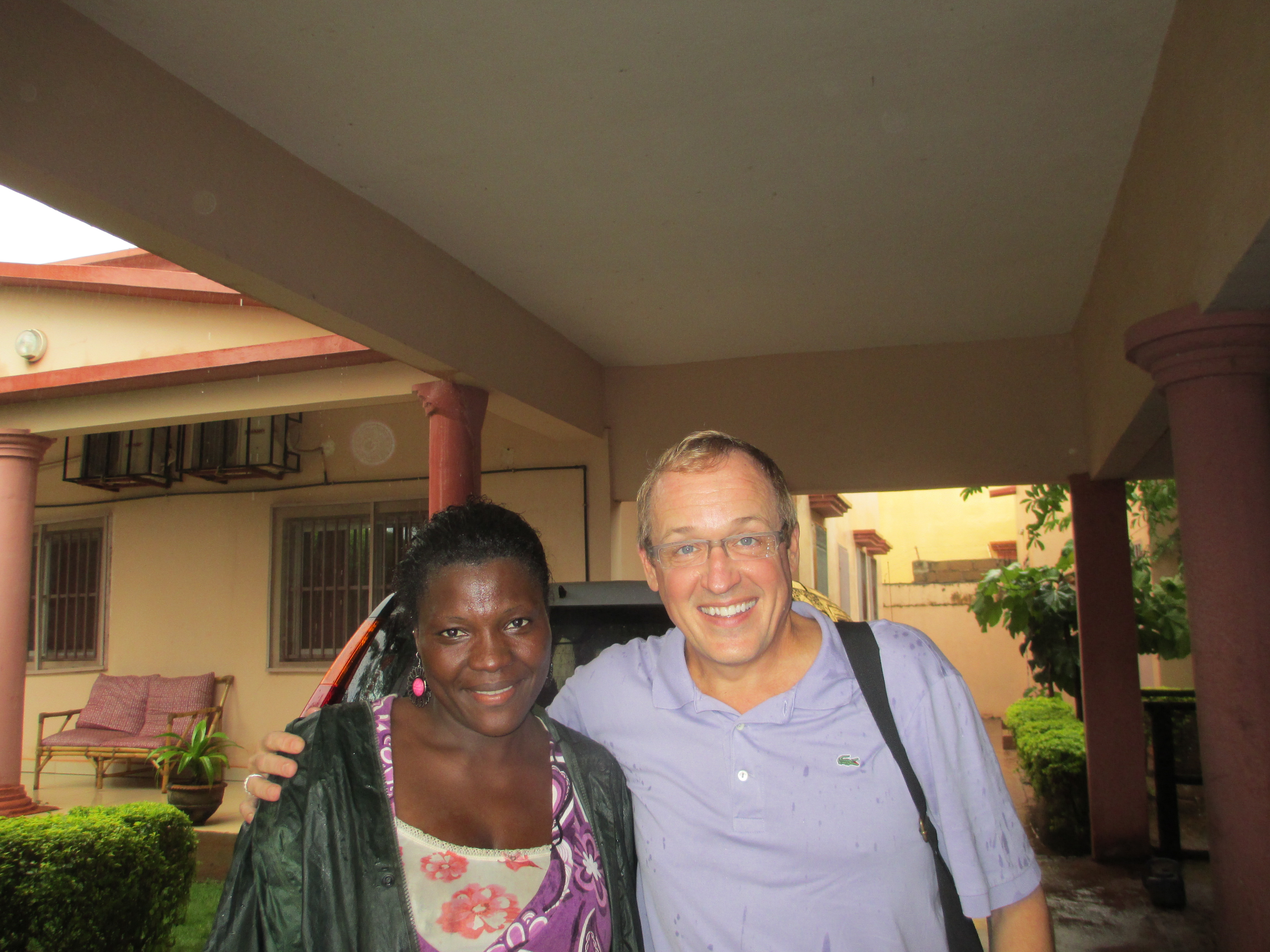
Ami and me. She’s the woman who runs a fruit & vegetable stand on the corner outside our house. She stores her produce in our carport t night and we haven’t stolen a single banana (yet).

Our teaching career in the US did not afford us the luxury of household help. Or meat. Or name-brand toilet paper. (NOTE: Our Republican legislature in Florida actually did cause a change in our teacher salary in 2010 for the first time in 6 or 7 years. But it happened to be a decrease of 3%, requiring us to choose between getting rid of HBO or skipping a 6-month dental check-up.). So suddenly having a staff devoted to our well-being—a maid, a gardener, and 2 guards (as well as a driver at our disposal) is a little disconcerting.

Yesterday our house guard Niambele washed our car and today he opened the car door for me when we pulled in. Oumar the gardener was tending the vegetable garden he planted for us, and Fati had a freshly baked quiche waiting on the counter. The house was spotless, and the dirty clothes from yesterday were clean, pressed, and stacked on the dresser (If I could get these wonderful helpers to write lesson plans I literally wouldn’t have a thing to do aside from personal hygiene and grooming.). I will say that we do not take this all  for granted as it makes us fully understand how damn lucky we really are. It would take Fati, mother of five, 22 years to earn what I made in a year as an “underpaid” Florida teacher.

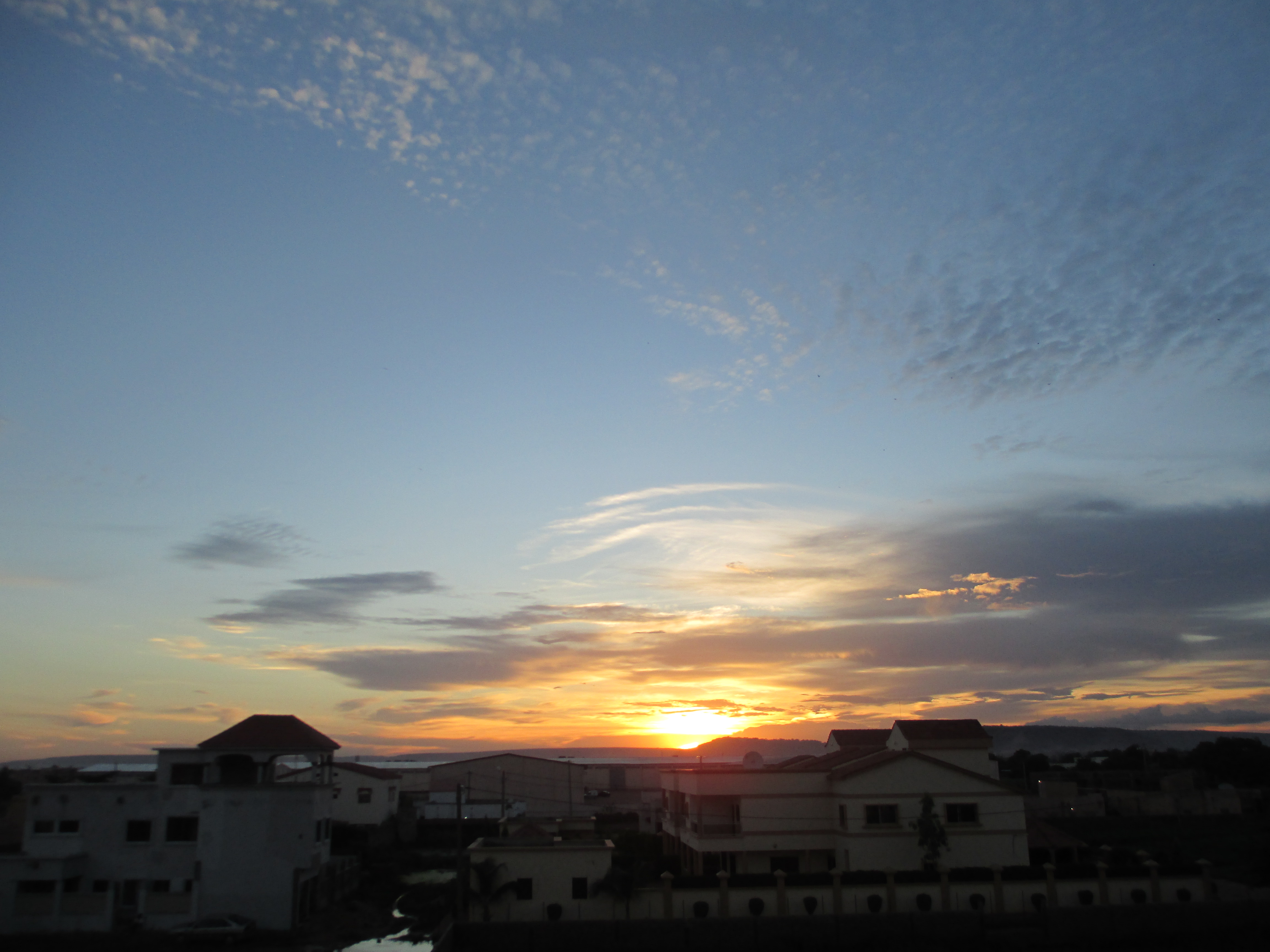
Sunset, time for a G&T and a spritz of Deepwoods OFF

Speaking of many kids, our school is slowly growing since the U.S. Department of State just announced that the families of Embassy employees can return to Mali. That’s a good sign that coup-related worries are fading and that Bamako is safe. Although “safe” is relative. I just heard about these grotesque flies that lay their eggs in laundry that’s on clotheslines. Then the eggs hatch while you’re wearing the clothes and the larvae get into your skin, and supposedly that’s why the maid irons everything because the heat kills the eggs. That’s far from “safe” in my book. And thank god Fati irons like a demon.

Anyway, in just a couple of days our school received confirmation that 11 American

My Bennetton-commercial-worthy class

students were returning in the coming weeks. I already had an American kid come today (American mom, doctor dad from Niger who specializes in malaria…yay!). And the wife of the Nigerian ambassador popped in today to tell me her child was on the way as well. (Politically speaking, that so far gives me the children of 2 ambassadors, the prime minister, and an official of the African Union–and here I thought I was going to be tucked away in a little school in the middle of nowhere)). And because some other countries as well as many NGOs rely on the opinion of Uncle Sam (USA #1!) they may also decide to allow their employees and their families to return. So I may receive a few more little whippersnappers but it’s all good. I spend my days trying to decide which

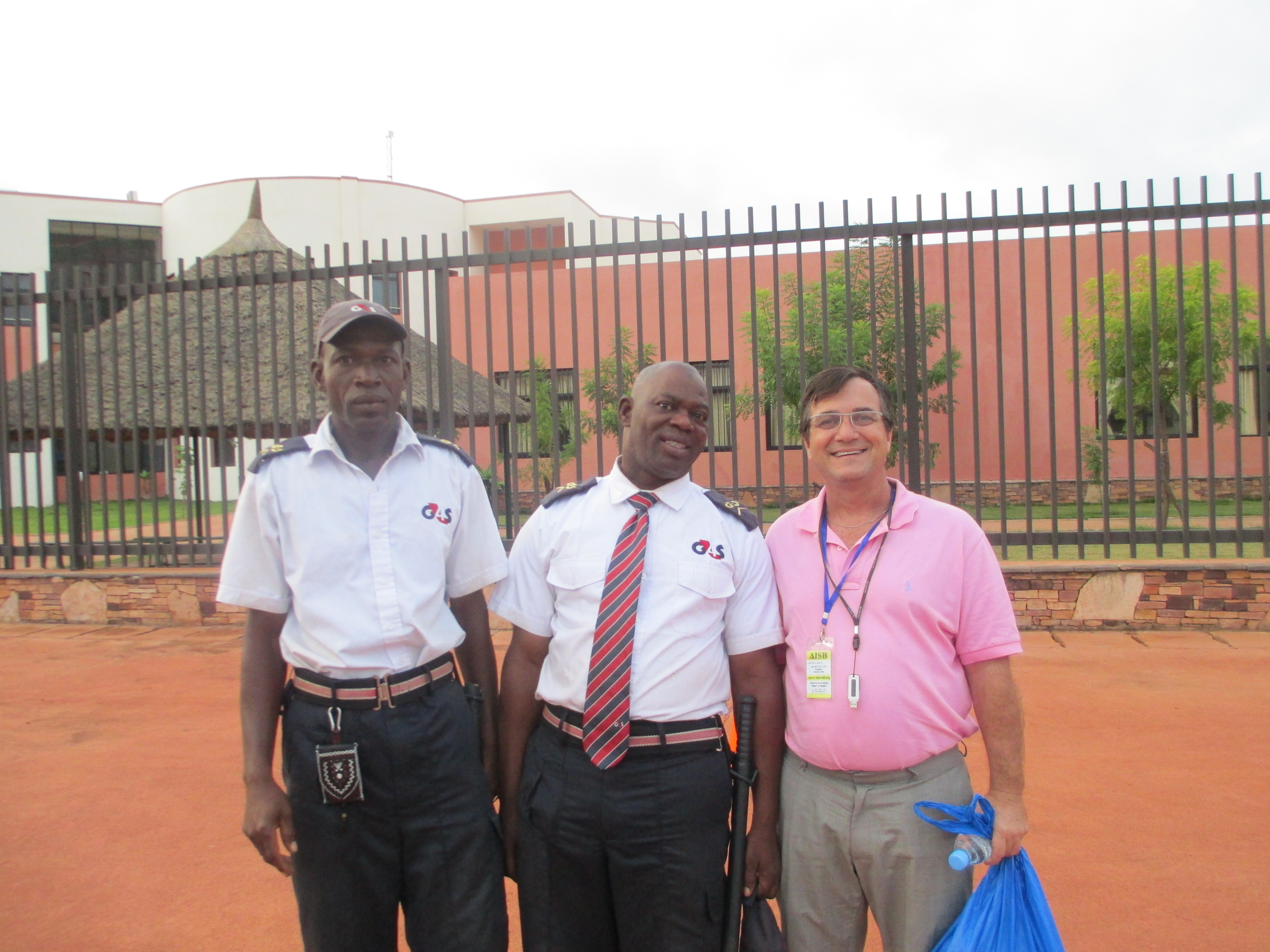
Jamey with two of our school’s guards. We are first to arrive each morning, and they give us a little lesson in speaking Bambara.

creative activity to do next and the kids (and their $30,000/yr tuition-paying parents) appreciate it all. No piles of test data looming over my desk, no threats that I’ll lose my job or get a lower salary if my students don’t test well next April, no directives from on high telling me what/when/how to teach, no dread, no stomach aches, no FCAT pep rallies or FCAT reward parties to plan. And we have THREE recesses and as much bottled water as we can gulp down (I’m up to 2 liters a day!) This doesn’t seem real.

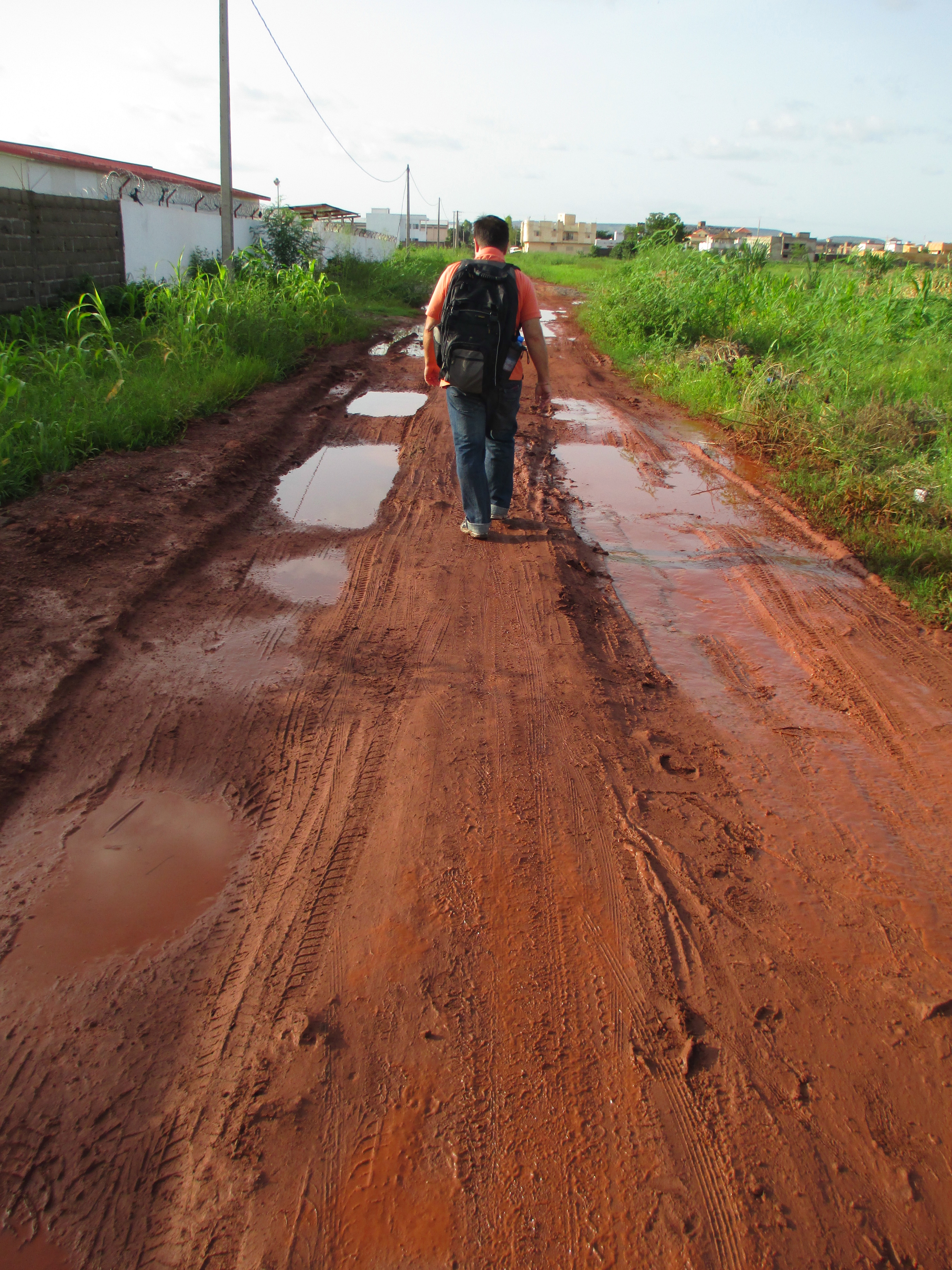
What also doesn’t seem real is this what happens when it rains. It doesn’t rain for long…maybe 30 minutes tops. But it pours buckets and because the ground is very clayish, the water doesn’t drain.

This is the “road” to our house after a big rainstorm yesterday afternoon. It flows like a river. Oh look! Here’s comes Humphrey Bogart and Katherine Hepburn on the African Queen!

And the “roads” have no drains (or curbs, or stop signs, or lines painted down the middle, or smooth surfaces). So the rain doesn’t just puddle up. It makes a river, a flowing river with rapids right down the middle of the road. It’s almost like a scene from The River Wild, and I wouldn’t be surprised if Kevin Bacon and Meryl Streep came rafting right down the centerline (if there was in fact a centerline on the “road”). And did I mention that the motos are still driving in this mess?

Another unreal experience happened last Saturday night when the U.S. Ambassador to Mali, Mary Beth Leonard, hosted a BBQ for our little faculty at her very sassy residence

Partygoers do a synchronized number as I hurriedly leave the dance floor feigning an injured achilles tendon.

(might I mention that this is the second time I’ve dined with her in the 25 days we’ve been in Africa). We dined outside to the music of a live African band and some dancing even ensued (and no it did not involve either Jamey or me doing African dance moves so get that picture out of your head). The food and drink was fantastic, but not as fantastic as she is…a down-to-earth, unassuming firecracker who is full of energy and spunk. I hope all of the U.S. ambassadors are representing us as well as she is. She even got into her bathing suit and swam with some of the faculty members’ kids. Later she came out with a bin of kitty litter for a teacher who had mentioned how hard it was to find that product in Mali. I was going to mention how I couldn’t find a 60” flat screen TV anywhere in Mali either.

I gave a reading assignment last Friday in which the students were to interview 2 adults about the concept of “perfect,” as in “What makes a perfect life?” It connected with the theme of a novel we were reading. When I was reading the assignments today I saw that one of my students, the daughter of a teaching couple at our school who also attended the BBQ, apparently interviewed the Ambassador while they were all in the pool!

The quilt-like art we presented to the US Ambassador at the party.

We presented her with a New England quilt-themed piece of art my class made (well, mostly me because I waited until the last minute) and had everyone in the school sign. She loves quilts and is from New England, and she said she was going to have it framed. What a night…a kitty litter giveaway, dancing under the stars, swimming and interviewing with the kids, a fullish moon, compliments about our art, and DEVILED EGGS! I almost forgot to mention that she had her cook make deviled eggs for us! And I bet that cook was smiling the whole time!

Chapter 8: Crisp Boxers & Stiff Drinks

By 4:00 each day in West Palm Beach we were home from work, plopped on the couch snacking, watching the latest Ellen show we had on the DVR and trying to decide where to get take out.

At 4:10 PM today we were on a patio next to our school with 3 colleagues, drenched in sweat, learning new steps to an African dance from a Malian dancer with tiny dreads who only speaks French and who we sort of understood, with three drummers pounding on interesting looking, handcrafted drums, and with the Niger River and the green hills as our backdrop.

Dancing With the Non-Stars (that’s me at far left totally in synch, and Jamey at far right just standing)

During our frequent breaks (and thank god they were frequent) one of the resident tortoises the size of a manhole cover ambled by. And the clouds were like a Jesus painting. Seriously, are we really here?

We were looking for a change of pace in life and I think we’ve found it, like when a child finds a surprise by sticking a fork in an electrical outlet (which, by the way, in Mali are round with 2 little prong holes). The world as we knew it is long gone, and we are loving the contrast.

Stopping at a roadside stand yesterday, we paid $6 for five bags full of fresh vegetables that in the U.S. would have cost $100 at Whole Foods. But at our next stop, a sort-of

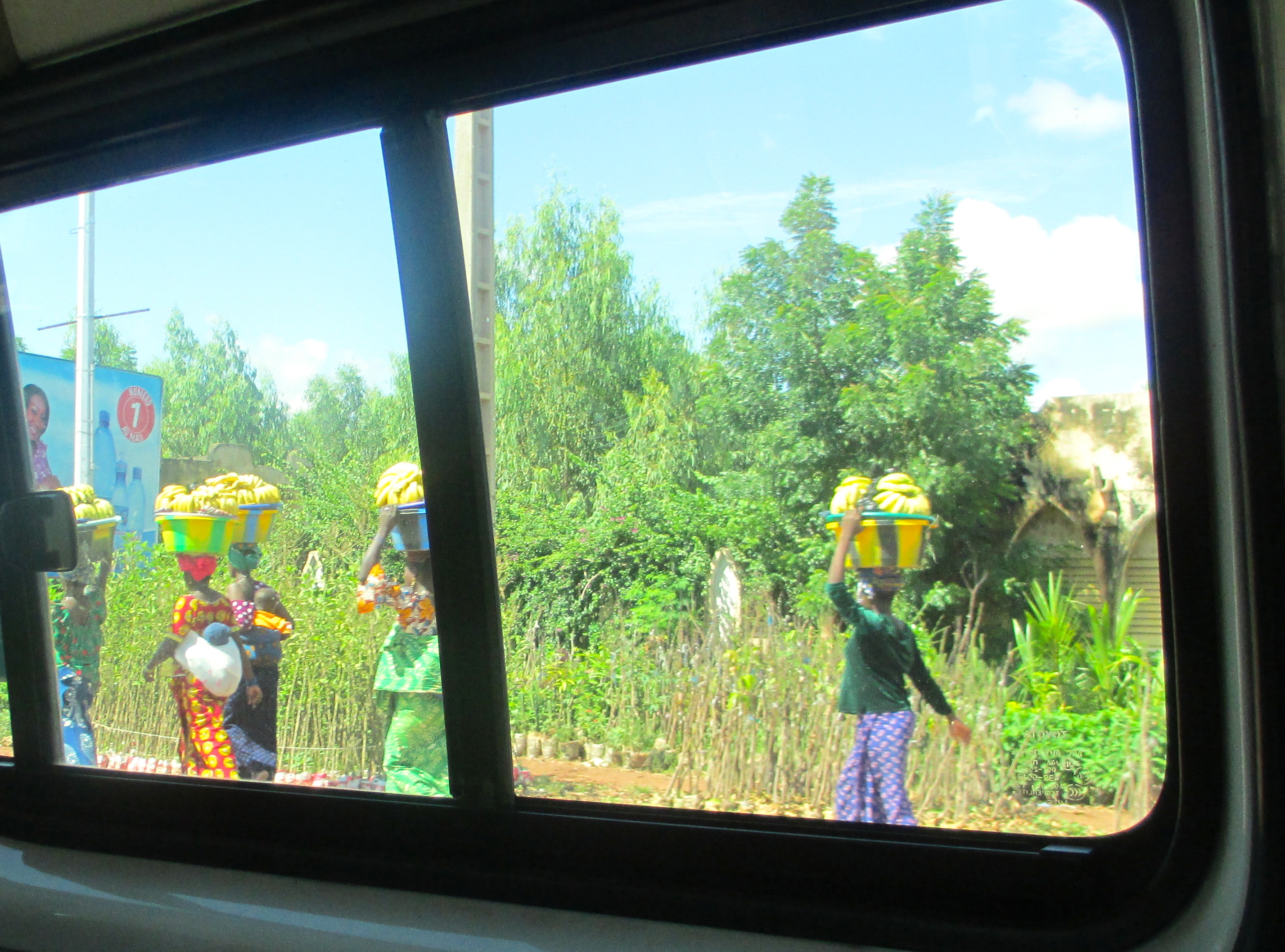
Bananarama

Western style grocery store, we paid $40 for a sad little Made-in-China ironing board that’s dorm room size. Later four of us ate lunch for $5 each at a local restaurant specializing in heaping plates of traditional West African food, then at the drugstore around the corner I paid $75 for 8 Meflaquine pills. So I guess the moral of this story is if you want to stretch your cash when you come to Bamako, eat lots of local food, wear wrinkly clothes, and embrace malaria.

It’s been a week of especially crazy contrasts. The students returned to school. Well, 84 of the original 200 kids from last year actually returned. The U.S. still hasn’t allowed the dependents of its Embassy staff to return since the March coup (even though things in

Faculty of the American International School of Bamako

Bamako are A-OK) so we are short a whole gaggle of American brats. Apparently the Dutch and Danish, who never even evacuated in the first place, aren’t big scaredy cats like some countries I know. There is a senior class of one this year, a cool Malian-Dutch kid who is the sole student in Jamey’s AP Physics class (so much for sitting in the back of class texting while the teacher lectures!). He’s a shoe-in for valedictorian from what I hear, and definitely will be in top 5% of his class. On the elementary side of the school every other classroom is empty since three of us are teaching combined classes, K/1st, 2nd/3rd, and 4th/5th, freeing up classrooms in between us. It makes for a spacious environment, plus I have pilfered everything from the now REALLY empty classroom next door so it’s like having my own private Target.

I have seven Grade 5 students and six Grade 4 students so far. From the minute the first student walked in during student orientation and told me my classroom smelled like gin I knew I was in the right place.

My expansive classroom/Olympic gymnastics venue

Among these 13 they speak Danish, French, Portuguese, Bambara, Hindi, Portuguese, Spanish, and English–only 2 speak English as a first language and half of them are tri-lingual! I have the child of the Danish ambassador, the child of the current Mali Prime Minister, and two children whose parents teach at the school too. No pressure (he says as he takes a swig from the bottle of Bombay Sapphire hidden in the crayon box).

The classroom discussions have been a tad interesting too. Example from the first day:

Me: Do any of you have teachers in the family?

Gin Student: My grandmother teaches college in Vancouver.

Me: Your grandparents live in Vancouver? I love that city.

GS: Well my grandmother lives there. My grandfather is gay and has a boyfriend and they live in another city.

Me: Did I hear the bell for recess? (swig, swig)

And what I found bizarre is during that exchange not one student even winced. Hell, even I don’t even know anyone with a gay grandfather!

One of the students’ Andy Warhol-style self portrait.

On Friday I played the song “Perfect” by the band Simple Plan, a heart wrenching, based-in-fact song in which the two brothers in the band sing about how they didn’t meet their father’s expectations (even though they are successful, wealthy musicians). I asked the students to analyze the lyrics for the main idea. PM’s son answered, “It’s just so cliché, Mr. Fessler.” They are keeping me on my toes for sure.

We bought a vehicle from a departed teacher (one who left the school, not one who died).

Bamako street scene

It’s a Honda SUV-something-or-other, totally not my style plus it cost a gazillion dollars to fill with essence (that’s French for gas, pronounced ess-AHHHNCE) But an SUV is totally necessary to drive on the things that pass as roads here. The red clay back road we take to school is less than a half mile long, but it’s an adventurous half mile with foot-deep water covering all of the road in places, mini jagged boulders, mud pits, parts that look like a smaller scale version of the Grand Canyon, and random bushes growing in what would seem to be the center of the road. Riding to and from school is sort of like getting a magic fingers massage from one of those vibrating mattresses, so it’s not all bad. I’m not an auto expert, but I’m thinking these conditions play havoc with all that stuff underneath the car (the other day we were riding with colleagues in their SUV and  a shock literally fell off the bottom of the car into the tire).

Jamey did drive on an actual main road last Friday for the first time, which is far better than our crazy back road but still crazy in many other ways. Our director had invited the faculty over for happy hour, gin and tonics by the pool, and I couldn’t resist (plus Jamey was my DD). So off we went on Sotuba Road, two lanes that somehow handle 4 or 5 lanes of traffic, full of motos (motorcycles), cars, little buses, donkey carts, people hauling big carts of eggs or bananas or auto parts, and people walking everywhere. Thankfully everyone travels at a slower pace than most places we’ve visited, but having motos zoom up on either side of you at the same time when you have your turn signal on and they still stay next to you, well, it just makes for a surreal driving experience. The gin was good by the way, Bombay Sapphire, and she also had US-style junk food, like chips that tasted Ruffles-ish. Definitely worth the dangerous first drive.

Our home is looking better everyday. On Saturday we had a driver take us across town (which in and of itself is a complete thrill ride) to buy some curtains from a World Bank Brit

“Hakuna Matata” says our living room!

guy who was transferred to Senegal. African print material, well made, and featuring our current favorite POC (Pop of Color)…orange…which of course was inspired by the plastic dog I wrote about in a previous post. They instantly brought life into every room of our place and pumped up the Africa-ness. I also used one curtain panel to make pillow covers that I whipped up by hand (thank you Grandma and mom for teaching me how to sew when I was 9). Last step is having one of the maintenance men come to hang our many, many pictures—apparently the solid concrete walls almost require a jackhammer to get a nail in them. Even our gardener has done his magic, which is a miracle since we gave him directions in French (or what we think was French). We now have potted plants everywhere–along the porch, on the roof deck, in the house, at our front gate…come to think of it I may have mixed up the number 5 with the number 55 when I was ordering these. He also took the vegetable seeds we brought with us and planted a raised bed garden next to our house, so I’m looking forward to haricort verts, salade, and other French names that sound so fancy even though they are just plain vegetables.

It is truly bizarre having a gardener, a maid, a driver, and full time guards just for our house. I’m not used to having people open the gates for us, carry our backpacks or groceries in, keep the yard looking perfect, scrubbing the floors and shower and kitchen every day, washing and ironing our clothes daily, and fanning us with long palm fronds (okay I’m making that last one up).

View from our roof deck

Plus they do all of this hard work for so little money…a little more than $100/month for a full time, 5-day-a-week maid (we spent more than that on groceries for the week). The guards get less. Even less than that for the gardener. In the states I was resigned to the fact that as a teacher we were at the bottom of the earnings totem pole, but here we’re freakin’ Richie Rich! It’s a little uncomfortable and hard for us to wrap our heads around. But man do I love coming home to a stack of ironed boxer shorts and socks.

Chapter 7: Cock-a-Doodle-Don’t

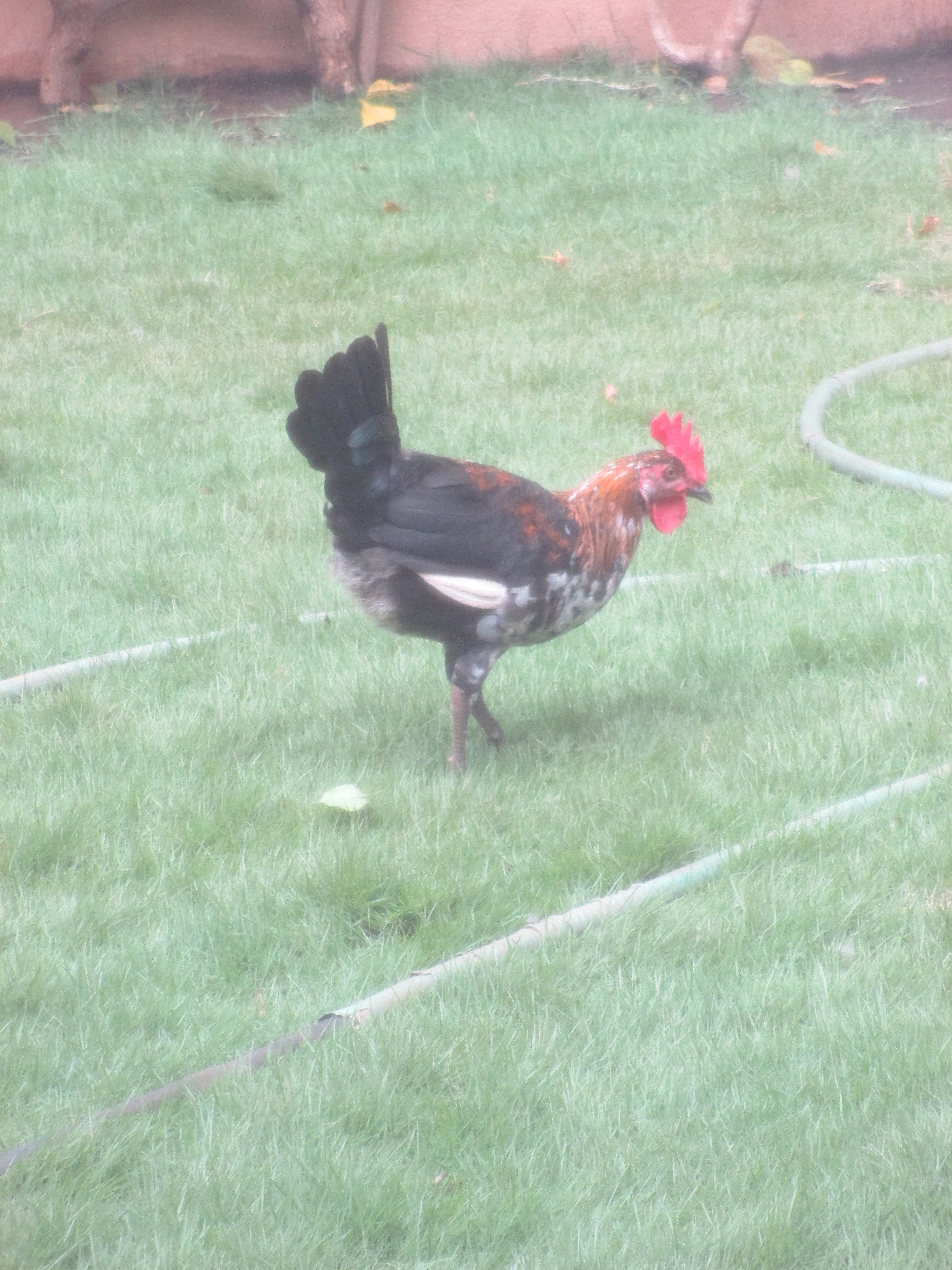
Just when we were getting used to our very personable rooster, he literally flew the coop. At least that’s what we think Fati (our maid) said in French to us this afternoon. Or she cooked him—hard to tell with our low level French comprehension.

Our rooster, just before going on holiday.

I did enjoy seeing this little rooster come to the glass front door every morning to get our attention. We wish him well on his adventure –or- hope he provided nourishment for an impoverished family, whatever the case may be. I’m pretending he’s on a little vay-cay.

We’ve just completed a full teacher-only week at AISB (American International School of Bamako). Today I was sitting at my classroom desk freaking out over scheduling, curriculum, classroom interior design, etc. when I looked out the window, saw the Niger River, and thought, “Holy crap! I’m in Africa!” Amazing how school stress can make you forget you’re in a third world country on another continent. This stress is different than what I experienced in the U.S. though. By this point in Florida I would have been surrounded by piles of FCAT test data (the high stakes Florida test) letting me know which of my students may not pass

I can see the Niger from my teacher desk. And some playground equipment.

the next FCAT in 8 months, deciding which students are most likely to pass and are actually worth the extra investment of time, being told not to schedule field trips or anything else remotely creative or enjoyable or to definitely NOT teach social studies and science–subjects not on the 4th grade FCAT–until April 2013 when the three week FCAT testing window is over, and being reminded how my salary, my job, and my health will suffer if my students don’t produce high test scores. Ah, the good ol’ days. At least now my stress only involves deciding which creative activity to do first, and how to create an inviting classroom in the light-filled, cavernous space assigned to me.

Our first week faculty meetings could not have been more different from what we were used to back in Florida. Our director actually apologized for keeping us so long at our first meeting–which went a whopping 70 minutes and actually involved time for teachers to talk about their vision for enriching the lives of students….as opposed to staring blankly at PowerPoint slides of color-coded test data and dreaming about less stressful career options, like alligator wrangling.

Growing a living maze in one of the school courtyards. I imagine some kids could get lost in there for days.

The answer to many teacher questions was “Just use your professional judgment,” something that made me do the happy dance in my head because it meant that this school considers me a professionals and capable of making judgments on my own! Every morning there were fresh French pastries, and at lunch the school cook, Fanta (yep, just like the soda), prepared a meal for the staff. She even made me a special garlic-free portion of every meal due to my allergy and unwillingness to have explosive diarrhea during Week 1.

My split class so far has nine 4th graders and eight 5th graders. They include the Danish ambassador’s son, children of officials with the Dutch, South African, Indian, and Nigerian embassies, a child of an African Union Commission official, and a Microsoft Mali exec’s kid. No Americans yet since DC hasn’t given the all clear sign for American Embassy dependents to return here, but that could happen in a couple of weeks. Apparently the US are always the last return because of so much paperwork they require. Go figure.

Our getting-to-school routine is a welcome change. As we come out of the front door our watchman dashes to greet us and open the gate. Then we walk about 7 minutes down an orange clay road which, if it’s the rainy season as it is now, may include an impromptu stream and series of car-sized puddles. We pass a couple of unfinished soon-to-be fancy two-story homes (although I’ve never seen anyone

Jamey takes the lead on our 7 minute walk to school.

working on these yet), fields of rice/corn/lettuce, two mules, various Malians either on a moto (scooter), bike, or walking–and in the case of women or girls, usually with something large balancing on their head, a couple of shacks made of sticks and scraps of plastic sheeting that are about the size of a walk-in closet and they house whole families. We greet everyone we pass with a “bonjour” and they seemed kind of surprised that we take the time to speak to them. Once we get to the school the guards and drivers out front greet us with all kinds of French and Bambara phrases (how’s it going, did you sleep well, you have mud all over your shoes) and then practice remembering which of us is Jamey and which is Jeff. This process is reversed on the way home, except that when we walk into our house it is sparkling clean and all of the dirty clothes we left are washed and ironed in a nice stack, including socks and undies, the dirty dishes we left in the sink are washed and put away, and our muddy shoes from the day before are clean and lined up at the door. It’s like being 8 all over again.

After school yesterday one of the teachers organized a Friday happy hour at a local hotel on the river.

Happy Hour on the Niger with our worldly colleagues

We caught a ride with fellow teachers Thomas and Cindy and their two kids as we don’t have a car yet (although we did just agree to buy one left by a teaching couple who didn’t return this year). Hard to imagine that we will soon be navigating the craziness on these main roads! First, there aren’t curbs on these TWO-lane roads that seem to accommodate three or more lanes of traffic, which consists of SUVs, giant trucks, gobs of motos (they zip around your vehicle on the left and right side—just inches away from you, and dart from the side of the road at any given minute.), carts pulled by donkeys, small beat up yellow cars that are actually taxis ($2-$3 a ride), locals crammed into green, open-sided vans that sort of represent a bus-like service but without set stops (as the vehicle slows down a guy shouts out where it’s going and people clamber to get on), and all of this happening within a haze of dust and exhaust. Lining every inch of the road on both sides are buildings (masonry or ramshackle stalls) selling things or just open areas where people are selling more stuff like gas in jars or 80s looking sofas and side chairs, all just plopped in the dirt and fumes. And there are people everywhere, just walking, or herding goats, selling phone cards, milling about. The robes they wear are bright and how they keep them looking so clean amidst all these clouds of dust is a mystery to me. This could be a great commercial for Tide I think.

A donkey cart merge.

On this particular ride with Thomas and Cindy last night, we detected an unusual sound as we made our way along the chaos. After pulling over we noticed the shock had fallen almost completely off and was hitting their tire. So we waved down a couple of taxis. Cindy, Jamey, and I rode in a taxi already occupied by a soldier in the front seat, his rifle wedged between his legs. We took a short cut through a market area where sheep butchering was going on, and where I glanced at piles of sheep intestines, heads, and other assorted body parts. Never a dull moment on a taxi ride through Bamako.

A happy hour sunset over the Niger.

Of course all of this craziness contrasts nicely with our eventual destination, a lovely hotel with a covered deck extending over the river where we sat quietly enjoying drinks and watching the sun sink into the river. Not a sheep intestine in sight.

Of course just sitting with our new colleagues is a treat because they are all fascinating people who could write books about all they’ve done. Just in our small group of Americans last night was someone who grew up in Nepal, another whose mom works for the State Department and who went to high school in Moscow, the Danish ambassador’s wife and son who have also lived in Thailand and Ecuador (I’ll have the son in my class), someone who worked in the Peace Corps in Niger, sisters from the US whose family moved to Mali years ago and whose mom runs a store offering crafts from women’s cooperatives in the region, and another who has taught at international schools around the world for 20 years and who rock climbs and teaches yoga. Sure beats sitting around chatting about the last episode of True Blood (though we did that too). We ended up at an Indian restaurant with the most amazing food and garishly decorated crown molding. And the Indian waiter spoke excellent English and French and had no problem leaving the garlic out of my delicious dal (spicy lentil stew served over rice).

And because I’m a teacher, here is a little lesson on a big Islamic holiday: During the past 30 days the Malians have been observing Ramadan, the Islamic holy month where they fast from sunrise to sunset (no liquids or food, which I didn’t realize at the faculty meeting as I snarfed down a croissant and coffee while sitting next to our Malian bookkeeper). It officially ends with the sighting of the new moon (there is actually a moon

Courtyard near my classroom. Flower Power!

sighting committee who makes this determination). On the way home last night our taxi driver told us the committee had spotted the moon. This means Eid ul-Fitr, Festival of Breaking Fast, begins and lasts through Monday, so our Malian staff at school as well as Fati our maid will have the day off on Monday. There will also be lots of family meals, sweets, wearing of new clothes, the giving gifts to children, prayer, and giving to charity. There is something about killing a sheep too, but I’m going to leave the details of that part out of this lesson.

And I’m sure our rooster will return once the celebrating is over.

Chapter 6: Waking up in Bamako

The front of “Maison du Coq,” our abode.

On our first morning in Bamako our driver was coming to pick us up at 9 sharp, so we awoke a couple of hours early to get a good look at everything in the light. I mean who knows, there could be a leper colony next door, or cat-sized spiders crawling on the ceiling. Thankfully the bright sunlight revealed no lepers or spiders, just our rooster and cats.

View of our garden and our hoarse rooster, who is still skeptical of our motives.

From the roof deck, that watery orange road alongside our house just glowed like a painting by Thomas Kinkade, painter of light. A boy walked along the road, and his white robe was blowing so perfectly in the breeze that I thought this wasn’t real. Behind him were several girls in green and yellow and orange robes who balanced various things on their head. It all made for a scene out of a foreign film, and boy do I hope I continue to appreciate simple things like this as time goes on.

Today was a whirlwind. After our driver took us on the 5 minute drive to school, Caroline, our school director, met us at the gates and introduced us to all of the guards and drivers–who already knew our names. Greetings are extremely important here. So it goes something like this:

Person 1: Bonjour!

Person 2: Bonjour!

Person 1: Ça va?

Person 2: Ça va?

Person 1: Ça va bien?

Person 2: Ça va bien.

Person 1: (insert more things in French or Bambara like, “May you be blessed” and :Hope you have good health” etc. and go on for up to 5 minutes)

Some school architecture.

Caroline took us through the school where we met the staff (who also already knew our names). Apparently we are rock stars because, unlike the other 5 new hires, we are the only ones who didn’t back out of our contract and showed up. In other words, we were the crazy/committed ones.

The school looks great…a real surprise at the end of a very nondescript, bumpy orange clay road. It’s two stories in some parts and has great details like curved towers, intricate stonework, voluminous indoor spaces, courtyards with gardens, a perfect combination of indoor/outdoor connections, and a location right on the Niger River (pronounced knee-zheer).

Looking at the Niger River from the school terrace, except I do not have a martini at the moment.

There is a large second floor terrace off of the library with sweeping views of the river, and we understand that they hold cocktail parties here for parents. Liquor and education, the perfect pair.

Jamey’s classroom is the size of two science labs. It has everything he needs and more—plenty of those lab table thingys, a private safety shower in case students spill chemicals all over themselves, LCD projector, white boards, storage, cool equipment like a distiller, a fume hood, you name it. It opens into a sassy little courtyard full of plants.

My 4th/5th combo classroom is just down the hall and is also the largest classroom I’ve ever taught in…again one could do a long tumbling pass right down the center. There are windows on 3 sides–one wall is lined with windows looking out onto a terrace, another has a view of the Niger River, and another set look into a planted courtyard. There is an LCD projector, tables (vs. individual desks) for the kids, and tons of furniture to choose from since the school has downsized teachers and students by half since the coup last March…100 kids vs. 200 in pre-K to 12. I have the biggest group of everyone, nine 4th graders and 9 5th graders. It’s so darned big that I’m racking my brain on the interior design and space planning. I could park a car in there and it wouldn’t interfere with anything. Since the school closed unexpectedly in April with the coup, everything was left exactly like it was on April 2nd–stuff still in the student desks, math problems on the board, and a big bar of Godiva chocolate in the teacher’s bottom desk drawer (is it sad that even having been in there for 4 months without AC and with plenty of African critters roaming around, that chocolate bar still looked good to me?). There was also a skinny turd-like thing on the floor, so I don’t know if that’s some exotic lizard excrement or what.

It’s really just like an American school was lifted up from the US and dropped down in Bamako. Everything we are used to having, they have–well, except for standardized testing mania, stressed-out teachers, and a government that continues making policies that harm teachers and students.

Later Caroline took us on a drive to a couple of supermarches (grocery stores) which were surprisingly like stores in the states and fairly well stocked. They do have odd combinations of items sometimes, like flat screen TVs for sale immediately adjacent to the Pringles (of which they had 12 varieties). Of course most of the products include only French names and descriptions so it’s an adventure deciding if we are buying shampoo, juice, or all-purpose floor cleaner (“lemony fresh” can apply to a lot of products, we have discovered). Paying is fun too since 500 CFAs (their unit of currency, pronounced see-fuhs) equals 1 dollar. So our total for our shopping trip (43,000 cfa) sounded like we had bought a nice car.

After shopping Caroline took us to her house in a fancier part of town (just up the block from the former president’s daughter’s home–the one who was chased out in the coup) and it was twice as spacious as ours. She has beautiful art collected from her travels and work around the world (she has worked at international schools in Rome, Zambia, Vietnam, and Bangledesh, and has travelled really everywhere else—including a 7 month overland journey through Africa in the late 80s). She’s having a BBQ Sunday night here for our little faculty of 20, so we look forward to meeting our colleagues.

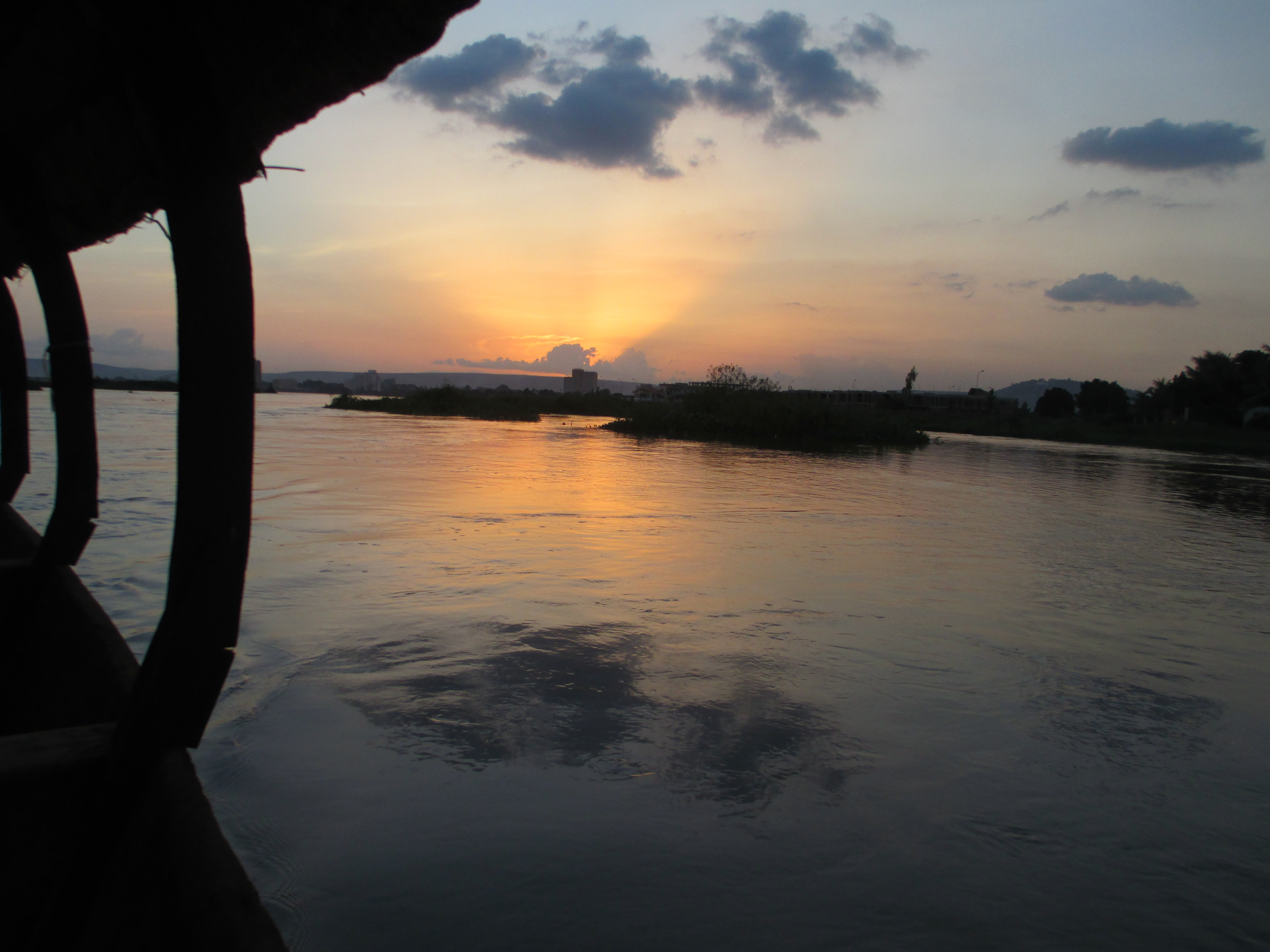
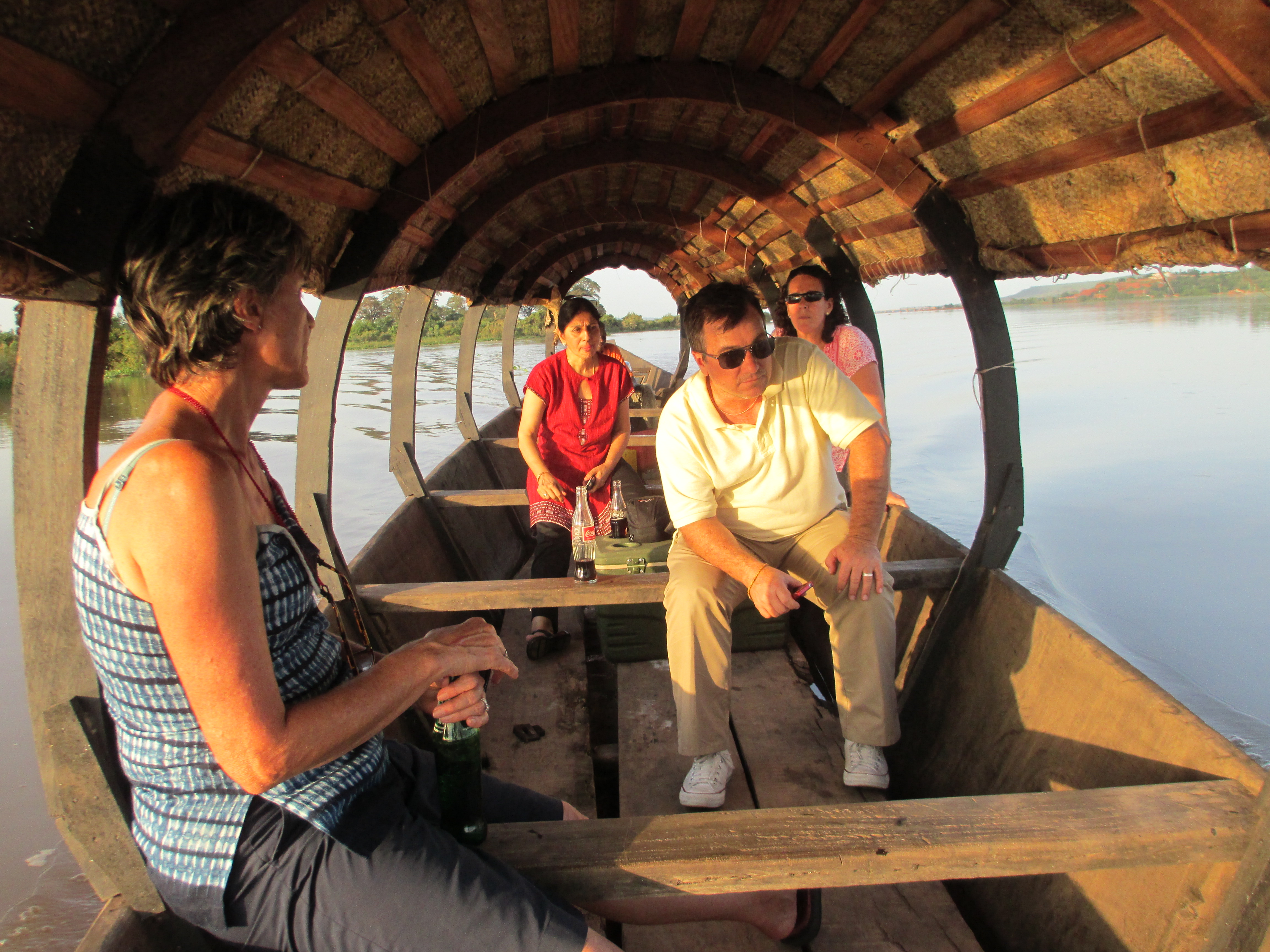
Our sunset canoe cruise on the Niger River.

In the following days we had some memorable experiences. Caroline took us and a couple of other teachers on a boat ride on the Niger River, in a traditional Malian canoe (this one with a motor, I might add, which most do not have). It was so quiet out on the water, like a different world. Found out that the man-eating hippos are nowhere near Bamako. Also found out that we do not want to touch this river water. At all.

Jamey and I also went alone to a clinic to get our second round of vaccinations. You just show up–no appointments necessary. Dr. Toureg was super nice, spoke English, and had a giganto fish tank in his office. The shots didn’t hurt a bit, but as before the price sure did. At least this time our new school insurance covers the cost.

And finally Caroline took us to the US Ambassador’s house for drinks and later dinner at a restaurant down the way. We were joined by a coupe of US Embassy nurses and another teacher who works at our school’s satellite location, a gold mine waaaay out in the middle of nowhere. She’s from Alaska so she’s used to being far away from civilization. The Ambassador was fascinating and oh so interesting. She’s casual and funny and she plays the flute too. Who could ask for more.

Our canoe had me, Jamey, the media specialist Jenny from South Africa, Caroline our director from Australia, Anka the secondary math teacher from Holland, and Sushma an administrative asst. & psychology teacher from India. Love em all!

Chapter 5: Good Golly Miss Mali!

So we’ve been in Bamako for almost 2 days and I am just now writing my first in-Mali blog post…partly because we don’t have Internet connected at our house (maybe by this weekend), partly because we’ve been occupied every waking second (more on that later), and mostly because it’s difficult to even begin to describe what we’ve experienced in just 36 hours. It’s like a party of sights and sounds is going on in my head and I’m the really, really drunk one someone has to guide around. But let me try to kick this off.

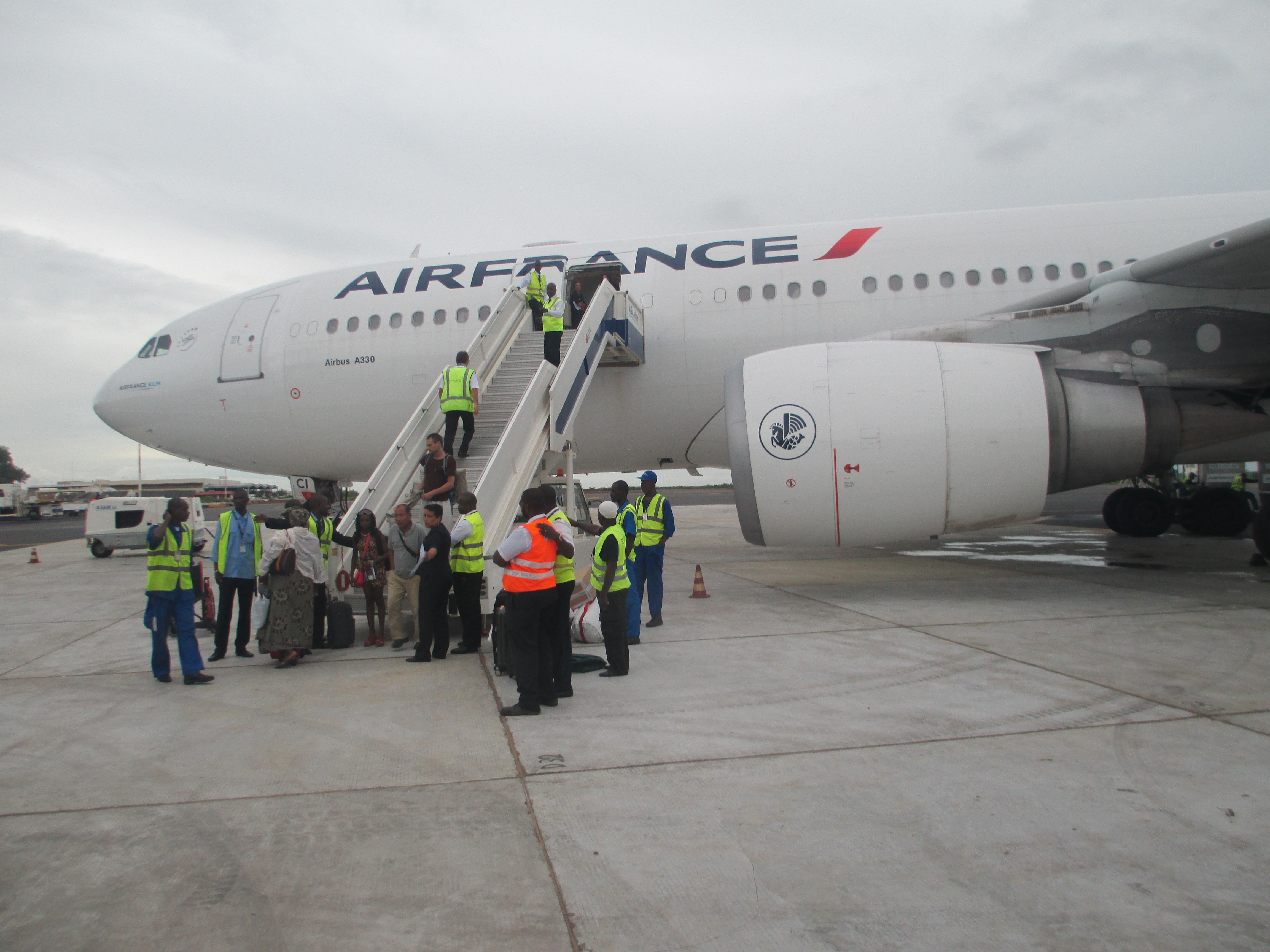
When our Air France flight started its descent into Bamako, the rain clouds had just passed and the sun was out so we could clearly see the landscape below. The soil was the color of Snooki’s skin, that unnatural orange that sort of glows in the light. The vegetation was vivid green, and next to that Jersey orange it was like a pop art painting. The airport was not a huge building, maybe from the 60s, and we departed the plane from a staircase down onto the tarmac (also very 60s) where a modern bus whisked us 30 seconds away to the terminal.

Unloading on the tarmac, just like in the old days.

Caroline, our school’s director who is originally from Australia, was meeting us at the airport but didn’t know if they’d let her through to the visa/passport area where we would be for a bit. So I was prepared, having written a few French sentences on a piece of paper in case I needed them: “Our director is waiting just outside if you have questions,” and “Does the AC get any colder than this” and other essential information. Most of the foreigners (and yes we were also surprised that we weren’t the only non-Malians entering the country) were directed to a tiny office to present our visa to a couple of youngish Malian army women saying many things in French. So in this room the size of a bathroom stall were a group of uniformed French soldiers, a couple of 20-something kids with backpacks, a CIA-looking guy with slicked back hair, Jamey and me, and the two army women. Everyone else apparently understood the directions and were gone in a few minutes. And there we stood as the women asked us something and we just smiled, Thank goodness it was at this time when Caroline bounced through the door with the originals of our visa and handed them over. We were through step one.

Next we zipped through passport control with nary a hitch and then collected our luggage which appeared just as we walked up to the moving belt. Even the big box was there containing the plastic orange dog we bought in Paris, not a dent anywhere. Siri, one of the school’s drivers, quickly loaded everything on carts and we were off through the airport. Caroline was marveling at how fast and problem-free this process was for us, and how just the week before her flight was 6 hours late and it took her more than an hour to clear customs and get her bags. And then….another Malian army woman stepped in to ruin our party. She pointed at the box I was wheeling and said something that maybe was “What’s in the big box you drug smuggler” or something to that effect. Of course how do you tell someone in a poor country that it’s a plastic orange dog by a famous Finnish designer that we bought in Paris that surely cost more than this soldier’s entire monthly salary. I told her it was an “object d’art” which was in one of my Rosetta Stone lessons or maybe it was something I saw in a movie. She didn’t get it. Then Caroline said “chien” (French for dog) and barked.

The offending dog, at its birthplace in Paris.

Maybe the soldier thought it was a live dog or maybe she was in a bad mood, but she made me follow her to another room, this one with an older Malian army woman with flawless makeup and a pretty big attitude. There was also a guy in a shiny robe-type thing doing calculations on a pad, and various male soldiers coming in and out saying something in French. The army woman ignored Jamey and me as we stood before our box with a plastic dog, so we just smiled. Suri, our driver (which I think has the same name as the child of Tom Cruise and Katie Holmes), came in and said something in French to the woman and she did not seem amused. She barked at him and he began opening our box, slowly unveiling the plastic orange dog. To say she was dumbfounded is an understatement. We didn’t understand her, but I’m sure she was saying something like, “What in the hell is this? You think I’m going to get a promotion for finding an orange plastic dog?” Suri and army woman went back and forth and the conversation was heated. I kept tryng to interject with bits of French saying “it’s for children,” and “it’s just a toy and of course it didn’t cost 145 euros even though that’s what the price tag on it says.” She banished Suri from the room and they locked the door.

Army woman punched something into a 60s looking adding machine and held it up while she said lots of things in French. The machine showed the number 50,000. Was this the number of lashes we were going to get? The dollars she wanted from us? The temperature outside? I kept saying “I don’t understand” in French while Jamey suppressed a smile, apparently finding this whole thing amusing. The shiny robed guy used broken English to say something about “CFA” (the unit of currency here that we had no clue about in terms of how it compared to dollars or euros) so we figured out she was charging us some kind of tax to bring this in. I said “euros?” and she punched in another number, 76, and held it up. We knew that mean over $90 dollars and at this point I was ready to pay just to get out of there, so I began to take the cash from my pocket. Then Caroline burst through the door again, timing her arrival perfectly. She doesn’t know much more French than me, but another soldier who knew some English explained that army woman was really ticked because Siri had insulted her, which may or may not have been true. Caroline apologized for his actions and the woman waved us away with our box and without paying a ransom.

Come to find out, we are at the tail end of Ramadan and the Malian Muslims fast between sunrise and sunset—no food or drink. Plus they get up early to pray and stay up late eating and drinking so they get little sleep. So in other words, they are all pretty cranky about now, and army woman was no exception. But we had survived with euros intact and we were on our way.

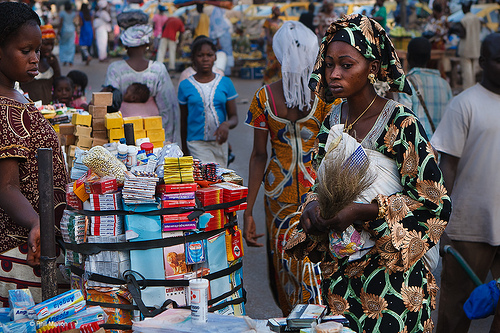
We were glad it was still light because there was much to see on the drive to our house, which I must mention was in an ice cold air conditioned van. Ahhhh. The whole scene outside was very movie-set-like. Women in bright robes balancing gigantic things on their heads, like containers and cloth wrapped bundles.

Bamako street action.

Motor scooters careening around everywhere (and they don’t wear helmets). Little open air stands lining the roads full of vendors selling everything and offering every service, from haircuts to autobody work. Donkey carts pulling wagons of corn. Huge Mercedes semi trailer trucks barreling along, horns honking. It was too much to take in, especially after just watching a quiet, sweet little rom com movie with Ewan McGregor on the flight here. But we were loving every minute of it.

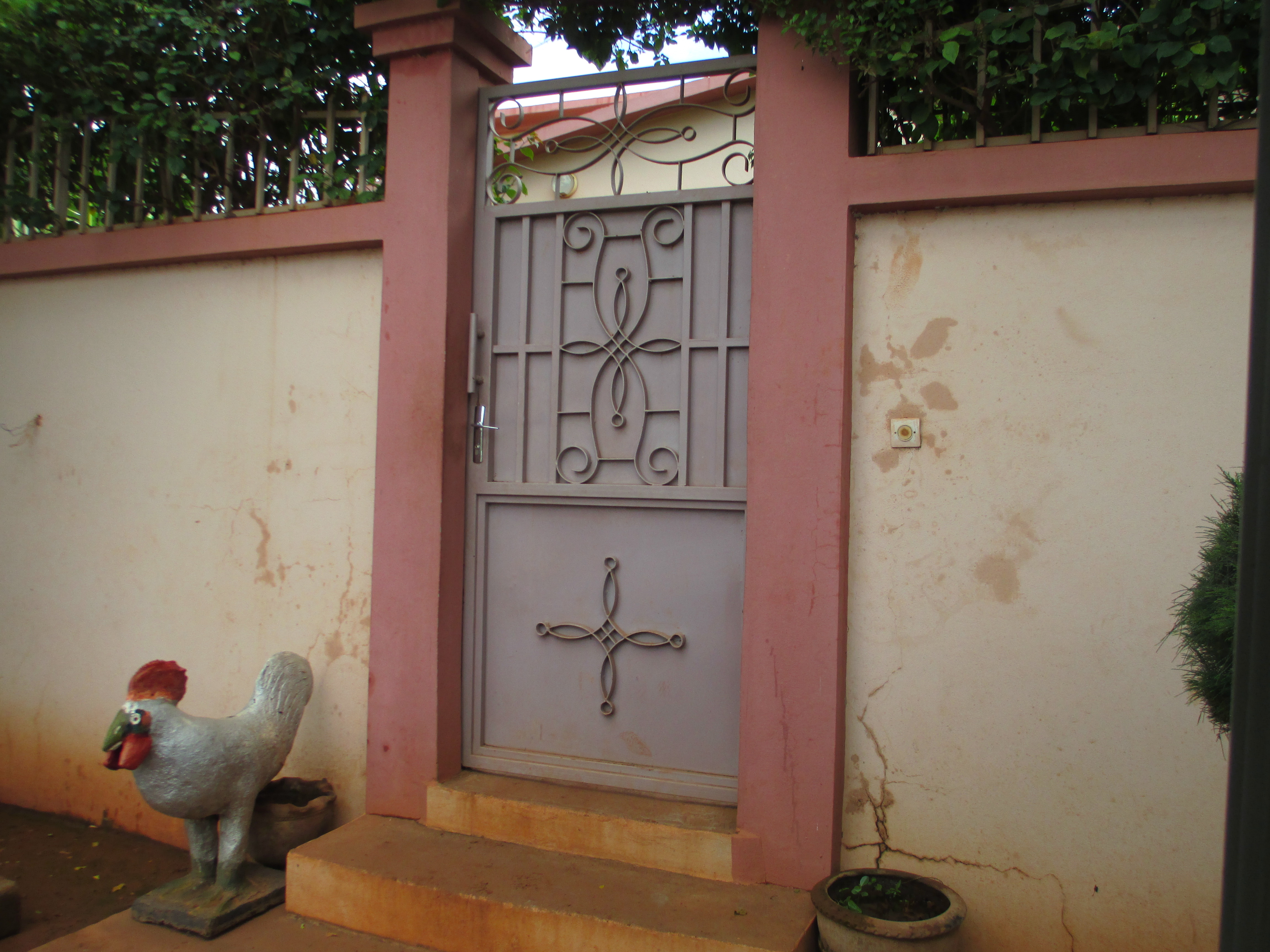
The “road” leading to our house was orange clay and after a few days of rain looked more like the Niger River, except with more bumps. It was dark by the time we pulled up in front of our walled compound, but we could see our gateway stoop was adorned with a large concrete chicken. Interestingly, rather than using addresses, you can identify your home with a unique sculpture, so we are the Maison de la Coq (House of the Cock/Chicken). And that’s kind of funny.

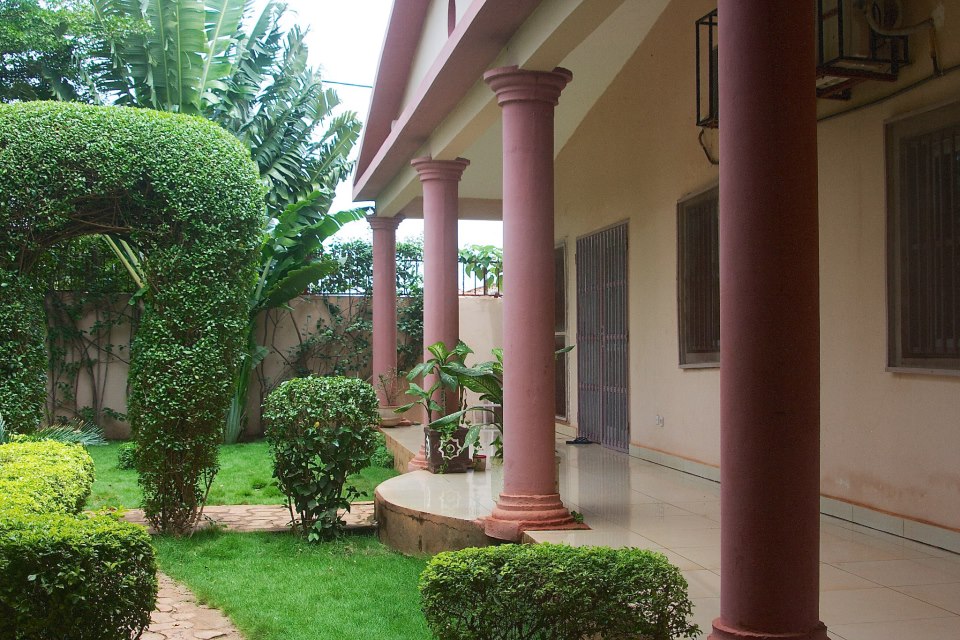
Our compound’s guard came out to greet us and carried our bags through a lush little garden to the porch that runs the length of the house. We saw right away that this place is big, really big. The part of the house you enter from the front door is three spaces, living, dining, and kitchen. A giant living room big enough for Gabby Douglas to do floor

Gate to our house and garden with our large chicken standing guard.

exercises. Lots of windows too, and rattan furniture. Dining room with very formal-ish wooden table and chairs (secondhand from the American Embassy here; anything that is formal-ish and dark wood is probably a hand me down from the Embassy). Double ceiling fans and a long, skinny remote-controlled AC unit at the top of the 10’ tall walls. The kitchen is very blue, every wall surface covered with midnight blue ceramic tile. But it has a American-sized fridge and a gas stove. It has a pass-through from the dining area so the space flows well. But geez is it blue.

Off of this three-part space is a long corridor, with the master bed/bath coming off the left side and 2 guest bedrooms and guest bath off the right. The master bedroom is gigantic too, about the size of the apartment in West Palm Beach we lived for the past year. We moved the furniture around a few times so it didn’t look like an auditorium, and it looks fairly comfortable now. The queen-sized bed has a sort of canopy structure over the top draped with a mosquito net which many people use in case one of those critters gets in the house. The master bath is a little scary, also very blue with tile floor to ceiling. We are trying to decide what furniture to put in there to fill the space since it’s echo-y, and echo-y is not good for a bathroom if you catch my drift. The guest rooms on the other side of the corridor are each half the size of the master and work perfectly as extra storage for our things.

Lots of things happening on the outside. On top of the house is a roof deck the size of the whole house, and it includes a thatched-roofed cabana. There is a small maid’s quarters if the maid lived on premises, but since ours doesn’t this is used for laundry and a bathroom for the maid, gardener, and guards. The whole yard is surrounded by a 6’ tall wall and lots of plantings, most of the same plants we had in South Florida. There is a metal door/gate going to the street that the guard opens and closes as we come and go. And the best part of all is that we inherited 2 very cool cats and a rooster who sounds like he needs to clear his throat before he crows. Supposedly there are chickens too but we didn’t see any.

Other teachers live in homes just adjacent to us and have a pool that we can use anytime, but they are just now arriving in the next days and we haven’t met them yet. We just needed to sleep at this point!

Chapter 4: Things are a Little Coup-Coup

Sundiata, founder of the Mali Empire, and someone obviously not afraid of color or stripes.

Mali appealed to us not just because of the 106 degree heat, sandstorms, and killer hippos, but because its recorded history stretches back thousands of years. In the 1500s, when Florida’s Native Americans were sloshing around in the mud and living in stinky huts, the wealthy Malian empires were trading in gold, salt, and copper, building universities, establishing a complex criminal justice system, and maintaining armies of 100,000 men.

As we researched Mali before deciding to sign our contract to teach there, we were more than pleased to discover it was one of the most politically and socially stable countries in Africa, having been a democratic, multi-party state since 1991. And none of their politicians had ever traveled hundreds of miles with a dog in a carrier strapped to the top of their cars.

But on March 22, a couple of months after we signed our contracts, a group of junior Malian soldiers complicated our plans a bit. Out of the blue they claimed control of the country’s presidential palace and declared the government dissolved and its constitution suspended. There was no shooting or violence, though they did carry off the president’s flat screen TVs (my first reaction was “thank God there are flat screen TVs in Mali”). They

Coup leader Capt. Amadou Sanogo wearing a spiffy beret and weather-wise short-sleeved military blouse.

claimed they didn’t want power, just a new president who would be more supportive of the military and their efforts to protect the far northern borders of Mali, deep in the Sahara desert. If they had waited just one month they would have had their wish, since elections were already scheduled and the current president was not running again. Patience is a virtue and apparently they weren’t so virtuous.

The following days were confusing. ECOWAS, a group of leaders from the surrounding West African countries, condemned the soldiers and imposed sanctions–including blocking all imports like gas. This did the trick in just a few days, and the soldiers stepped back while a new interim government was put in place. Unfortunately during this week of crazy chaos, many of the embassies and aid organizations sent their staffs and their families out of Mali, leaving our future school without many students. It closed temporarily and sent the teachers away to conduct lessons via the Internet for the 6 remaining weeks of the school year.

Our director gave the faculty the option of getting out of our contracts and seeking employment elsewhere. But after Jamey and I discussed it we decided to stick with the school and not be big baby quitters. Hell, this all about adventure anyway! Plus, we are so ready to jam to the sounds of the Afro-pop group Amadou et Mariam (they have a new song out featuring the American singer Santigold) while wearing a boubou (a West African robe with the best name ever). BTW I always thought Amadou et Mariam were so cool wearing their dark sunglasses all of the time, then I read they met at a school for the blind.

The school does expect fewer students, at least until all of the Embassies send the families back (Canada just did, and the US decides next week) and the faculty was reduced slightly. So as a result I’ll be teaching a 4th/5th grade split class, and Jamey will teach one less biology course (though he agreed to also oversee the virtual learning platform at the school). This could change if more kids return. We will just go with the flow. It can’t be half as bad as the hoops the schools make us jump through in the US. And AISB has no high stakes testing. Let me say that again…no high stakes testing! I’ll never be able to say that in the US.

Since the initial trouble in Bamako, things have been relatively calm. A new interim government was put in place though they haven’t been very effective in dealing with the troubles 1000 miles north in the Sahara—troubles that have been ongoing for years. If you get any news from Mali these days, it’s all about what’s going on up there, where Islamist rebels control 3 small desert towns and are making life horrible for the residents. Diplomatic talks are happening—lots of them—and if that fails the countries in the region have a force of 3000 soldiers ready to assist. All of this action in the far north doesn’t really affect life in Bamako where we will live and teach, but we do hope it can finally be resolved (and without opening a can of whoop-ass if at all possible).

People ask if we are scared about it all, but recent horrific events in the US have been more violent and unsettling than anything that’s happened in Mali for a long time. Sure the Malian government has had its problems and certainly has a long way to go before it’s in good shape again, but I can’t I say the same thing about my home country? Whatever the case, we land in Bamako August 8th after a week in Paris!


Chapter 3: Escape from Planet of the Tests!

Since my previous posts have explained our reasons for going to Mali, West Africa to teach, it’s time to introduce our new school: American International School of Bamako.

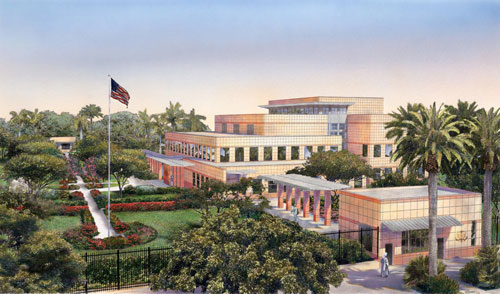
AISB front entry of the new campus overlooking the Niger River

Here is the official description from our school handbook: The American International School of Bamako (AISB) is an independent, coeducational, private day school which offers a full U.S. educational program from pre-kindergarten (age 3) through grade 12. The School was established in 1977 to serve the needs of American and international community students seeking an English-Language education. The school year is divided into two semesters.

My students will be from North America, Europe, and Africa, primarily the children of either embassy workers or NGOs like Save the Children. They will all speak English, though there will be some who require ELL services.

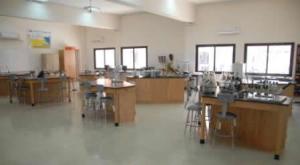
A brand spanking new campus opened in April 2011. The new campus includes spacious classrooms for all primary grades, a secondary campus with student lounge areas, athletic facilities, science labs, two computer labs and a wirelessly connected campus, library and performing and visual

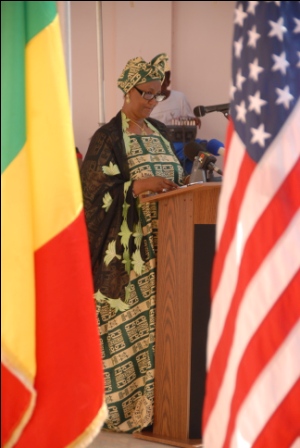
Malian Prime Minister at AISB’s opening

arts facilities, all on five hectares all overlooking the Niger River. The ribbon-cutting ceremony was quite the big deal, attended by Malian Prime Minister Madame Cisse, as well as the Malian Minister of Education and the U.S. Ambassador from the American Embassy.

At AISB there are about 200 students in K-12. The faculty includes a full-time school director, Caroline Jacoby (originally from Australia), secondary principal Randy Neen, 25 full-time and 2 part-time teachers, including 17 U.S. citizens and 10 teachers of other various nationalities. All professional staff members have university degrees or teacher certificates and more than half the faculty hold Master’s degrees.

AISB students wearing the school’s African pattern

The school schedule is nearly identical to the schedule in Palm Beach County. The AISB school year is approximately 176 days and comprised of 2 semesters divided into 2 quarters each. School runs from late August until early June. Three long holidays occur during the year, one in October, one in December and one in April. The school day begins at 7:30 a.m. and ends at 2:20 p.m.

Besides he 3-week winter holiday and 2-week spring holiday, there are a few school holidays that we don’t have in Florida, including Sept. 21-22 (Mali Independence Day), October 20-29 (fall break), January 24 (Muslim Holy Day), January 31 (Muslim Hold Day), May 1 (International Workers’ Day), and May 24-25 (Africa Day Holiday).

I knew this school was the place for us when I read the school’s mission statement and belief’s statement. For the first time in years I won’t be part of a school system where the goal is to get kids to pass the big state test at the end of the year! I will be able to actually teach with the needs of the kids in mind. Unlike Florida, my pay won’t be based on student test scores, I won’t be forced to spend days/weeks/months preparing kids for a single test, and I’ll even have some sense of autonomy in my classroom. Teachers with autonomy? What a concept.

AISB Mission Statement

The American International School of Bamako is committed to providing a challenging, enriching, English-language American-based educational program which encompasses holistic student development in a nurturing, student-centered, multi-cultural environment.

AISB Beliefs Statement

– We are a community of learners in which education is a cooperative endeavor involving students, parents, staff and teachers.
We believe in encouraging resourcefulness, creativity and self-expression.
– We will give our students the tools necessary to become life-long learners.
– We believe each person is a unique individual with dignity and worth.
– We believe in providing a supportive and safe learning environment.
– We believe our students should develop an awareness of and a respect for different cultures, locally and globally.

AISB main lobby

I did the hot pink highlighting above because that’s a huge statement, something most U.S. schools can’t say anymore. I can actually focus on giving kids a holistic education steeped in creativity, and depth, and with a global perspective. I wouldn’t be able to do that in the U.S. (or at least not openly).

And while the school is based upon the American Educational System, it has unique “international qualities” due to its setting in the Republic of Mali, in French-speaking Africa, and due to the diverse international backgrounds of the school population. Modifications to the basic American program complement the school’s international setting and population–such as French Language instruction and the inclusion of Malian culture, history and geography in the curriculum. How cool is that?

Chapter 2: Hello, Mali

If you read my previous post, you know the backstory about our obsession with being abroad (and yes that’s “abroad” not “a broad”). So here’s how we went from dreaming to doing.

January 2011: While presenting at a conference in Orlando, noticed another presenter’s bio said “lived and taught abroad for 17 years.” Interrupted her lunch to get the scoop. Told us that she and her husband (with kids in tow) taught at international schools in 7 different countries, including Kenya. American style schools, tax-free salary, housing and everything else provided, and no high-stakes testing. What?! Told us to Google “International Schools Services,” (ISS) the organization they went through to do this.

February 2011: Paid fees to join ISS. Both of us were approved after filling out 3 zillion application papers. Even though it was the tail end of the recruiting period for the 2011-2012 school year, began emailing international schools across the globe. Lots of jobs in the Middle East, but discovered their laws weren’t exactly supportive of couples like us (e.g. Saudi Arabia: same-sex sexual activity punishable by death, prison, fines, and/or whipping).

March 2011: Skype interviews with international school in Kenya! Looked promising until our research revealed 14 year prison sentences for gay people. Didn’t work out after all, we breathed sigh of relief. Made big chart of scary countries to avoid.

Niger River, Mali

April 2011: Decided to get serious–if we were really moving abroad we needed to unload our worldly possessions. Put our house up for sale in the worst real estate market ever. Sold full price within a month to former editor of Architectural Digest magazine (as a guest house, mind you). Sold decades worth of our “stuff” at an estate sale. Learned you can actually survive without 10 boxes of Xmas decorations, massive collections of Fiesta ware/turtle figurines/1950s furniture/metal lunch boxes/etc, and 37 kinds of cookware. Sad to see others buy our stuff just to add to their stuff, but happy to take their cash! Even scanned scrapbooks/photo albums to make digital versions, and chucked the physical versions. Our load is lightened and we’re ready to rumble.

June 2011: Moved to a 700 sf furnished apartment in happening part of town, walking distance to everything. Came with our clothes and art. With weekends free of lawn care, Home Depot trip$, and home maintenance torture we concentrate on snagging international teaching gigs. With dwindling opportunities for the 2011-2012 school year, decided to focus on 2012-2013 possibilities. That recruiting season would start in the fall.

September – December 2011: Planned to attend a recruiting fair but in meantime emailed dozens of international schools we were interested in, all located in countries where we wouldn’t be flogged, fined, or hanged because we were a male couple of 25 years. Many amazing possibilities (exotic locales with warm climates a plus, of course). Had Skype interviews with international schools in China, India, South Africa, Korea, western Africa (Mali). Nothing solid yet.

American Embassy, Mali

January 2012: Received another email from Head of School at the American International School of Bamako (AISB), in Bamako, Mali saying they were still interested. Had another Skype interview at 5 AM our time (thank goodness the video wasn’t working), said they’d let us know in a day. The next day we got an email that started with this:

Dear Jeff and Jamey,
It was a pleasure talking with you both yesterday. We feel that you would both be excellent additions to the AISB faculty and community and as such I would like to offer you positions at AISB for the 2012 -2013 school year. The contracts will be for two years. Jamey would be teaching MS/HS science which would encompass; Grade 8 science, Grade 9 conceptual physics, Grade 10 Chemistry, Grade 11 Biology and AP Biology (probably) or possibly AP Environmental Science. Jeff would be an elementary classroom teacher teaching grade 4.

A two-year contract that includes housing, medical, moving expenses, and even an R&R trip to Paris!

Before we accepted we consulted with a director we befriended during our international search, a super helpful person who knew a lot about most of the international schools. A colleague of this director sent this statement about AISB:

I have worked with the Directors and several Boards at the American International School of Bamako during the past three years (in governance workshops and in their last head searching).  It is a great little school — the community is small and friendly, as is the staff; teachers and administration are professional; the new school director, Carolyn (who is Australian) is excellent; parents consist of many expatriates from many different countries (mainly from North American, Europe, and Africa), working mostly in development and diplomatic organizations; Malians are very friendly, outgoing, with a strong visual and performing arts culture.  Bamako, Mali is also hot all of the time, dusty winds part of the year, poor people and undeveloped infrastructure. To me, positive attitudes at the school and among Malians, all of which are in abundance, more than compensates. I’d go there in a heartbeat.

Excellent director, nice people, AND a strong visual and performing arts culture?! It’s like Glee Africa!

The Great Mosque of Djenne, Mali

Then we checked with the travel website Lonely Planet. Here’s what they said:

If you only visit one country in West Africa, make it Mali. This is a country as rich in historical significance as it is blessed by an extraordinary array of sights, not to mention being home to many of West Africa’s major cultural groups.

Mali’s natural wonders range from the deserts of the north to the fertile greenery of the south, with the Niger River weaving a path through the heart of the country. The lucrative trade routes of the Sahara once made the region the world’s richest, and the Niger, one of the grand old rivers of Africa, still provides Mali’s lifeblood. To journey along it (preferably on a slow boat) is one great journey.

Not far from the riverbank, the extraordinary Falaise de Bandiagara rises from the plains. It shelters one of West Africa’s most intriguing peoples, the Dogon, whose villages and complex cultural rituals still cling to the rocky cliffs. A visit here is utterly unforgettable.

Some of Africa’s greatest empires also rose from the Niger’s hinterland and bequeathed to Mali some of its most dramatic attractions: the legendary city of Timbuktu – whose name has never lost its remote allure – and the gloriously improbable mosque at Djenné are merely two among many. Even in places where the landscape seems too barren to support life, you find Mali’s famous elephants sharing the Sahelian soil with Tuareg and Fulani nomads.

There’s almost as much to hear in Mali as there is to see, with a musical soundtrack provided by some of Africa’s most celebrated stars. Whether you dive in to Bamako’s wonderful live music scene or time your arrival to coincide with the country’s two world-famous music festivals, Mali’s diverse rhythms will soon have you on your feet. 

SOLD! We signed the contracts and began to plan our exit strategy.